Saturday, 20 October 2012

Who Creates Wealth? (IV)

In a previous post in this series we've seen that shareholders in general do not contribute to the firms they own. Yet, they gain from it.

One could be tempted to justify this (as many in the Austrian economics camp do) on moral grounds. In the latest post, we've seen that this objection seems to be irrelevant.

----------

Two new objections are possible now. What if Fred was an original capital subscriber? What if he contributed capital to the firm? Without his thrift there would be no Apple Inc! Surely he deserves a reward for that?

Or perhaps the reader would object the examples used on a different ground. Small shareholders don't control the firm. Big shareholders do; their momentous decisions on crucial matters, that's what creates wealth. (h/t Tao Jonesing, and comments here)

We'll consider the second objection (the decisions) in this post, leaving the capital contribution objection for a subsequent post.

----------

Let's consider this objection carefully. The point is not that shareholders in general deserve their gains (small shareholders, for one, don't deserve them), but that some shareholders (the big ones) do.

In other words, there is a difference between small and large shareholders, justifying big shareholders' gains. Namely, large shareholders contribute something (i.e. their decisions); small ones don't contribute anything.

This means that, if there is a justification for these gains big shareholders get, it must be these momentous decisions. Thus, anyone making those decisions would deserve those gains, perhaps proportionally to the decision's importance.

This introduces several questions, which we'll leave aside, for brevity's sake. [1]

Here we'll settle these questions in an arbitrary manner: big decisions are those made solely by the board of directors and senior management. We'll reconsider the whole issue later.

In their capacity as directors or managers, these individuals are in reality the owners' agents, legally obliged to act on the owners' behalf. And they are paid for the work they do in that capacity: salaries, directors' fees. Observe carefully: they work and get paid for it (by the way, extremely well paid), just like any other worker.

In other words, managers and directors are legitimately entitled to a compensation for the services they render to the firm. One might question, however, the magnitude of the compensation.

----------

As it happens, managers and directors are sometimes owners. But if these manager/owners get salaries and directors' fees for the work they do as managers and directors, what, then, justifies their keeping profits in addition to their salaries/fees?

For the moment, I'll advance the two possible answers that seem to be left:
  1. What explains their receiving profits/dividends is their legal ownership of the firm. Exactly like individual shareholders and speculators.
  2. The capital contribution (which, as already said, we'll discuss in a coming post).
Observe that this means that the crucial objection is not whether some individuals (big shareholders/managers or just top managers) make momentous decisions, versus small shareholders, who make no decisions. It's these large shareholders/managers' job to make these decisions and they are compensated for that: in the exercise of their functions they are extremely well-paid workers; but workers, all the same.

The crucial objection to my conclusion that profits and dividends are due only to ownership is the capital contribution, which small shareholders don't make and that large shareholders make (assuming, and only to the extent, they actually contributed something to the firm!). This explains my choice of leaving this last objection for the last post in this series.

----------

Before closing, we should go back to the arbitrary answer given before: crucial decisions are those made solely by top managers.

If this were so, then rewards should be proportional to the decision's importance to the firm. Good decisions, leading to good outcomes, must be highly rewarded. Bad decisions, leading to poor outcomes, must not.

I don't think we need to go to great lengths to see that this is not what happens:


Notes:
[1] For instance, everybody in a firm, from the chairman of the board, down to the receptionist and the janitor, makes decisions affecting the firm. What makes their decisions different? How do we measure a decision's importance? What is a big decision, anyway?

Friday, 19 October 2012

Is Franco Still Dead?

After images of the savage rampage by Spanish police against protestors and members of the general public were seen world-wide (prompting Argentine president Cristina Fernández to denounce the repression in the General Assembly of the United Nations), the Spanish government headed by Mariano Rajoy has taken steps to avoid the repetition of the incidents a few weeks ago.

To that effect, the director general of the National Police, Ignacio Cosidó, announced this week his intention to reform the law, to forbid "the capture, reproduction or edition of images, sound or data" about the police, in exercise of their functions.

With his party ("People's" Party) in absolute control of Parliament since last year's election, Cosidó's plan seems likely to be adopted.

In Cosidó's mind, apparently, the problem does not lie in the police's disproportionately violent action. After all, the Madrid police authorities had time enough to plan a special operation, mobilizing up to 1,300 anti-riot agents, including reinforcements brought from 30 out of the 52 police anti-riot units all over Spain.

So, the problem was not the extreme brutality displayed by the police, leaving 64 injured, but the images of it shown abroad, which Cosidó considers could endanger the officers.

I can't see how images like this endanger police officers, and therefore, I show them:


Cosidó's preoccupation with the well-being of Spanish police officers should come as a welcome surprise to his subordinates, as since he assumed its direction, the National Police has been rocked by never before seen confrontations between the old top brass, sacked in its entirety by Cosidó upon assuming the position, and the new appointees. Allegations flying that the Police are now being used almost extra-judicially in investigations against political foes, who once investigated personalities linked to the "People's" Party.

----------

And while in Spain the police beat up protestors and passersby alike, and attempts to curtail civil rights in the best Fascist/Falangist tradition as taught by Francisco Franco, in Greece the official police force seems to have recruited an unofficial parallel police force, provided free of charge by the neo-Nazi Golden Dawn; apart from being investigated for using a female detainee as a human shield and torturing left wing activists.

----------

It seems Merkel and her masters are achieving their goals: dumping all the bullshit of capitalist democracy and its touchy-feely talk of human rights. There is one and only one human right these people recognize: property right. If you don't believe me, ask the people who know: the libertarians.

Either you get used to it, or you do something about it.

And some folks, in Germany, are trying:


The video title reads: "Merkel booed while singing the national anthem in Stuttgart, October 12, 2012".

Perhaps you should, too. Before you are at the receiving end of the clubs.

Sunday, 14 October 2012

Germany's Past … Europe's Future?

Hindenburg (left), Ludendorff (right), 1917. [A}
August/September 1918: The Imperial General Staff, headed by field marshal Paul von Hindenburg and general Erich Ludendorff, reached the conclusion that Germany had lost the war.

Although German armies were fighting on foreign lands (German borders still largely unviolated), Germany had suffered 2.5 million fatalities (about a fifth, civilians lost to starvation), plus 4.25 million wounded. Bulgaria (a German ally) collapsed, and the Austro-Hungarian Empire was close to. The Allied naval blockade reduced the Imperial Navy to impotence, denying German access to foodstuffs and raw materials required for its war effort. With civilian protests demanding food increasing in number and intensity, the internal political situation in Germany was deteriorating rapidly. To make things worse, the full weight of the American intervention only began to be felt.

Diplomatic negotiations started, US president Woodrow Wilson demanding, among other things, the Kaiser's abdication, and the democratization of Germany. Hindenburg and Ludendorff, de facto rulers of Germany, would need to assume responsibility for the defeat; the consequent loss of face to the General Staff could lead to its losing influence in a democratic Germany.

Forced by the circumstances, Hindenburg and most of the General Staff accepted, in spite of the drawbacks; Ludendorff, however, perhaps affected by depression, changed his mind and resigned in protest, under disputed circumstances.

Communists and Social Democrats

Since the latter half of the 19th century, the Social Democratic Party of Germany (SPD) included all shades of Marxists. The SPD right-wing, which would eventually abandon Marxism, was headed during war times by figures like Friedrich Ebert, Gustav Noske and Philipp Scheidemann. The SPD left-wing, headed by Karl Liebknecht and Rosa Luxemburg, among others, gradually left or were expelled from the party, initially over the issue of supporting the war effort, which they opposed:
"The present war was not willed by any of the nations participating in it and it is not waged in the interest of the Germans or any other people. It is an imperialist war, a war for capitalist control of the world market, for the political domination of huge territories and to give scope to industrial and banking capital."

German Revolution 1918-19
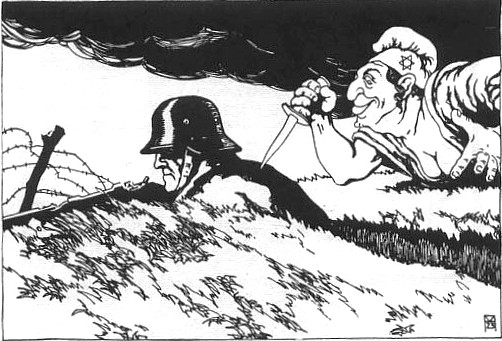
Dolchstoßlegende.
Austrian postcard (1919) [B]
October 1918: Prince Max von Baden, with Hindenburg's support, announced the constitution of a new cabinet, including the social democrat Ebert, in an attempt to neutralize the social democrats.

November 1918: The revolt of the High Seas Fleet, based in Wilhelmshaven and Kiel, spread among civilians all over Germany. The former SPD left (grouped in the Spartacus League and the USPD) supported the revolt, with Anarchist elements. Kurt Eisner (USPD) proclaimed the republic in Bavaria, in a bloodless revolution, where private property would by guaranteed. Facing violent armed repression in Berlin, the Spartacists, led by Liebknecht, decided to respond with violence (against Luxemburg's opposition). Kaiser Wilhelm II fled to the Netherlands and prince von Baden resigned, Scheidemann declared the Republic (November 9), and Ebert was left in charge as president and chancellor. Ebert and general Wilhelm Groener (de facto Army commander) reached an agreement: the General Staff would support the Ebert cabinet, in exchange for keeping control over the German Army; the Army was given free hand to deal with the revolt. Ludendorff, in disguise, left for Sweden. There he went on to propagate the Dolchstoßlegende, the stab-in-the-back myth: the victorious German armies had been betrayed by socialists, communists and Jews. Absent Ludendorff and Hindenburg finding it below his station to sign the armistice, the signature fell to center-right politician Matthias Erzberger (November 18).

----------

The Ebert-Groener agreement had serious consequences not only for the development of Germany into a supposedly Western-style liberal democracy, but would set a precedent that today's European politicians seem too eager to follow: in practice a large role in the violent suppression of the left-wing revolt fell on the illegal right-wing ultra-nationalist and conservative paramilitary Freikorps, whose rabid anti-Marxism recommended them to the ruling classes, including the newly promoted SPD leadership. Unfortunately for Jews and other ethnic minorities, these groups were often also anti-Semitic, racist and xenophobic.


Aftermath

The Army/Freikorps ruthlessly suppressed the left-wing revolt on Ebert's behalf. Luxemburg and Leibknecht were murdered (January 15, 1919) by a Freikorp unit under the command of captain Waldemar Pabst. Isaac Deutscher, the left wing British historian, reportedly wrote:
"In her assassination Hohenzollern Germany celebrated its last triumph and Nazi Germany its first".
Pabst (who publicly boasted, "I had them executed") framed his subordinates for the crime. In 1920 he played a leading role in a failed putsch against his former ally, Ebert. Although he never officially joined the NSDAP, his right-wing credentials were useful to gain a directorship in German and Swiss weapon manufacturers. After WW2, Pabst may have been involved with neo-Nazi activities. He died peacefully in Germany, at the age of 89, in 1970.

Ebert, who remained chancellor until his death at the age of 54, in 1925, survived the above mentioned 1920 coup d'etat attempt by his former Freikorp allies, but never was fully accepted by the rest of the German ruling classes. The foundation named after him is the main educational/research outlet of the current SPD.

Scheidemann, who proclaimed the republic, and became chancellor after Ebert was named president, self-exiled to Denmark after the Nazi takeover. He died in 1939.

Noske, who personally directed the repression in Berlin, lived an apparently uneventful live under the Third Reich until 1944, when he was arrested as suspect for the 1944 plot to murder Hitler. The allied advance saved him from execution. He died in 1946.

Erzberger was murdered (August 16, 1921) by elements linked to the Freikorps. His crime was to sign the armistice.

Eisner was murdered on February 20, 1919. He had his resignation to the position of Bavarian Premier with him. His murderer, Anton von Arco-Valley was an Austrian national, radical conservative and pan-Germanic nationalist, who served under the German flag, apparently not linked to the Freikorps.

Arco-Valley, whose mother was an Austrian aristocrat of Jewish faith, was, nevertheless, intensely anti-Semitic. Allegedly, he hoped the murder of Eisner (who was both Jewish and socialist) would prove his bona fides to the Thule Society (an aristocratic occultist group in Munich linked to the Deustche Arbeiterpartei, DAP). Reportedly Arco-Valley said this about Eisner:
"Eisner is a Bolshevist, a Jew; he isn't German, he doesn't feel German, he subverts all patriotic thoughts and feelings. He is a traitor to this land."
Another Austrian national living in Bavaria, corporal Adolf Hitler, was recruited as Army undercover intelligence operative in July 1919. In that capacity, he joined the DAP.

A fanatical pan-Germanic nationalist and anti-Marxist, like Arco-Valley, Hitler, unlike his aristocratic counterpart, understood how appealing socialist ideas were to the German working class. Therefore, he appropriated the socialist rhetoric, sans class conflict, plus a furious anti-Semitism and prefixed Nationalsozialistische ("nationalsocialist") to the Deutsche Arbeiterpartei title, resulting in NSDAP. On November 8, 1923, with the support of Ludendorff and his own militia (the SA), Hitler attempted a putsch, that failed. On April 1, 1924, Hitler was sentenced to 5 years in the Landsberg Prison. He occupied the same cell Arco-Valley had occupied.

March 1919 Revolutionaries
after summary execution. [C]

Thousands of German workers, activists, trade unionists and common people caught by the indiscriminate repression, shared Luxemburg, Leibknecht, Eisner and Erzberger's fate. The permanent and radical rift between communists and Anarchists, at one hand, and social democrats, at the other, facilitated Hitler's rise to power. Communists, social democrats and Jews organized their own militias (Rotfront, Eisernes Front, and Reichsbund Juedischer Frontsoldaten, respectively), against each other and against the nationalist Freikorps and the SA.

On January 30, 1933, president Hindenburg appointed Hitler chancellor.

President Hindenburg and chancellor Hitler
(March 21, 1933) [D]

Image Credits:
[A] Hindenburg and Ludendorff (1917). Bundesarchiv, Bild 146-1987-127-09A / CC-BY-SA. Wikipedia.
[B] Illustration of the Dolchstoßlegende. Austrian postcard (1919). Wikipedia.
[C] March 1919 Revolutionaries after summary execution. Bundesarchiv, Bild 102-00539 / Groß, Alfred / CC-BY-SA. Wikipedia.
[D] President Hindenburg and chancellor Hitler. (March 21, 1933). Bundesarchiv, Bild 183-S38324 / CC-BY-SA. Wikipedia.

Wednesday, 10 October 2012

Good News... Bad News... (IV)

The Financial Sector Union and the Australian Services Union, in simultaneous media releases, dropped this news:
  • "Forecasts from the 2008 study [Off-shore and off work. September 2012 update] are on track to be realised in the absence of policy intervention.
  • "More than 80,000 service [and financial] sector jobs have moved offshore since previous report.
  • "With more than 20,000 jobs moving offshore each year we would expect between 700,000 and 1 million jobs to move off-shore in the next three decades.
  • "Action is needed to address service sector [and financial] off-shoring crisis and boost competitive position of Australian service [and financial] industries".

----------

In a case of very good timing, RBA's deputy governor, Philip Lowe's speech to the Financial Services Institute of Australasia (FINSIA) on the same subject of off-shoring, broke the good news.

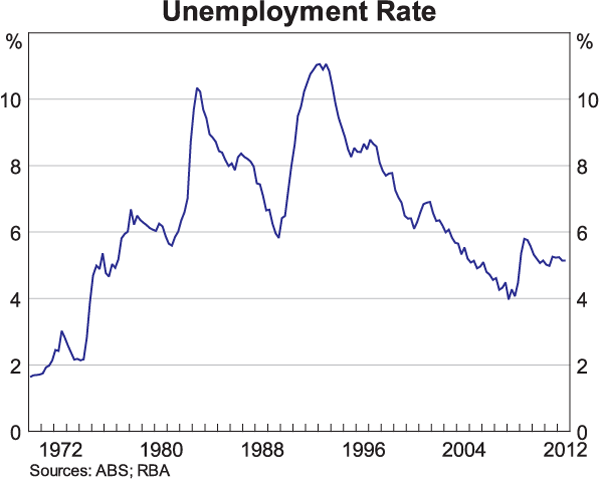
Lowe treats a number of interesting subjects, all of which would deserve consideration. For instance, he includes the following unemployment rate chart, which shows that, by recent standards, unemployment is not too bad.

Click for a larger image.

No mention, however, is made to the fact that by late-1960s' standards, our current relatively low unemployment rate is high. No explanation is offered for this, either. But one can assume it has something to do with the abstract, slightly vague and undoubtedly mysterious "structural changes"

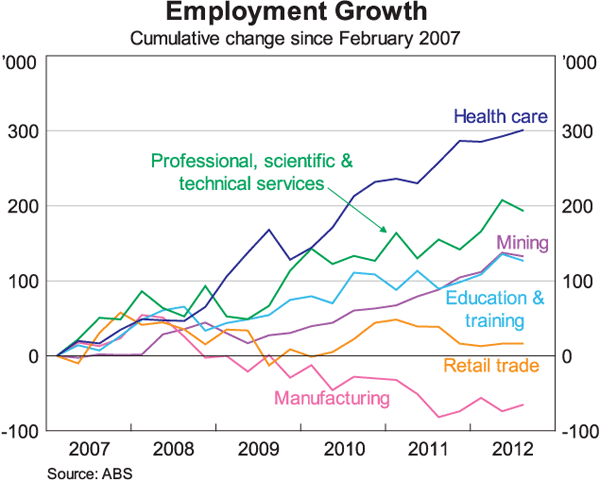
The bit of Lowe's speech that apparently caught the eye of journalists was "that since 2007, about 300,000 net new jobs had been created in healthcare, 200,000 in professional and scientific services and about 130,000 in each of the mining and education sectors".

Lowe included the following chart, illustrating this behaviour:

Click for a larger image.

Note that, for instance, retail trade basically employs now the same quantity of people it did in 2007, regardless of the increment in the population: in other words, there are less people employed in this industry per capita. If you prefer, nowadays, it is harder to get one of these jobs.

The same conclusion applies, with more reason, to manufacturing.

Well, I suppose if one loses one's job in manufacturing, then one could try moving to a growth area, like healthcare, professional and scientific services or mining and education and training.

Upon a closer examination, however, the reader would agree that perhaps a job in professional and scientific services or education and training is not too realistic an option for an unemployed blue-collar worker: you need time and savings to get the qualifications; but even if you did get them, why would any employer prefer a middle-aged graduate to a much younger one?

You have two options left: mining and healthcare. Mining sounds like a long shot: even the "permabulls" seem to finally accept that mining has gone through the development stage, where large numbers of workers were required.

What about healthcare? That certainly seems an option. Mind you, not a top tier job (like doctor, or something) for the same reason that a professional/scientific services or education/training jobs are not realistic: qualification and age.

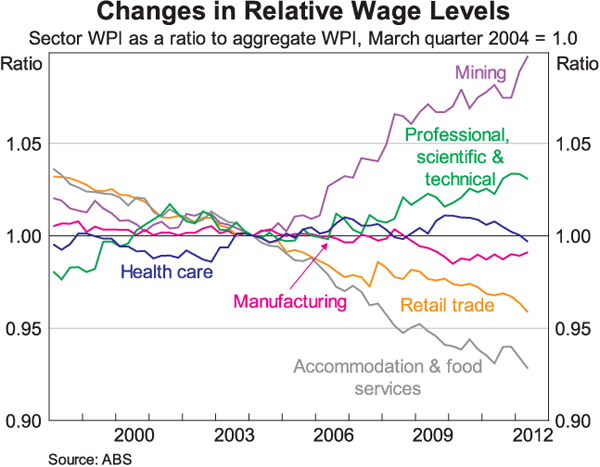
But a more modest healthcare job seems possible. And how much to they get paid? Lowe also offers a good chart:

Click for a larger image.

Healthcare, in average, has not gained anything over the average pay since 1998.

In other words, if you were a blue-collar worker, you lost your manufacturing job, need now to struggle to get new qualifications (say, in healthcare), so that you can compete against younger candidates and, at best, if you succeed, you will have gained nothing.

Not so awesome, I'd say. And that without taking into account the predictions made by the Services and Financial Sector unions.

This may be just me, but if I were one of those former blue-collar workers, right now, I wouldn't be too happy.

Now, the question is, can we do something about it? To be honest, I don't think so, under capitalism, that is.