Showing posts with label Confidence Fairy. Show all posts
Showing posts with label Confidence Fairy. Show all posts
Monday, 9 January 2017
On Markup: Is the Price Right?
In Fred Lee's "Post Keynesian Theory of Prices" the concept of markup is the common denominator to the conceptual mishmash post Keynesians call their "theory of prices".
Being such a crucial notion readers could naturally ask what, exactly, is "markup"? And one should expect and indeed demand a clear answer to such a fundamental question. Clear definitions, after all, are of the essence, right?

Wednesday, 5 October 2016
Romer’s Identification Problem in a Nutshell.
 |
| Unidentfied Economic Object. [A] |
Others are more technical; the "identification problem", among them.
So, what is the "identification problem"?
David Ruccio explains using a simple supply and demand model. It's very didactic, so readers can follow easily (hell, even I did!), to get a general idea. It has a drawback, though: Prof. Ruccio explains the identification problem in a supply/demand setting, not in the specific situation Prof. Romer wrote about.
Based on Prof. Ruccio's explanation, I'll provide more concrete details using a "toy" model.
Saturday, 24 September 2016
Romer's Waves.
Paul Romer's "The Trouble With Macroeconomics" gave the blogosphere heaps to comment.
You didn't read Romer's paper? No worries! Noah Smith ("The New Heavyweight Macro Critics", September 14) summarises it, in a Reader's Digest kind of way. What does Smith think about it? Hard to say, other than "Ouch. He also calls various typical DSGE model elements names like 'phlogiston', 'aether', and 'caloric' " Smith remains safely non-committal ("committal" would sound dangerously like "commie", I suppose). Maybe one could sum up his view as "totally awesome, dude".
Tuesday, 20 September 2016
Romer's Magical Creatures.
 |
| (source) |
Things began last year, with “Mathiness in the Theory of Economic Growth”, when Prof. Romer took aim at growth theory (one of his areas of expertise). Now, with “The Trouble with Macroeconomics” he extends his critique to macroeconomics (particularly to RBC and the much maligned DSGE).
Friday, 5 August 2016
Glenn Stevens, Oz's Alan Greenspan?
"The risk he [Glenn Stevens] faces is that, if doomsayers such as Steve Keen are right this time, Stevens could go down as Australia's Alan Greenspan - the man who fuelled the US housing bubble that ended up blowing up its economy." (Michael Janda)
Last Tuesday (August 2) the RBA decided to lower interest rates to a historical minimum of 1.5%, in an attempt to inject some oomph into the flagging Australian economy.
Saturday, 23 January 2016
Coyle on Minsky, Where's Keynes?
Diane Coyle (part-time professor of Economics at the University of Manchester, plus a long CV) is a high-profile British Keynesian economist. She posted recently a favourable review of L. Randall Wray's latest book "Why Minsky Matters". Wray, as readers know, is a leading MMT proponent and an expert on Minsky.
Monday, 14 December 2015
Eugenics: Did Fisher Shoot Keynes?
"If you shoot at a king you must kill him." (Ralph Waldo Emerson)Sir Ronald A. Fisher (1890-1962) is considered one of the 20th century's greatest statisticians. Together with his work in biology ("the greatest biologist since Darwin" in Richard Dawkins' opinion) Fisher's contributions earned him among other honours and awards, "three medals of the Royal Statistical Society, the Darwin Medal (1948) and the Copley Medal (1956). He received honorary degrees from numerous Universities, and was a member in over 20 academies, societies, and institutes".
Thursday, 26 November 2015
The Paradoxical Kalecki (and part iii)
(From part ii)
The tables below may help in this discussion.
In principle, capitalists hold the frying pan by the handle: they decide (i) the payroll cut magnitude (D) and (ii), from what they get, capitalists decide how much to consume and invest (without loss of generality, in the examples following they consume as much as they invest).

Sunday, 6 September 2015
Keynesian Uncertainty: Policy Implications.
Prof. J. Barkley Rosser expounds on the diverse conceptions of uncertainty Keynesians entertain and their policy implications ("Alternative Keynesian and Post Keynesian Perspectives on Uncertainty and Expectations", Journal of Post Keynesian Economics, Summer 2001, Vol. 23, No. 4, pp. 545-566):
My two cents: While the adjective "opportunistic" -- which Coddington used -- fits Keynes wonderfully, I doubt "Keynes' encounter with subjectivism" was "only a passing one". On that, I'm sure the man was being sincere. After all, correct me if I am wrong, but wasn't he a believer in utility, too?
"Ultimately, of course, Post Keynesians must face the implications of the deep assertion of fundamental uncertainty by Keynes. Heiner's (1983, 1989) arguments are comforting that people will fall back on rules of thumb in moments of great uncertainty. But this is less useful when a la Shackle it is the crucial decisions of people themselves that are bringing about the uncertainty. There is the threat invoked by Coddington of a nihilism that cannot make any predictions even for policy. Davidson, who has excoriated so many for not properly recognizing Keynesian uncertainty, must also face this essential contradiction as he hopes for the successful implementation of beneficial policy that requires some degree of forecasting and ergodicity. His response (Davidson, 1996, p. 506) is to invoke Reinhold Neibuhr's Serenity Prayer: God grant us the grace to accept with serenity the things that cannot be changed (immutable realities), courage to change things that should be changed (mutable realities), and the wisdom to distinguish the one from the other.
"This observer suspects that Keynes himself would have found the line between these two to be uncertain." (emphasis mine)Alan Coddington ("Deficient Foresight: A Troublesome Theme in Keynesian Economics", American Economic Review, 1982. Vol. 72, No. 3, p. 480):
"This paper has been concerned with a theme in Keynes' writing that it is convenient but -- as we have seen -- rather unsatisfactory to refer to as that of uncertainty in economic decision making. It has been my purpose here to present Keynes' foray into this area as an opportunistic but mild flirtation with subjectivism. I have argued that those who have been impressed and influenced by this strand in Keynes' work fall into two groups: (i) those who fail to see that Keynes' encounter with subjectivism is only a passing one; (ii) those who fail to see that subjectivism, once introduced, cannot be confined within the limits that would suit their [purportedly subversive of mainstream economics] analytical purposes." (emphasis mine)
----------
My two cents: While the adjective "opportunistic" -- which Coddington used -- fits Keynes wonderfully, I doubt "Keynes' encounter with subjectivism" was "only a passing one". On that, I'm sure the man was being sincere. After all, correct me if I am wrong, but wasn't he a believer in utility, too?
Regardless, there is something delightfully ironic in having to invoke God's help in order to apply Keynes' deep insights: here.
Tuesday, 7 July 2015
Straight from the Horse's Mouth.
h/t Houses and Holes (Macrobusiness):
"PRIME MINISTER: Ok, do we have any questions?
"QUESTION: Prime Minister, how concerned are you about the problems in China and Greece, those economic problems spreading to Australia and especially the plunge in the Chinese stock prices?
"PRIME MINISTER: Michael, look, the important thing is to do whatever we can to build a strong and prosperous economy locally, and again I get back to the Grocery Code of Conduct. This is about ensuring that we have the strongest possible local businesses to supply the strongest possible local businesses. We have a great supermarket system. That rests on the shoulders of great local suppliers and this is about ensuring that we continue to have very strong local suppliers, best possible product at the best possible price so that we get the best possible deal for consumers – and if we do that we will avoid the problems that we see overseas". (here)[Bloody blah, bloody blah]
"QUESTION: PM, are you concerned that the Chinese Government potentially has intervened in their stock market to try and prop it up given the losses that have been experienced over the last two weeks?
"PRIME MINISTER: Well, again, look, I’m not going to offer a running commentary on what other governments do. My business today and every day is to ensure our country is in the best possible position to deal with whatever comes. Whether it be challenges to our economic security, whether it be challenges to our national security, the job of this Government is to make our country as strong as it possibly can be and that’s why the small business budget boost was so important with the instant asset write-off which has done so much to boost confidence, and that’s why today’s Grocery Code of Conduct is so important. It’s all about producing stronger local businesses and if we’ve got stronger local businesses, we’ll have a stronger economy and we’ll be very well placed to deal with whatever the future throws at us."Paraphrasing PM Abbott, well, again, look, he's not concerned at all about the terrifying power of
But, but, but, all local VSPs are really, really concerned …
So, what gives? Is the Animal Spirits for real or maybe Abbott -- believe it or not -- for once is right?
----------
Man, you've gotta love the Animal Spirits/Confidence Fairy thing: it may not explain shit, but it gives me hours of fun.
UPDATE:
08-07-2015. Minutes after posting this, Houses and Holes posted this:
"The Shanghai stock market is open and down she goes 8%:"
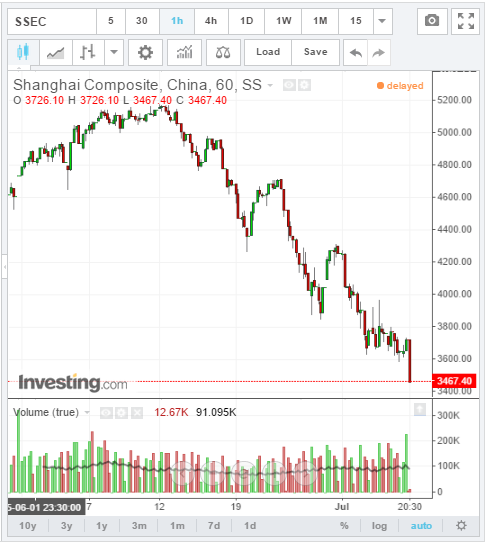 |
| (source) |
Animal Spirits!
Sunday, 5 July 2015
Greece to Merkel: Oxi!
It seems "keyneses" are heading for another terrible week: the Greeks (and even some Germans, see below) decided to answer Oxi in the referendum:
 |
| (source) |
Animal Spirits!
Wednesday, 1 July 2015
Animal Spirits: Two Days Later.
Two days ago, "keyneses" all over the world were looking at their computer monitors in consternation: there wee red numbers everywhere (see here).
That's how things look like today (10:35 AM Thursday, 2 July 2015, AEST GMT+10):
 |
| (Right-click to open another tab with a larger image. source) |
 |
| (Right-click to open another tab with a larger image. source) |
Okay, maybe it's too soon to claim victory. Keynes did not establish any kind of timeframe for the awesome power of Animal Spirits to manifest itself (funny that, wouldn't you say?), so perhaps we should give it some more time to produce its magic. Let's wait. Shock and awe are surely on their way.
Like a VSP-K (Very Serious Post Keynesian) professor likes to say: "eventually" something is bound to happen.
Monday, 29 June 2015
The Attack of the Animal Spirits.
Well, it would seem the Animal Spirits of many "average business men" (or "keyneses", for short) are currently (4:45 AM Tuesday, 30 June 2015, AEST, GMT+10) rather subdued:
 |
| (Right-click to open another tab with a larger image. source) |
 |
| (Right-click to open another tab with a larger image. source) |
----------
M. Hollande and Frau Merkel reach out to Tsipras; while M. Juncker, barely suppressing a tear, feels "betrayed" (poor, poor thing).
Aussie markets: "$36 billion wiped off Australian stocks" (like, ouch!)
And today's the day! One step closer
Aussie markets: "$36 billion wiped off Australian stocks" (like, ouch!)
----------
Friday, 26 June 2015
Greece: Bailout Referendum Announced.
It seemed inevitable (see here and here) and it's one very important step closer:
The Sydney Morning Herald:
Greek Prime Minister Alexis Tsipras calls for referendum on aid package
Date June 27, 2015 - 9:09AM
Birgit Jennen, Nikos Chrysoloras and Rebecca Christie
The BBC:
Greece debt crisis: Tsipras announces bailout referendum
22 minutes ago
----------
This should be a test for the powers of Keynes' mythical Animal Spirits/Confidence Fairy.
Thursday, 11 June 2015
The Horror of the Confidence Fairy (and viii)
(From Part vii)
"The impression of Keynes that one gains [reading his interpreters] is that of a Delphic oracle, half-hidden in billowing fumes, mouthing earth-shattering profundities whilst in a senseless trance -- an oracle revered for his powers, to be sure, but not worthy of the same respect as that accorded to the High Priests whose function it is to interpret the revelations." (Axel Leijonhufvud, quoted here)Studying a minimalist Keynesian model -- the income determination model -- we've seen what role Animal Spirits play among Keynesian infidels: by assumption, it strikes once and with enough power to throw the economy into a recession. But, there's no a priori reason supporting that assumption.
So far, we have considered the contradictions popping up when Keynes, non-ergodicity, Animal Spirits, are allowed to change the scenario above, as the Keynesian literalists demand. The end result, a powerful -- if ironic -- defense of laissez-faire: capitalism may suck big time, but reform/intervention could make things worse, through non-ergodicity.
For those intent on preserving Keynes' legacy at any cost and selling Keynesianism as the way for the Left, the road leading from Keynes to Hayek seems not so much of reconciliation, but of capitulation.
----------
Let's turn our gaze to the other side of the Keynesian religious war: the apostates. Among them -- de facto -- Keynes, non-ergodicity, Animal Spirits no longer reign. That's probably a good thing.
However, while one could suspect apostates regard their pious opponents' faith with little respect, don't expect open admissions of apostasy from them. For reasons we better omit, you won't see many Keynesians ever coming out -- proud and loud -- of the anti-Keynesian closet, and apostates, too, will still pay lip service to Our Lord. (Suffice it to say that there is a strong cultish element in economics in general, particularly evident in Keynesianism -- and, no, Marxists aren't immune, either).
But if Animal Spirits do not cause slumps, well, what does?
Apostates may be able to cure recessions, as claimed, and experience seems to confirm; they may be able to predict the economy's behaviour. But -- at least based on the Master's teachings -- they don't know what caused the disease, in the first place. Beyond generalities about aggregate demand, they have no explanation. In fact, they don't know they don't know.
 |
| Deus Ex Machina Man, by Phil Foglio. (source) |
They, in other words, lack a theory of crisis. But the search for one -- ironically, too -- could lead these economists -- often considered Centre-Left -- away from a comfortable deus ex machina and into troublesome places:
"For it was Keynes, not Marx, who cracked the code of crisis economics -- who explained how recessions and depressions can happen." (here)There may -- after all -- be something wrong with capitalism.
It's hard to tell which of his competing crises theories Marx would have supported: he died before clarifying his views. But this passage seems highly suggestive:
"The ultimate reason for all real crises always remains the poverty and restricted consumption of the masses as opposed to the drive of capitalist production to develop the productive forces as though only the absolute consuming power of society constituted their limit." (here)
----------
The internal inconsistencies of Keynesianism have a way to come back to haunt Keynesians, don't they?
Post Keynesians, the self-appointed alternative, may keep Keynes' thought, but at the cost of Keynesian policies. Mainstream Keynesians may keep Keynesian policies, at the cost of Keynes' thought. (Update: 09-09-2015 see here; yet another update, 19-05-2016, because it's really cool to be proven right)
Which, if any, of those two paths will Keynesians take? Faithfulness to the Master, or Apostasy? Faced with this dilemma, Lord Skidelsky seemed to join mainstream Apostasy, after debating Paul Krugman, a chief apostate. In a supreme irony, apparently Hicks himself moved in the opposite direction, influenced by Paul Davidson.
This may depend on how personally invested one is in Keynes' hero-worship: Keynesians are a diverse bunch.
One option is to ignore the contradictions. This should prove popular: go on about one's business.
Another approach, open to high-profile mainstream Keynesians actively involved in promoting Government intervention, requires discreetly jettisoning Keynes, whenever hounded by the more recalcitrant loyalists:
"One way to answer this is to point out that Keynes said a lot of things, not all consistent with each other. (…)
"But surely we don't want to do economics via textual analysis of the masters. The questions one should ask about any economic approach are whether it helps us understand what's going on, and whether it provides useful guidance for decisions." (here)Those closer to the classical political economists, particularly Marx and Sraffa, and/or to MMT, should find it easier to distance themselves from the Master (Update: 09-09-2015 see here). Some of them have already started down that path, anyway: the idea that capitalism may have something inherently self-destructive should not be alien to them.
It is those highly visible and vocal heterodox, ideologically and philosophically (some of them, politically) closer to the Austrian School, who may face a more serious challenge. Having built their group identity as alternative in strident opposition to mainstream Keynesians, neoclassicals, and Austrians, and around their strict adherence to
And, apart from the contradiction treated here, there is also the issue of Keynes' own attitude towards neoclassicism. Not Kosher, definitely.
In retrospect, it was always doubtful they would have ever gained a significant foothold in academy. Perhaps now it's more a matter of whether they will eventually lose steam and subsist as a kind of fringe group, as so many other economic fads, or simply vanish. However, among the Austrians there are already those who think in terms of Austrian/Keynesian syncretism: keep an eye on this space.
Realistically, while the issues at stake are serious, this is unlikely to result in a paradigm shift against the whole of Keynesianism, although it should come very close to that for some of its sects.
----------
As the Great Recession fades from memory, it's likely that the movement calling for a renewal of economic thinking and education it's already past its peak and changes achieved, if any, should be marginal.
It may be mere coincidence, but the parallel between most of Post Keynesianism and new political pseudo-Left parties product of the crisis, like Syriza, seems striking: too many expectations, too little substance.
While I regret the lost opportunity, seeing the contradictions in what for a time looked like one of the main alternatives, it's hard to say whether that's such a bad thing.
Image Credits:
I found that image on the internet. If readers know for a fact I am infringing anyone's property rights, please leave a comment and, at your discretion, I will either remove the image or provide full credits.
Saturday, 6 June 2015
The Horror of the Confidence Fairy (part vii)
(From Part vi)
"In IS-LM models there is always something in the background shifting the IS curve. What is it? In my view that 'something' is Keynes' animal spirits (…)." (Roger Farmer, here)
 |
| Animal Spirits in Alaska. [A] |
However -- for reasons beyond the role of Animal Spirits -- the IS-LM model is one point of long-running and irreconcilable dispute between economists like New Keynesian Paul Krugman, and a host of Post Keynesians (for instance, Steve Keen -- here, Krugman's reply -- and Lars P. Syll -- here, Krugman's reply -- among the more consistently opposed; Mario Seccareccia and Marc Lavoie, among the occasional commenters). A few, like Matías Vernengo, seem more accepting of the IS-LM (here and here).
Luckily, one can still illustrate the role of Animal Spirits with the use of a more basic concept, whose validity is -- to my knowledge -- accepted by virtually every Keynesian economist, regardless of prefixes: Keynes' multiplier.
The equation below -- from Dornbusch and Fischer (1994), page 71 -- shows the equilibrium income (Yo) for a capitalist economy, with government but no foreign trade (Marxist/Post Keynesian economist Peter Cooper offers a derivation, for a model with additional foreign trade):
1
Yo = --------------------(Co + Io + Go + c TRo)
1 - c (1 - t)
TRo government transfers
Go government spending (non transfers)
Co autonomous consumption
Io autonomous investment
The multiplier is shown in red. For reasonable values of c (marginal propensity to consume: Keynes' "psychological propensity to consume") and t (tax rate), the multiplier is a number larger than 1.
In blue, within parentheses, are the aggregate autonomous demand (AAD): "exogenous variables" (i.e. not determined within the model).
But, where are the "Animal Spirits"…?
Hiding inside Co, Io, and c!
Suppose "keynes" -- short for the "average business man" -- feels a bit under the weather and reduces autonomous investment to I1: AAD falls. Multiplied by, well, the multiplier (which didn't change) it yields a smaller Y (say, Y1).
Less workers are needed to produce Y1 than were needed to produce Yo: employment falls, too. An unpredictable change in "spontaneous optimism" causes a fall in autonomous private investment, causing AAD to fall, causing output and employment to fall. Animal Spirits set a recession in motion.
Enter Hicks/Krugman. The government may not control Io, Co, or c, but it controls TRo and Go. If the government increases either of them -- a.k.a. fiscal stimulus -- just enough to offset the shortfall in AAD, the Y recovers to the level of Yo (say Y2 = Yo).
The mechanism -- in this minimalist model -- is deterministic. Randomness intervenes only as the initial exogenous shock; after that, output and employment (plus interest rate and inflation) are predictable:
"And as I have often argued, these past 6 or 7 years have in fact been a triumph for IS-LM. Those of us using IS-LM made predictions about the quiescence of interest rates and inflation that were ridiculed by many on the right, but have been completely borne out in practice. (…) " (Paul Krugman, "Unreal Keynesians")This is the happy ending for Keynesians like Hicks and Krugman (and, apparently, to some Post Keynesians like Cooper and Vernengo): Animal Spirits dropped out of the blue and struck once, but the recession was -- predictably -- solved.
However, that -- as we've seen and as Post Keynesians have insistently argued -- was not necessarily Keynes' happy ending ("If the fear of a Labour Government or a New Deal depresses enterprise, this need not be the result either of a reasonable calculation or of a plot with political intent; it is the mere consequence of upsetting the delicate balance of spontaneous optimism").
It certainly isn't the happy ending for "Austerians": What if the mere announcement of fiscal stimulus further scares "keynes", who again slashes autonomous investment? What if the "psychological propensity to consume", c, falls and with it the multiplier? What if, in other words, Animal Spirits are not exogenous and become the Confidence Fairy?
There's no a priori reason stopping Animal Spirits from striking again.
In more philosophical terms: If the economy, ultra-sensitive to the intestines of "keynes", were unpredictable (uncertain) … -- or, like Old Keynesian economist Paul Davidson likes to say, non-ergodic -- wouldn't that mean that the effects of stabilization policies are also uncertain, unpredictable, non-ergodic, even counterproductive?
----------
References
Dornbusch, R. and Fischer, S. (1994). Macroeconomics. New York: McGraw-Hill
Image Credits:
[A] Totem in Alaska. National Archives and Records Administration. This work is in the public domain. Wikipedia.

Sunday, 31 May 2015
The Horror of the Confidence Fairy (part vi)
(From Part v)
"But the thing that is most needed now is something monetary policy can't directly cause: more of the sort of ‘animal spirits’ needed to support an expansion of the stock of existing assets." (Glenn Stevens, RBA Governor, here)Lacking a theory of what causes slumps, Animal Spirits offer a convenient multipurpose explanation to the Keynesian economist: Animal Spirits strike unexpectedly, and create an exogenous, unpredictable shock to aggregate demand.
This is where Keynesian economists see themselves and the Government playing a role: they are there to counter, through fiscal and/or monetary policy, that shock.
With nuances and qualifications, many a Keynesian economist subscribes to the "Animal Spirits as imp who strikes once and is to be vanquished".
"But the goat, on which the lot fell to be the scapegoat, shall be presented alive before the Lord, to make an atonement with him, and to let him go for a scapegoat into the wilderness." (Leviticus 16:10. KJV)Understandably so: it's convenient, neat and plausible.
----------
"There is always a well-known solution to every human problem -- neat, plausible, and wrong." (H.L. Mencken)Other Keynesians -- particularly, Post Keynesians -- have taken issue with that view: it may be neat and plausible, but it's unfaithful to Keynes -- they argue -- therefore, it's wrong.
Again Ross Gittins, channelling the New Keynesians Akerloff and Shiller, gives a useful account of how Keynes' ideas were diluted and places the responsibility on Sir John R. Hicks' "efforts to make Keynesian thinking more acceptable to economists steeped in the neo-classical assumption" (here).
In Gittins' account, Hicks made the multiplier protagonist of Keynesian economics, leaving Animal Spirits out of the film, except for a cameo at the beginning of the story, "so they [Keynesian economists] could do what they thought mattered most, win support for Keynes's key policy prescription: the use of government spending to stimulate demand when it was deficient."
In what concerns Animal Spirits, that would have been Hicks' sin. In doing so, he created "the imp who strikes once and the avenging Keynesian economist" view.
Gittins' story seems more or less correct. Hicks, writing in "IS-LM: an Explanation":
"Neither of us [i.e. Keynes and himself] made any assumption about 'rational expectations'; expectations, in our models, were strictly exogenous. (Keynes made much more fuss over that than I did, but there is the same implication in my model also)."So, perhaps Hicks did misinterpret or, at any event, misrepresent Keynes' ideas, particularly those regarding Animal Spirits/expectations: for Keynes -- the critics argue -- Animal Spirits played a much more central role.
They are probably right, as we've seen.
----------
"It will be admitted by the least charitable reader that the entertainment value of Mr. Keynes' General Theory of Employment is considerably enhanced by its satiric aspect." (Sir John Hicks, "Mr. Keynes and the 'Classics' ")Before casting the first stone, however, put yourself in Sir John's shoes.
How would you have explicitly modelled the effect of "digestion", the "weather", "fear", "nerves", and "hysteria" on the decisions of the "average business man" (let alone convinced your readership that you were actually being serious)?
Would you have made a deliberate fuss over that?
And how would you have explicitly modelled the effects of activist policy on "the fear of a Labour Government or a New Deal" on the investment decisions of the "average business man"?
Keynes' Animal Spirits may work reasonably well as a self-referential joke, but, as Sir John may have understood, economic theoreticians are known for their dull sense of humour.
Tuesday, 26 May 2015
The Horror of the Confidence Fairy (part v)
(From part iv)
|
| (source) |
"[I]t was Keynes, not Marx, who cracked the code of crisis economics and explained how recessions and depressions can happen." (Paul Krugman, "Why Aren't We All Keynesians Yet?")
"A good way to understand the origins of the current economic crisis in Australia is to examine the historical behaviour of key macroeconomic aggregates." (Bill Mitchell, "The Origins of the Economic Crisis")
"Q: So uncertainty is the root cause of this unemployment equilibrium?
"A: No uncertainty is NOT central for unemployment. Lack of demand is, even if prices are flexible. (Matías Vernengo, "History versus Equilibrium: a False Dichotomy")
"Animal spirits -- also known as 'confidence' and 'expectations' -- are the main factor causing the economy to speed up and slow down, speed up and slow down again". (Ross Gittins, "Economy Follows Wherever our Moods Take us")
"It will not do to treat questions relating to economic policy, to trade and industry, and especially to population, as if they were metaphysical speculations in which each person can adopt the point of view which appeals most to his temperament -- and still more frequently, perhaps, to his private interests." (Knut Wicksell, here)
One thing is to figure out who the Confidence Fairy's estranged deadbeat dad is, another is to determine how much unpaid child support he owes her mother.
But here we shall not attempt that. Instead, let's try to understand how Animal Spirits explain recessions.
Things are bound to get interesting.
----------
Given the previous selection of opposing opinions, something must be clear: if Keynes "cracked the code of crisis economics and explained how recessions and depressions can happen," he took the secret to the grave.
From Mitchell's current non-Keynesian disregard for Animal Spirits (which I, for what it might be worth, applaud and share), to Vernengo's somewhat middle-of-the-road position, to Gittins' all-powerful Animal Spirits, there is an ample range of colours, sizes, and models to choose from.
(Bear with me on Gittins' inclusion in the list: his position, influenced by the work of George Akerlof and Robert Shiller, is not all that different from Lord Skidelsky's and it can be contrasted with Keynes' own).
Paul Krugman's own stance seems closer to Vernengo's.
----------
 |
| (source) |
After crafting the separate threads of his argument (Chapter 12 explaining Animal Spirits), Keynes weaves them in Chapter 18. His model has "given factors", independent variables and "volume of employment and the national income", as dependent variables.
After some preliminary considerations, Keynes: "Thus we can sometimes regard our ultimate independent variables as consisting of
- the three fundamental psychological factors, namely, the psychological propensity to consume, the psychological attitude to liquidity and the psychological expectation of future yield from capital-assets,
- the wage-unit (…) and
- the quantity of money (…)"
Would that qualify as "metaphysical speculations"?
----------
Upon closer inspection, readers will note that Mitchell (a Post Keynesian economist strongly influenced by Marx) is explaining his own practice with no explicit reference to Keynes, let alone his Animal Spirits. A few years ago, he would still mention it -- with already palpable ambivalence. My guess is that experience has made Mitchell gradually drift away from the Master, at least on that: he, unlike Keynes, exclusively considers objective, measurable variables.
To the extent that quote is representative (and it may not be), Vernengo's position seems more ambiguous. Himself a Post Keynesian influenced both by Marx and Sraffa, one could expect his views on Animal Spirits to be closer to Mitchell's than to Gittins'. In fact, in that quote it's unclear whether he is explaining his own views, or those of Keynes (if the latter, I'm afraid he doesn't seem to be right).
----------
So, Prof. Krugman, Keynesian views on the cause of the current situation seem to run the whole gamut, from the materialist, to the extremely subjectivist -- or metaphysical, if you will. Not bad, for the "explanation" Keynes decoded.
Somehow, I'm reminded of Nikolai Bukharin: "[T]he motives of the isolated individual constitute the point of departure for the Austrian School".
Image Credits:
I found those images on the internet. If readers know for a fact I am infringing anyone's property rights, please leave a comment and, at your discretion, I will either remove the image or provide full credits.
Sunday, 24 May 2015
Bits and Pieces (VI)
Without mentioning her by name, Keynesian economist Paul Krugman ("Conservatives and Keynes", May 5, 2015) writes on the Confidence Fairy.
In my opinion, whether he realises it or not, this is the key part of his post:
"Keynesian economics, if true, would mean that governments [and economists, I'd add] don't have to be deeply concerned about business confidence, and don't have to respond to recessions by slashing social programs."However, can you write "Keynesian economics" without "Animal Spirits"?
----------
One who would probably deny that is Prof. Roger Farmer (Distinguished Professor of Economics, at UCLA, apparently a non-Post Keynesian economist): he proposes the adoption of Animal Spirits as a new fundamental for Keynesian economics.
In a post ("Rational Expectations and Animal Spirits", February 3, 2014) last year, Farmer had this to say about his work:
"In standard dynamic stochastic general equilibrium (DSGE) models there is a single rational expectations equilibrium. In the models I work with there are many rational expectations equilibria. Not just one, or two or three: but an infinite dimensional continuum of them. That is not a problem. It is an opportunity that I exploit to model the idea that beliefs matter. In my work, I close my models by adding an equation that I call a 'belief function'. The belief function is an effective way of operationalizing the Old Keynesian assumption of 'animal spirits'. It is a forecasting rule that explains how people use current information to predict the future. That rule replaces the classical assumption that the quantity of labor demanded is always equal to the quantity of labor supplied."Now (and this is the thing), how would that fit with Keynes' -- the oldest Keynesian -- Animal Spirits, is something I cannot fathom. To paraphrase Him (about whose words I was reminded recently): "I simply do not know".
----------
Incidentally, Paul Krugman alludes to Farmer in "Choose Your Heterodoxy" (25-04-2015). An appropriate title, no doubt. But that's not why I draw your attention to it. What caught my eye is this:
"As I've written many times, economists who knew their Hicks have actually done extremely well at predicting the effects of monetary and fiscal policy since the 2008 crisis, whereas those who sneered at this old-fashioned stuff have been wrong about almost everything."So, economists -- at least those who "know their Hicks" -- can predict things extremely well.
Fair enough. One is entitled to bragging rights if one makes a prediction and it comes to pass. Why should that be interesting?
Well, because other Keynesian economists (like Wren-Lewis and Syll) say economic prediction is not possible. In fact, neoclassical Marxist Chris Dillow agrees with them on that:
"Macroeconomics - when done well, which is only some of the time - does the former [explanation]. This might be all that can be expected. Whatever else is wrong with macro theory, the inability to foresee recessions is not the problem."
----------
Is that just me, or these are strange times?
----------
UPDATE:
 |
| (source) |
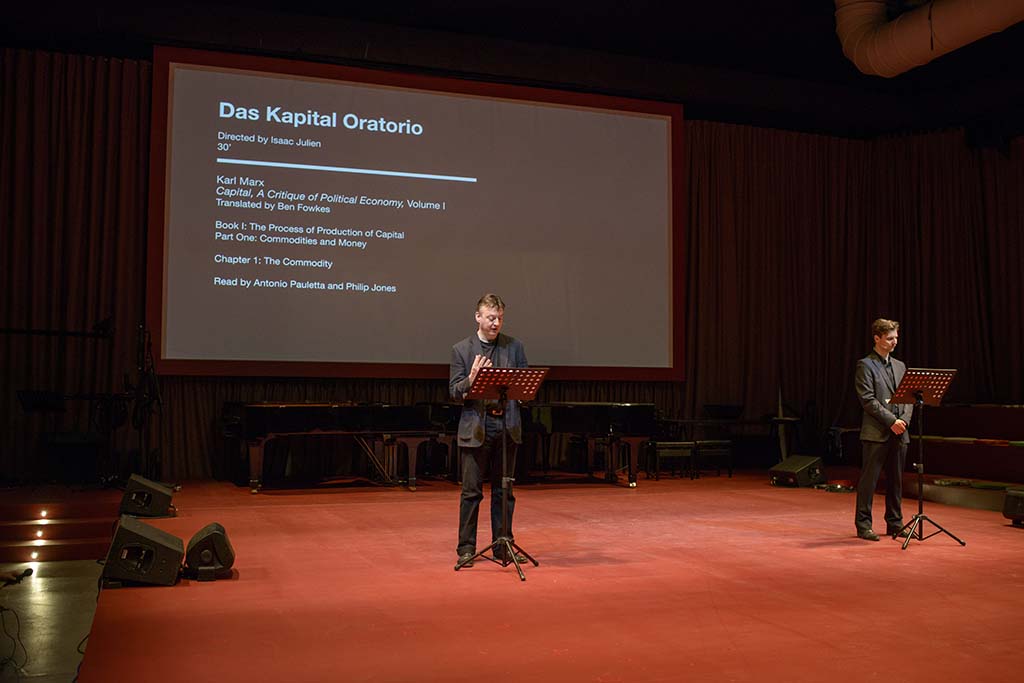
I couldn't hope for a better way to illustrate my previous comment on the strangeness of our times than pointing to "Das Kapital at the Arsenale: how Okwui Enwezor Invited Marx to the Biennale", by Charlotte Higgins (h/t David Ruccio), on the public readings of Das Kapital in the Venice Biennale.
Thursday, 21 May 2015
The Horror of the Confidence Fairy (part iv)
(From Part iii)
"Who is John Galt?" (Ayn Rand, "Atlas Shrugged")
"This is the best chapter in the book and one of the most important economics essays of all time." (Tyler Cowen, "Keynes’s *General Theory*, chapter 12" or here)
"Bukharin was right when he stressed that the [subjectivist] marginalist school adopts the point of view of the rentier". (Ernest Mandel, "The Marginal Theory of Value and Neo-Classical Political Economy")
Whether you call her Confidence Fairy, Regime Uncertainty, or Animal Spirits, her father, Keynes, introduced her to the history of economic thought in Chapter 12 of his masterpiece ("animal spirits - of a spontaneous urge to action rather than inaction") and explained her significance one paragraph later:
"This means, unfortunately, not only that slumps and depressions are exaggerated in degree, but that economic prosperity is excessively dependent on a political and social atmosphere which is congenial to the average business man. If the fear of a Labour Government or a New Deal depresses enterprise, this need not be the result either of a reasonable calculation or of a plot with political intent; it is the mere consequence of upsetting the delicate balance of spontaneous optimism. In estimating the prospects of investment, we must have regard, therefore, to the nerves and hysteria and even the digestions and reactions to the weather of those upon whose spontaneous activity it largely depends."
----------
It doesn't take a literary critic to perceive in Keynes' ode to the subjectivity of the all-important, powerful and benevolent, if fickle, "average business man" a self-satisfied worldview which had barely changed in twelve years, since the publication of "A Short View of Russia" in 1925. Keynes (like Ayn Rand and Ludwig von Mises) sees the capitalist as the economic demiurge, whose broad shoulders sustain the world he alone created:
"How can I adopt a creed which, preferring the mud to the fish, exalts the boorish proletariat above the bourgeois and the intelligentsia who, with whatever faults, are the quality in life and surely carry the seeds of all human advancement?"Nor does it take a psychologist to suspect Chapter 12 to be highly introspective, self-descriptive, almost confessional, with its constant appeals to personal experience ("We know from extensive experience … Nor can we rationalise our behaviour …") and even his own personal petty phobias (he explained in 1926 his "fear of a Labour Government": "It is a class party, and the class is not my class", that made of the Labour Party the "Party of Catastrophe" in "Am I a Liberal?").
In both passages Keynes, the financial speculator -- or rentier, if you prefer -- more than addressing academics, is addressing his fellow Olympians, the financial capitalists and the bourgeois, in general -- whom Rand illustrated with John Galt, the demi-god who, reacting to their impositions, could destroy the world of the moochers by his mere absence.
There is a strong family resemblance between Confy and her dad. Perhaps Rand should have given Keynes a second thought.
----------
The spontaneously generous encomium this chapter receives from leading libertarian economist Tyler Cowen may surprise at first, but is not gratuitous:
"This is the best chapter in the book and one of the most important economics essays of all time. …
"Upon rereading it, I am overwhelmed by its insight and also its relevance to our current [i.e. April 30, 2009] predicament." (here or here)
Subscribe to:
Posts (Atom)