Showing posts with label science. Show all posts

Monday, 24 April 2023

War Schizophrenia (Updated).


(source)

Today Australians and New Zealanders commemorate Anzac Day: the anniversary of the tragic Anzac Corps landing in Gallipoli, in 1915.

Since then, however, Australians also commemorate today all the wars and engagements of the Australian military since Federation: from World War 2 to Iraq and Afghanistan – all of them, without exception, overseas, most of them in far flung places around the world.

The official ceremonies start before dawn. As you might expect, they’re a solemn even sombre affair, where Australians are warned “lest we forget”.

Sunday, 16 October 2022

Bits and Pieces.


I think we can give up hope this third consecutive La Niña will be any better than her two previous sisters.

On Thursday 6th Sydney broke the record for the rainiest year since data collection began in 1858: that day rainfall over Observatory Hill meteorological station totalled 2,206.8 mm. The previous record (2,194.0 mm in 1950) had stood for 72 years.

(source])

To give readers – particularly European ones – an idea how much rain that is: in the 278 days of the year from January 1st to October 6th 2,606.8 litres of water fell over every square metre around Observatory Hill (1,000 litres of distilled water weigh 1,000 kg: one tonne).

From October 6th to the end of the year there are 87 days.

Saturday, 1 January 2022

North Atlantic’s Warm Winter.

(source)

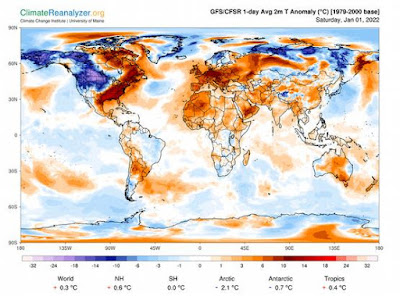
With the exception of Scandinavia, all of Europe, parts of western Siberia, and the Atlantic coast of North America are set to register above average temperatures (1979-2000 base) on January 1st, 2022, according to ClimateReanalyzer.org. In eastern US and Canada, Germany, Denmark and Poland temperatures may exceed the average for this time of the year by more than 10ºC (18ºF).

Thursday, 9 December 2021

The Trap of “Net Zero”?


That chart, from The Conversation article appended below, speaks for itself. It may sound like hyperbole, but that may well be the most important chart I have ever seen.

It takes, however, some explaining to understand what it  says. It is not a comfortable story.

Tuesday, 23 November 2021

Sorry, Guys, but Your Drought is Our Rain (Updated).


Our world is interconnected.

(source)

It’s official, the Bureau of Meteorology has declared a La Niña event. It’s the second La Niña in a row, which is relatively unusual. Perhaps because of that it’s expected to be less intense and less prolonged than is common with such events (it’s expected to last until next January, but it could last the whole summer).

Okay, but what is La Niña and why does it matter?

Thursday, 16 September 2021

Australia’s Back-Stabbing Diplomacy. (Updated)


“It’s really a stab in the back. We had built
a relationship of trust with Australia, this
trust is betrayed”, Jean-Yves Le Drian,
Minister for Foreign Affairs.


Scotty from Marketing announced yesterday as a fait accompli that he decided to breach the $90 billion contract signed with France’s Naval Group for the construction of 12 conventional submarines and instead purchase an unspecified number of nuclear subs from an as yet unspecified Anglo-American consortium, at an equally as yet unspecified cost … to be delivered God only knows when (because the bloody delivery dates are, you guessed, unspecified: this just keeps getting better and better).

And, if you believe Andrew Probyn, in a nominally democratic nation, he and his henchmen and -women may have been cooking up that deal in secret for months, while pretending to be in a partnership with France. You know what double-crossing means, don’t you?

Tuesday, 17 August 2021

Judgement Day?


The news may have left American readers – at least those less absorbed by the fall of Afghanistan or the “pandemic of the unvaxxed” – reeling:

(source)

Yep, that’s right. For the first time since its creation in 1930 (that’s 91 years, people!), the US Bureau of Reclamation declared a Tier 1 water shortage in the US’s largest fresh water reservoir. Come January the great states of Arizona and Nevada, plus their southern – and perhaps less great – neighbours of “old” Mexico will have their Colorado River water allocations reduced (Arizona, currently worst affected, will lose about one fifth of it). Further cuts affecting other equally great states are scheduled.

But wait, there’s more. When the water level is high, the Hoover Dam (which created Lake Mead) generates up to 2,000 megawatts of hydroelectric power. Currently it’s only 327.66 m above sea level or 1,075 ft (which triggered the Tier 1 restriction declaration). If it were to fall to 289.56 m (950 ft) the Dam would not be able to generate any electric power.

Thursday, 12 August 2021

Q&A: the 2021 IPCC Report.

The Orroral Valley Fire (Australian Capital Territory)
on January 29th, 2020 (20:51:04). [A]


By now most everybody has heard or read the news about the 6th IPCC Assessment Report released this week.

From my perspective, a relatively good news is that, although permafrost is indeed thawing, so far this thawing has not reached catastrophic proportions and is expected to remain that way for a while.

As regular readers might be aware, I am particularly concerned with permafrost (and the methane hydrates of the Arctic Ocean, both of which are considered potential tipping points). I have been researching that subject and in the near future I’ll write more on this.

Saturday, 7 August 2021

The Sea of Fire.

 
We’ve all seen the news about wildfires in the western US and Canada. In Australia SBS and ABC have also reported the fires in Greece and Turkey and occasionally those in the Russian Federation.

(source)

Unfortunately, reporting those stories separately is slightly misleading. Deutsche Welle provides a more comprehensive picture. This map – courtesy of DW – shows the locations of wildfires in the eastern Mediterranean (plus the Black Sea), current as of 05/08/2021:

(source)

Tuesday, 3 August 2021

The Victoria Street Green Ban and Juanita Nielsen.

(source)

Fifty years ago, Australian unions pioneered the modern conservation and environmental movement in Australia. The first half of the 1970s was the time of the green bans.

Monday, 19 July 2021

Amazon Basin and CO2 Flows.


Last Friday I closed with a reference to the paper “Amazonia as a Carbon Source Linked to Deforestation and Climate Change”, by Luciana V. Gatti (from the Brazilian National Institute for Space Research) and co-authors.

The research team divided the 7.25 million km² Amazon basin (containing between 100 billion and 146 billion metric tons of carbon) into four regions: TAB_TEF (northwest), SAN (northeast), ALF (southeast), and RBA (southwest).

Using aircraft to collect air samples at different altitudes over 5 sampling sites (two of them, TAB and TEF, on the northwest region; of the remaining 3 sampling sites, one for each region), it was found that:

Friday, 16 July 2021

Is the Artic Permafrost Thawing?


Source

Down Under is enjoying a comfortably cool winter. Because of La Niña, this year has been relatively rainy too, which means that crops were abundant. The bad news is that plenty water and food also means mice galore.

But the really terrible thing is that rain over the Murray-Darling Basin makes the rats go berserk.

Friday, 4 June 2021

Inactive Government = Student Activism.


After a COVID19-imposed pause, the protests against Australia’s inaction on climate change started again.

(Photo credit: your intrepid reporter, the Magpie)

In spite of unseasonable late-autumn cold (severe only by Aussie standards) and the rain the Sydney School Strike 4 Climate organised last Friday May 21st was a success (media coverage). As it has become common, in addition to the SS4C teenagers and the Extinction Rebellion crowd, old-timers and parents with little children formed the bulk of the attendants. Very welcome were representatives from the First Nations.

Wednesday, 19 May 2021

May 21: #ClimateStrike!

(source)
 

The kids of School Strike 4 Climate are calling a strike this Friday 21st. Their website has information on strikes in the capital cities of all states and territories. Or, if you are in Sydney, go to the SS4C-Sydney facebook.

If you live in smaller towns, you can add your own strike.

In Sydney the meeting point is Sydney Town Hall (corner of George and Park streets) from 1200 hours.

To donate, go to their Chuffed Support School Strikers! page .

Come on, old-timers, move your backsides. We can't let the grandkids down. And, as a watermelon myself, I'm looking at you particularly, fellow watermelons.

Very important: for your own safety, for everybody's good and to minimise the inevitable ill-faith criticism from the Murdoch lackeys, don't forget to bring your own facemasks; be mindful of social-distancing guidelines!

Saturday, 1 May 2021

Thursday, 15 April 2021

Oz: When it Rains it Pours.

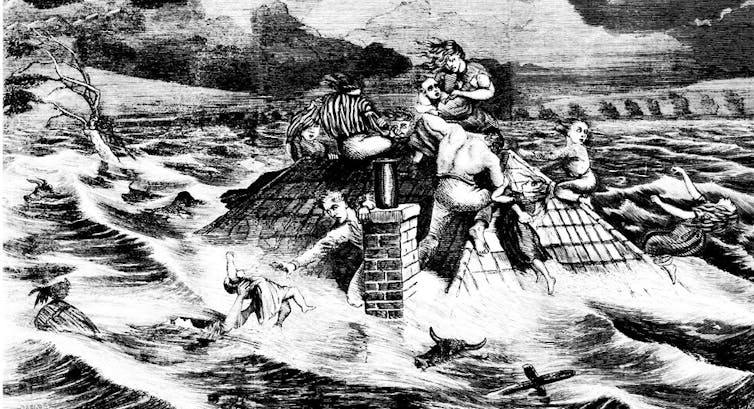
Weather extremes have always been a feature of this great southern land. The thing is that those changes seem to be getting more extreme and more frequent and more extended geographically, affecting places normally free of them


Yes, Australia is a land of flooding rains. But climate change could be making it worse

Etching of the 1867 flood in the Hawkesbury-Nepean Valley, depicting the Eather family. illustrated Sydney News/author provided
Joelle Gergis, Australian National University

Thursday, 8 October 2020

The Budget: How About Wildlife?

The Federal Budget has generated a lot of comments. It is certainly based on an unprecedented fiscal expansion; but there are fiscal expansions and then there are fiscal expansions. Annabel Crabb put it this way: "It recognises the people it wants to help, and screw the rest." She's right.

After that, the few who won biggly and the many who were left out in the cold made their voices heard. In the cacophony resulting, even Morrison's gas-fueled technology roadmap, designed to make Australia forever dependent on fossil fuels, was forgotten. You see, whether by accident or by design, it was announced before the budget, almost as if to make it sure people would be too worried about their own livelihoods to care about climate change.

And yet, as terrible as all that is, there is yet another piece of bad news people have overlooked:

Sunday, 4 October 2020

The Ecological Marx and Engels.


MECW. [A]


Karl Marx and Friedrich Engels wrote a lot. To give you an idea: the Marx and Engels Complete Works (MECW) the most complete  – in the sense of collecting their discovered writings between 1835 and 1895) –  compilation of their written opus, numbers 50 volumes, each one between 600 and 800 pages long.

Even excluding introductions, content pages, appendices and endnotes, that’s plenty of writing: published and unpublished books and pamphlets, drafts and research notes for future work, newspaper analyses, public addresses, private and official letters to family, friends and associates, political or otherwise, communiqués. The variety of subjects they treated in those documents at least matches the variety in the kind of documents they produced: from philosophy, history, economics, sociology, politics, down to the kind of news one sends to one’s relatives and friends.

Much more importantly, however, is that scholars and academics in all those fields – plus many others –  have found inspiration and insight there.

But Marx and Engels not only wrote a lot, they also read a lot. An amusingly ironic anecdote, told by the late Christopher Hitchens, illustrates: “Oh Mr. Marx, yes, to be sure. Gave us a lot of work ’e did, with all ’is calls for books and papers …” – a retired British Museum’s reading room librarian reminisced for the BBC, early 20th century. After that, the librarian added, nobody ever heard of Mr Marx again.

They – on top – not only thought long and hard about what they read, they also observed the world they lived in (modern opinion-makers – or opinionators, depending on your perspective – would be sensible to follow their example: we know you can write, the doubt is whether you can read). 

Marx and Engels, in other words, did their homework: they learnt.

So much so, in fact, that careful readers, approaching their writings from different backgrounds, can identify insights surprisingly relevant to our own times.

And although Marx and Engels were not scientists in the modern sense of the word – nor did they ever claim otherwise – they read about science as well … (something economists and opinion-makers alike, negatives notwithstanding, seldom do nowadays).

Image Credits:
[A] Marx and Engels Collected Works. Author: Ben Sutherland. Source: WikiMedia. File licensed under the Creative Commons Attribution 2.0 Generic license. My usage of the file in no way suggests any endorsement from the file's author.

Without further ado

Saturday, 19 September 2020

The Year of Fire.


Wildfires in the western states of the American Union have received considerable attention in Australian media, perhaps because the story looks a lot like what we witnessed here a few months back and because Australian firefighters were sent there to help in the effort to contain the fires.

Much less coverage has been given to fires in the Pantanal in the Brazilian states of Mato Grosso and Mato Grosso do Sul currently affected by a drought. The Pantanal (a Portuguese word whose literal translation is “swamp”), as Brazilians call that area, is a wetland, thus, the numerous pictures of carbonised “jacarés” (i.e. alligators). Readers may remember that last year forest fires had already visited the Amazon rainforest, a little to the north/northeast of the Pantanal.

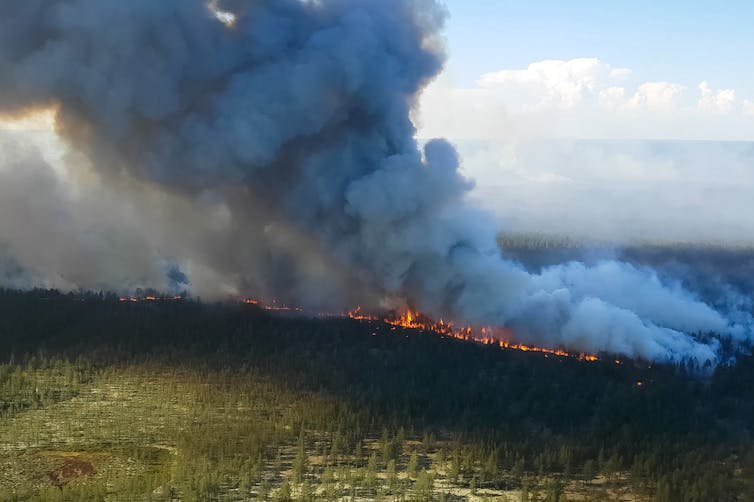
But it is the wildfires in Siberia (also for the second year in a row) which have received next to no mention in Australian media.

Arctic warming: are record temperatures and fires arriving earlier than scientists predicted?

LuYago/Shutterstock
Christopher J White, University of Strathclyde