The history of all hitherto existing society is the history of class struggles.
Freeman and slave, patrician and plebeian, lord and serf, guild-master and journeyman, in a word, oppressor and oppressed, stood in constant opposition to one another, carried on an uninterrupted, now hidden, now open fight, a fight that each time ended, either in a revolutionary reconstitution of society at large, or in the common ruin of the contending classes. Karl Marx and Friedrich Engels (1848).
Manifest der Kommunistischen Partei. [A].
That quote – particularly its first sentence – is rather well known. So much so that compilations of famous quotes seldom fail to include it (threesuchexamples).
But why should that quote, extracted from a work spanning at least 50 thick tomes, be so well-known?
After a COVID19-imposed pause, the protests against Australia’s inaction on climate change started again.
(Photo credit: your intrepid reporter, the Magpie)
In spite of unseasonable late-autumn cold (severe only by Aussie standards) and the rain the Sydney School Strike 4 Climate organised last Friday May 21st was a success (media coverage). As it has become common, in addition to the SS4C teenagers and the Extinction Rebellion crowd, old-timers and parents with little children formed the bulk of the attendants. Very welcome were representatives from the First Nations.
Politicians and the literati have a very limited attention span. Perhaps that’s because the news cycle gets ever briefer. Or maybe they – like Matt – are just too busy praising “unjustly forgotten” books they never read, to pay attention to what happens in the real world.
This is particularly true when educated, better-off, upwardly mobile Leftists – including some who, much to my dismay, call themselves Marxists – are called to evaluate the achievements of the organised labour movement. If accomplishments are acknowledged – if, I repeat – it seldom goes beyond improvements on working conditions and pay (say, the 8 hour workday); moreover, even those gains are often belittled as “sweetheart deals” in payment for services rendered to capitalists against Third World workers.
And yet, unions both in Australia and in the US played a key role – “unjustly forgotten”, as Matt wrote in another context – in the fight against South African apartheid, as historians Peter Cole and Peter Limb argue (in Australia, Commie unionists also were among the pioneering environmental activists).
It is true, however, that given the lawful and unjust limitations imposed on the right to strike (embodied in the “protected industrial action” notion), that kind of union activism has been made next to impossible, much to the relief of our masters’ mouthpieces Christopher Pyne, Michaelia Cash, Michael Stutchbury, Chris Kenny and … Peter Hartcher. Thank you very much, Labor party.
Lessons that can be learnt from dockworkers who helped bring apartheid to its knees
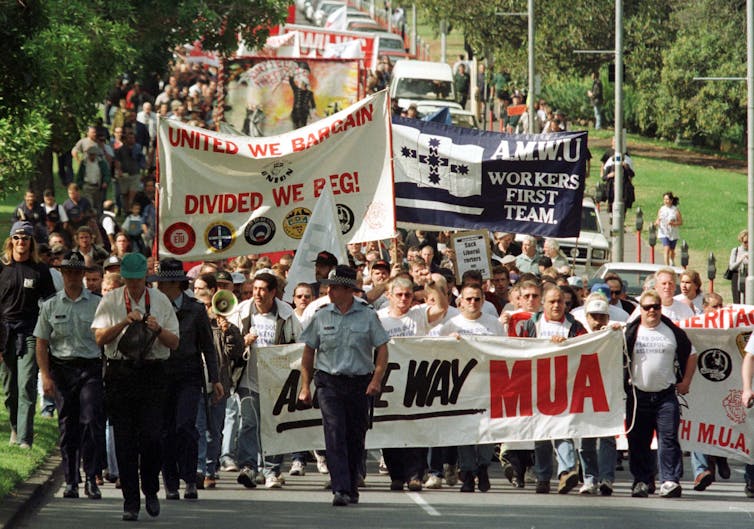
Dockworkers in Australia, pictured here alongside other trade union members in a march through central Melbourne, acted in solidarity with South African workers in the 1980s.
ReutersPeter Cole, Western Illinois University