The Summit of the European Union–Community of Latin American and Caribbean States (CELAC, by its initials in Spanish), held in Brussels just concluded.
Representatives of some 60 countries from the Americas and Europe, including President of the European Union Ursula von der Leyen and head of the European Council Charles Michel plus heads of state and government, gathered for the summit, the first in eight years.
Although the European side offered economic cooperation, one of the main topics on the agenda was to gain CELAC’s support in the NATO war against Russia. China was also part of the agenda.
It’s official, the Bureau of Meteorology has declared a La Niña event. It’s the second La Niña in a row, which is relatively unusual. Perhaps because of that it’s expected to be less intense and less prolonged than is common with such events (it’s expected to last until next January, but it could last the whole summer).
Yep, that’s right. For the first time since its creation in 1930 (that’s 91 years, people!), the US Bureau of Reclamation declared a Tier 1 water shortage in the US’s largest fresh water reservoir. Come January the great states of Arizona and Nevada, plus their southern – and perhaps less great – neighbours of “old” Mexico will have their Colorado River water allocations reduced (Arizona, currently worst affected, will lose about one fifth of it). Further cuts affecting other equally great states are scheduled.
But wait, there’s more. When the water level is high, the Hoover Dam (which created Lake Mead) generates up to 2,000 megawatts of hydroelectric power. Currently it’s only 327.66 m above sea level or 1,075 ft (which triggered the Tier 1 restriction declaration). If it were to fall to 289.56 m (950 ft) the Dam would not be able to generate any electric power.
The research team divided the 7.25 million km² Amazon basin (containing between 100 billion and 146 billion metric tons of carbon) into four regions: TAB_TEF (northwest), SAN (northeast), ALF (southeast), and RBA (southwest).
Using aircraft to collect air samples at different altitudes over 5 sampling sites (two of them, TAB and TEF, on the northwest region; of the remaining 3 sampling sites, one for each region), it was found that:
Down Under is enjoying a comfortably cool winter. Because of La Niña, this year has been relatively rainy too, which means that crops were abundant. The bad news is that plenty water and food also means mice galore.
But the really terrible thing is that rain over the Murray-Darling Basin makes the rats go berserk.
On a recent Q&A session on China and the 100th anniversary of the CCP, Bill Birtles (formerly ABC’s China correspondent), Bang Xiao (ABC’s bilingual journalist specialising in China), Stan Grant (ABC’s foreign affairs analyst) and Yun Jiang (Australian National University) answered questions from the public.
Clinton asked: “China’s system of governance seems totally at odds with any definition of communism. Or am I alone thinking this?”
In June 2016 FARC (Spanish acronym for Revolutionary Armed Forces of Colombia), the long-running Marxist-Leninist guerrilla insurgency, signed a ceasefire with the Government of Juan Manuel Santos. A year later FARC handed over its weapons to the United Nations, in accordance with the ceasefire agreement.
After fighting on the losing side of a 50 odd year revolutionary war, the writing had been on the wall for FARC for a while. FARC’s surrender was an admission a strategy that had once looked so promising to then young, New Left-inspired, would-be revolutionaries all over Latin America, had failed.
Wildfires in the western states of the American Union have received considerable attention in Australian media, perhaps because the story looks a lot like what we witnessed here a few months back and because Australian firefighters were sent there to help in the effort to contain the fires.
Much less coverage has been given to fires in the Pantanal in the Brazilian states of Mato Grosso and Mato Grosso do Sul currently affected by a drought. The Pantanal (a Portuguese word whose literal translation is “swamp”), as Brazilians call that area, is a wetland, thus, the numerous pictures of carbonised “jacarés” (i.e. alligators). Readers may remember that last year forest fires had already visited the Amazon rainforest, a little to the north/northeast of the Pantanal.
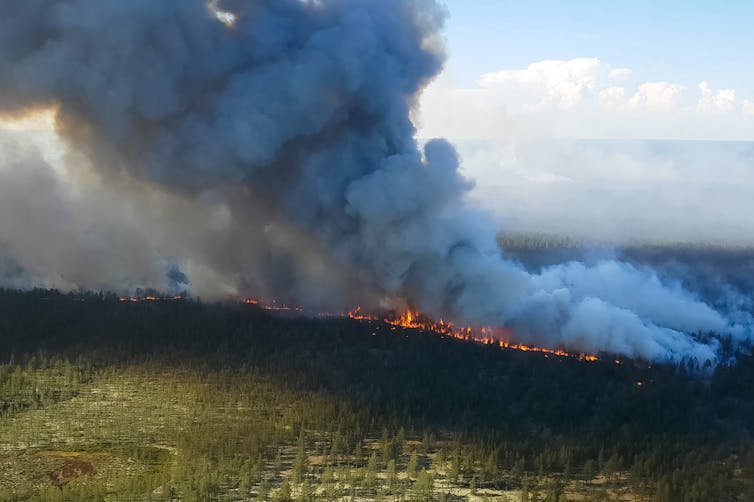
But it is the wildfires in Siberia (also for the second year in a row) which have received next to no mention in Australian media.
Arctic warming: are record temperatures and fires arriving earlier than scientists predicted?
The image photo below shows the Amazon fires: the red dots. NASA added the borders. I added the country and city names. Two tidbits of information to give readers an idea of the magnitude of those fires:
the road distance between Sao Paulo and Rio de Janeiro (the two larger white spots towards the southeast) is some 450 kilometers;
the bold white line between Brazil and Uruguay is approximately 800 kilometers long.
Was this man-made? From ABC News: "Experts say most of the fires are set by farmers or ranchers clearing existing farmland". Capitalism will still destroy us.
Huge fires are raging across multiple regions of the Amazon Basin. Guaira Maia/ISA
By Danilo Ignacio de Urzedo, University of Sydney
Record fires are raging in Brazil’s Amazon rainforest, with more than 2,500 fires currently burning. They are collectively emitting huge amounts of carbon, with smoke plumes visible thousands of kilometres away.
Fires in Brazil increased by 85% in 2019, with more than half in the Amazon region, according to Brazil’s space agency.
After promising that the Great Again US of A would have a "physical, tall, powerful, beautiful Southern border wall", costing $US21 billion paid entirely by the rapists tough hombres South of the border, period, no buts, no ifs, end of the story, it turns out now that this was the very, very, very great talk between the mighty The Donald and México's El Presidente, Enrique Peña Nieto.
"Eles são brancos e se entendem". (Brazilian idiom)
[A]
Robert Vienneau informs us that slaves in the U.S. often identified themselves with -- and even took pride in -- their masters.
Vienneau quotes from "Narrative of the Life of Frederick Douglas":
"When Colonel Lloyd's slaves met the slaves of Jacob Jepson, they seldom parted without a quarrel about their masters; Colonel Lloyd's slaves contending that he was the richest, and Mr. Jepson's slaves that he was the smartest, and most of a man."
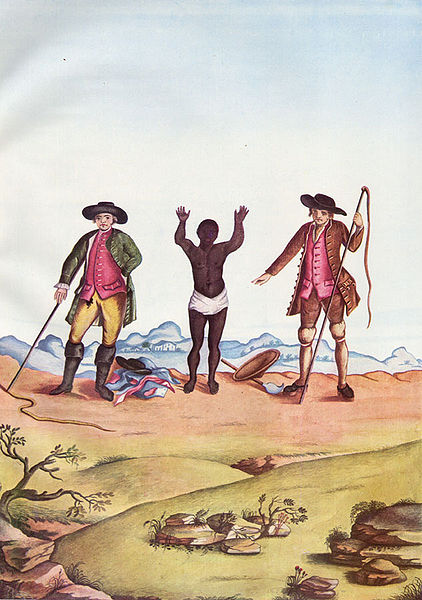
Apparently, Brazilian slaves could be a bit more cynical than their North American counterparts. One of their pieces of folk wisdom (the opening quote) suggests that; surprisingly, it endured and entered contemporary popular speech.
A hot spell during the Cold War, the 1960s-1970s saw the rise to power of right-wing dictatorships all over Latin America, generally supported by the U.S. under the pretext of countering/preventing Soviet influence. Whether that influence was real or merely imagined often was a secondary consideration.
Following the Cuban Revolution, those decades were important for Latin American (perhaps Ibero American would be more precise) folk music, as a generation of composers, musicians and singers came of age and adopted diverse streams of revolutionary thought, giving origin to the Nueva Canción musical movement.
In Argentina two particularly important names were Mercedes Sosa and Horacio Guarany (in Spanish), both of mixed Amerindian and European backgrounds.
Before playing the video, look at the picture below.
It depicts a man and a woman embracing (Guarany and Sosa) -- maybe lovers or friends -- smiling, happy in each other's company. Now, look more closely: the Philips logo on the long play's cover top left corner.
Perhaps it's just me, but I find that cover powerfully symbolic of capitalism's fundamentally inhumane, irrational, self-destructive nature.
If you believe the Argentine dictators, those two persons were extremely dangerous fifth-columnists, Soviet-backed anti-capitalist activists (don't they look "scary" to you?), and yet, when it comes to making money, the capitalists behind Philips did not mind giving them a break.
But that's not the half of it. In their obsession with saving capitalism, the Argentine dictators could not trust Philips themselves on judging what was good for them. Not even a seal of approval, like the logo, was enough for overzealous defenders of the "free" market.
Or maybe the reason they were considered dangerous was that the couple in the picture seemed happy. Love and friendship, happiness, a truly human life -- it seems -- is too much to ask for people like us.
----------
Sosa interprets "Si se Calla el Cantor" (trans. "if the singer falls silent", full lyrics translation), Guarany (music and lyrics), also sings and plays the guitar.
Normally, when people outside of Ibero-America think of Ibero-American music, if they think of anything, they think of samba, bossa nova, salsa, maybe Tex-Mex (update: flamenco and tango). That's it.
Spain and Portugal themselves are assumed to have little of its own to add to the list.
Currently, no heterodox economist is more talked about than Yanis Varoufakis (and for good reasons, too). Here is one of my posts on Varoufakis: his views on Post-Modernism.
----------
As Tony Abbott may face next week a secret ballot from his party colleagues to decide his future as PM, I was reminded of this:
Kaiser structures section 4 of his paper as replies to a series of objections against debt relief. Ironically, in that section, he himself points precisely to the reason further debt relief is unlikely to be voluntarily given.
This is the fourth objection (page 19):
"Germany obtained its debt relief only because of the Cold War".
And this is his reply:
"Quite correct. The agreement and its generous terms demonstrate two things: (1) the strong commitment of the Western Allies not to repeat the mistake committed after the First World War, namely destabilising the defeated enemy politically and socially by imposing an unpayable toll; (2) the ability of the Adenauer government to capitalise on West Germany’s unique position as a front-line state in the Cold War. Without this latter point, aspect (1) would still have been valid. John Maynard Keynes and other architects of the post-war global economy stressed it time and again. However, the ultimate relief might have been somewhat less generous, had it not been considered to be a contribution towards the containment of the 'communist threat'."
He closes that reply thus:
"But what does that mean? Are present-day commitments -- for instance, to economic and political stability in the Eurozone or to the Millennium Development Goals -- less serious than Western political interests in the 1950s?"
“And he gathered them [i.e. 'the kings of the earth and of the whole world'] together into a place called in the Hebrew tongue Armageddon”. Revelation 16:16 (KJV)
The prophesied war of the end of the world refers -- naturally -- to future events, yes?
Well, maybe. But, just for the sake of the argument, what if the war had already been fought? And, what if the good guys had actually lost?
If you ever read a Spanish language novel (even in an English translation), you could do much worse than picking Mario Vargas Llosa's 1981 "La Guerra del Fin del Mundo" ("The War of the End of the World" is its English title), based on true historical events (the War of Canudos, in Brazil).
----------
Sobradinho (o sertão vai virar mar -- i.e. the desert will turn into a sea), by Sá e Guarabyra (Portuguese lyrics, my adaptation from this version)
O homem chega e já desfaz a natureza
Tira gente, põe represa, diz que tudo vai mudar
O São Francisco, lá pra cima da Bahia
Diz que dia, menos dia, vai subir bem devagar E passo a passo, vai cumprindo a profecia Do beato que dizia que o sertão ia alagar
O sertão vai virar mar, dá no coração
O medo que algum dia o mar também vire sertão
Vai virar mar, dá no coração
O medo que algum dia o mar também vire sertão
Adeus Remanso, Casa Nova, Santa Sé
Adeus Pilão Arcado, vem o rio te engolir
Debaixo d'água, lá se vai a vida inteira
Por cima da cachoeira, o Gaiola vai subir
Vai ter barragem no salto do Sobradinho
E o povo vai se embora com medo de se afogar
O sertão vai virar mar, dá no coração
O medo que algum dia o mar também vire sertão
Vai virar mar, dá no coração
O medo que algum dia o mar também vire sertão
Remanso, Casa Nova, Santa Sé, Pilão Arcado
Sobradinho, adeus, adeus, adeus
----------
It happened, somehow.
Canudos, circa 1895. [A]
Canudos survivors surrounded by the Brazilian Army, 1897. [B]
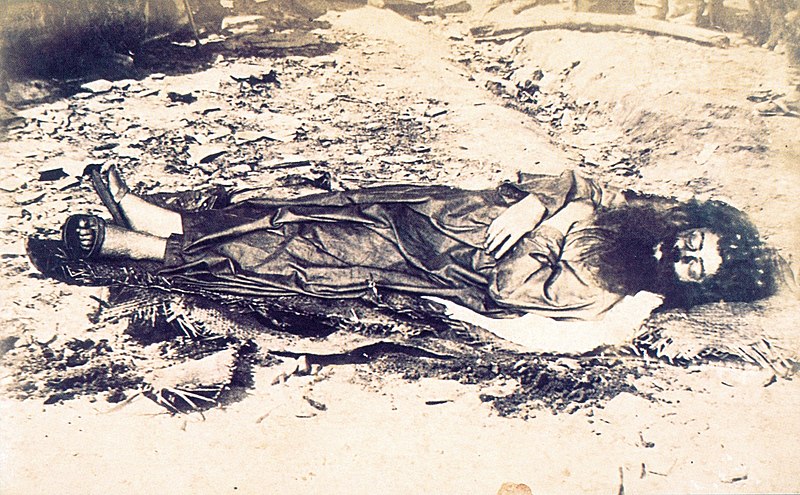
Antonio Conselheiro, by Flávio de Barros. [C]
"After 17 years [i.e. in 2013], Canudos re-emerges with drought". (source)
----------
"Colonel Macedo nods. 'Did you see him die?'
"The little old woman shakes her head and clacks her tongue, as though sucking on something.
" 'He got away, then?'
"The little old woman shakes her head again, encircled by the eyes of the women prisoners.
" 'Archangels took him up to heaven,' she says, clacking her tongue. 'I saw them.' "
There is redemption, even for us, the rabble.
----------
And the desert did turn into a sea (o sertão alagou mesmo, né?), as the saint Counselor (o beato Conselheiro) said.
Image Credits:
[A] Canudos. Image in the public domain. Source: Wikipedia.
[B] Survivors. Image in the public domain. Source: Wikipedia.
[C] The only photograph of Antonio Conselheiro, the mystic rebel and spiritual leader of the War of Canudos (1896-1897). Author: Flávio de Barros. Image in the public domain. Source: Wikipedia.
"The Lord gave, and the Lord hath taken away; blessed be the name of the Lord". Job 1:21
A few years ago, the BRICS were all the rage. Brazil, in particular, seemed quite successful:
Source: Google
Riding on the back of the resources boom, the Brazilian balance of trade was positive during the first decade of this century, reaching a record surplus in 2006 of nearly USD 6 billion (source). Together with a moderately expansive fiscal policy (2.4% of GDP on average, with a 4.3% peak in 2003, and two highs in 2005 and 2009, both around 3.5-3.6%, source), the Da Silva and Rousseff administrations (from the pseudo-left Workers' Party) appeared to have found the magic formula to keep business people and the rest of us happy. The Lord gave it.
According to James Petras (the Bartle Professor, Emeritus, of Sociology at Binghamton University), things may have changed for the worse since Rousseff's appointment of Joaquim Levy as Finance Minister (h/t MNE). Levy, a “Chicago Boy”, is linked to Bradesco, a Brazilian financial giant.
Petras qualifies Levy's policies as “shock therapy” and believes that, “contrary to the expectations of President Rousseff, cuts in credit, salaries and public investment will depress the economy – and send it from stagnation into recession”. The Lord took it away.
Frankly, I haven't followed the situation in Brazil, but I'm happy to accept Petras' opinion. He also believes that:
“First and foremost, inequalities will increase because whatever income gains ensue will be concentrated at the top. Government deregulation and fiscal and exchange rate policies will deepen the imbalances in the economy, favoring creditors over debtors, foreign finance over local manufacturers, owners of capital over wage workers, the private sector over the public.”
“Levy’s shock therapy will heighten class tension and inevitably result in the break-down of the social pact between the so-called Workers Party regime and the trade unions, the landless rural workers and the urban social movements.”
----------
However, I do find Petras' analysis wanting in two matters. First of all: there is no point in singling Levy out as responsible for this: “It's not personal, Sonny. It's strictly business”, in the immortal words of Michael Corleone. If Bradesco has too much power, the solution is pretty simple: nationalise it.
Another thing that escaped Petras' attention is that, whenever these pseudo-left parties have to choose between the people's interests and business interests, they will inevitably, invariably choose the latter. It's in their nature, as the scorpion said to the dying frog in the Frog and Scorpion fable.
To predicate fiscal stimulus on technical grounds, as MMTers and Keynesians are wont to do in these circumstances, is not the solution: political will, not brains, is what is lacking.
Again, it doesn't take a genius to figure the solution: real socialism, not pseudo-left, not bullshit social democracy, not third way.
The good news? We don't need to wait for the Lord.
From this Saturday on I'll do my best to post a link to a musical piece, which I find personally meaningful (sorry, youngsters, you'll probably hate me for this).
To start, I couldn't possibly get anything better than Plácido Domingo, singing Carlos Gardel's “El Día que me Quieras”. Domingo, on top, chose three great songstresses!
You may not remember them, but I few years back the Three Tenors (Domingo, José Carreras, and -- What's his name? The Italian fellow … -- just kidding, Luciano Pavarotti was great, too, even if he wasn't Spanish) were all the rage.
I didn't like the musical accompaniment that much, unfortunately: too “American”. Oh, well.