Showing posts with label finances. Show all posts

Friday, 5 July 2019

The No-Surprises Country.


Labor’s electoral defeats aside, Australia is a most predictable place.

Tuesday the House of Representatives passed the “Morrison” income tax cuts and to no one’s surprise Thursday night it was the turn of the Senate, where it passed with no amendment whatsoever. The COALition, with the complicity of every party and independent (the Greens and independent Tasmanian MP Andrew Wilkie excepted) ruthlessly threw four out of every ten Australians under the bus. Australians like this young couple and their infant son:

(source)
(Frankly, I’m not interested in Josh Frydenberg’s sophistry. The less I see his ugly, porcine mugshot, the better. I don’t care either about Anthony Albanese’s spin.)

Friday, 26 June 2015

Greece: Bailout Referendum Announced.


It seemed inevitable (see here and here) and it's one very important step closer:


The Sydney Morning Herald:

Greek Prime Minister Alexis Tsipras calls for referendum on aid package
Date June 27, 2015 - 9:09AM
Birgit Jennen, Nikos Chrysoloras and Rebecca Christie


The BBC:

Greece debt crisis: Tsipras announces bailout referendum
22 minutes ago

----------


This should be a test for the powers of Keynes' mythical Animal Spirits/Confidence Fairy.

Friday, 25 January 2013

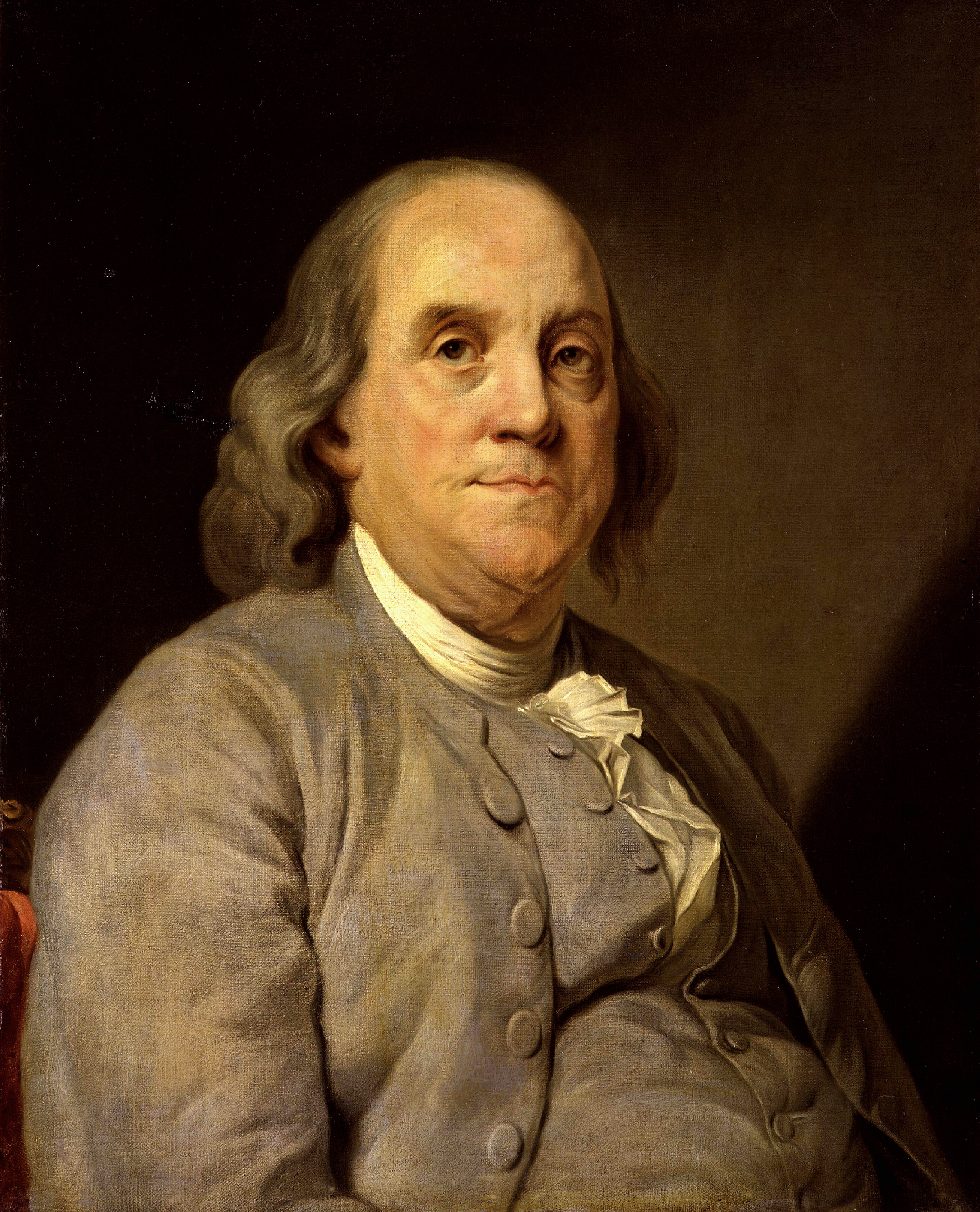
Ben Franklin, Paper Money and LTV.

Benjamin Franklin (c. 1875),
by Joseph-Siffred Duplessis [A]
Benjamin Franklin (1706-1790), the renowned American polymath, was "leading author, printer, political theorist, politician, postmaster, scientist, musician, inventor, satirist, civic activist, statesman, and diplomat".

Being such a prominent figure in American history, it's curious that two rather controversial aspects of Franklin's public life are much less mentioned: Franklin advocated the use of paper money.

To add insult to injury, in his 1729 pamphlet "A Modest Enquiry into the Nature and Necessity of a Paper-Currency" Franklin also explained why labour should be the real measure of wealth. [1]

In that pamphlet, and conscious that opinions on policy matters were affected by vested interests ("Men will always be powerfully influenced in their Opinions and Actions by what appears to be their particular Interest"), Franklin first explained why some interest groups would oppose an increase in "our present stock of paper money":
"I say all such [moneylenders/bankers] will probably be against a large Addition to our present Stock of Paper Money; because a plentiful Currency will lower Interest, and make it common to lend on less Security".
To make things worse, Franklin's advocacy of paper money did not propose anchoring the value of paper money to that of precious metals, but to labour:
"For many Ages, those Parts of the World which are engaged in Commerce, have fixed upon Gold and Silver as the chief and most proper Materials for this Medium [of exchange] (...) But as Silver it self is no certain permanent Value, being worth more or less according to its Scarcity or Plenty, therefore it seems requisite to fix upon Something else, more proper to be made a Measure of Values, and this I take to be Labour.
"By Labour may the Value of Silver be measured as well as other Things. As, Suppose one Man employed to raise Corn, while another is digging and refining Silver; at the Year's End, or any other Period of Time, the compleat Produce of Corn, and that of Silver, are the natural Price of each other; and if one be twenty Bushels, and the other twenty Ounces, then an Ounce of that Silver is worth the Labour of raising a Bushel of that Corn.
(...)
"Thus the Riches of a Country are to be valued by the Quantity of Labour its Inhabitants are able to purchase, and not by the Quantity of Silver and Gold they possess; which will purchase more or less Labour, and therefore is more or less valuable, as is said before, according to its Scarcity or Plenty".
Those who've read my post Adam Smith and LTV should find the passage above quite reminiscent.


Notes:
[1] And that, if I had to guess, explains why some MMT supporters found "some convoluted passages" they didn't understand in Franklin's pamphlet.

Image Credits:
[A] "Portrait of Benjamin Franklin" (c. 1875), by Joseph-Siffred Duplessis. Source: National Portrait Gallery, Smithsonian Institution. Wikipedia.

Thursday, 17 January 2013

Papaconstantinou and "Them".

George Papaconstantinou [A]
Last year George Papaconstantinou was passing judgement on the whole Greek nation and a harsh judgement it was. (See here)

Papaconstantinou (economics graduate from LSE and New York University and former Greek Finance minister) excoriated smaller parties for, in his views, their part in the fiscal chaos involving their nation:
"I didn't hear any smaller party ever being against an additional measure of including more people in the public sector. I did not hear them be against any kind of extension of benefits, even if they were going to the wrong side".
Once started, Papaconstantinou would not so easily stop, either. Everybody in Greece was equally at fault and he was there to tell them so:
"We cannot have a private sector which doesn't take its obligation seriously, and we cannot have people not paying their taxes and I'm sorry, this is the vast majority of the population which is somehow evading their taxes.
"So nobody is outside this, nobody is innocent to the crime. Of course politicians bear the biggest burden, and of course they will be punished for this, as they are being punished, but let's understand that this is a mentality change, we need a regime shift, but one that is based on Greece staying in the euro and Greece being true to its obligations".
Since then and for almost a whole year they (the politicians, that is) went unpunished, largely thanks to Papaconstantinou losing the infamous Lagarde list.

----------

This is Papaconstantinou now:
"Greek ex-minister Papaconstantinou faces tax probe
"Greek MPS have voted to launch a criminal investigation into ex-Finance Minister George Papaconstantinou.
"He is accused of tampering with a list of suspected tax evaders with Swiss bank accounts.
"Three of Mr Papaconstantinou's relatives were removed from the list. He has denied involvement.
"But MPs voted against extending the probe to another ex-finance minister, Evangelos Venizelos, and former PMs Lucas Papademos and George Papandreou"
. (See here)
----------

Papaconstantinou no longer points his righteous finger at them. He now claims he was singled out among them for punishment: he is being made a scapegoat (see here).

And, you know what, now I believe him:
"'Horrible Citizens': The Life of Greece's One Percent
"The Greek economy has been tanking for years now as the country struggles to balance its budget by imposing deep austerity measures. But the country's richest residents haven't noticed. Many aren't taxed at all, and some of those that are prefer to dodge their obligation to the state instead".
(See here)

----------

Does that leave the little fish off the hook? Not at all. But there are two differences among the little and the big fish.

Firstly, because the bigger the fish, the bigger the bite:
"I won a public works contract through an open tender. I met the local mayor and he proposed giving me another works contract. But he tells me straight - you get 2,000 euros, and I get 8,000 euros. Well, I was really disillusioned and I wasn't having any of this. So the mayor gave the contract to another company instead."
"My driving school teacher told me that if I wanted to pass the driver's test I had to give 200 euros to the examiners, otherwise they would fail me. I asked him what I should say if they had any technical questions about the car's mechanics. He said, 'Just tell them there's 200 euros under the hood and they'll get the message'."
Secondly, the little fish are trying to change things (See here). The big fish are happy with things as they are.

As long as the big fish remain big, the little fish will have to put up with them...

Image Credit:
[A] "Greek politician Giorgos Papakonstantinou on September 30, 2009". File licensed under the Creative Commons Attribution-Share Alike 2.0 Generic licence. Wikipedia. My use of the file does not in any way suggests its author endorses me or my use of the work.

Tuesday, 25 December 2012

The Whole Enchilada...

h/t Matías Vernengo (Naked Keynesianism).

Matt Taibbi (Taibblog) provides an example illustrating why there is no reform that can fix capitalism. It complements my previous post magnificently.

It shows that it's not a matter of creating better models, explaining and convincing some misguided academics and technocrats. Patching up a few things here and there will not do either.

----------

I suppose people could say many things about Glenn Hubbard. His Wikipedia profile, for instance, says he is the dean of the Columbia University Graduate School of Business, and Russell L. Carson Professor of Finance and Economics. So, the man has more than enough academic credentials and I am sure he has an intellect to match.

Until a few months ago, Taibbi adds, he "was a leading economic advisor to Mitt Romney and a rumored (perhaps even consensus) candidate for the Treasury Secretary job". Therefore, he is also successful in policy and political circles.

From reading the fragments of Hubbard's deposition in the lawsuit against Bank of America and Countrywide Financial (currently, Bank of America Home Loans), fragments which Taibbi presents, one can confirm that Hubbard is highly intelligent, plus being good with the words, and able to keep his cool under pressure.

Furthermore, one can see that Hubbard is a man who is paid handsomely for his services (but no more than high-end escorts, who charge for their services around the same):
"He took $1200 an hour specifically to not learn how subprime loans were created. Moreover, he did this non-learning for Countrywide years after the financial collapse, long after the truth about that company had already become common knowledge pretty much everywhere in the world outside Hubbard's office (...)"

----------

Smarter people than me can theorize and create new models; they can teach and preach until they are blue in the face, but they will not convince Hubbard and others like him. Neither will they convince think-tankers, shock-jocks or politicians (of both "liberal" and "conservative" persuasions) of their mistake, because it is not a matter of lack of brains, as Hubbard's example demonstrates. "It is difficult to get a man to understand something, when his salary depends upon his not understanding it", as Upton Sinclair once said.

It is not a matter of patching up the financial services alone, either. For one, Taibbi mentioned the connection between the financial services, universities and parties. Reform the financial services, without severing its links to universities and parties, and you'll have gained little, if anything.

But Taibbi didn't mention the notorious bureaucracy-private enterprise revolving door. He wasn't, either, speaking of climate change, or taxation and public services, industrial relations or a range of things where the same things happen.

Paraphrasing Cathy O'Neil, no "financial services reform" band aid will fix this boo-boo.

So, dear smart people, by all means, theorize, create new models, teach and preach. Technocrats, propose better regulations. But don't fool yourselves, with luck, if you are persistent, right, and communicate your ideas really well, you may convince people like me.

Don't get me wrong, this may help, but it is not enough.

Moreover, forget about convincing people like Hubbard, let alone those paying his fees. Upton Sinclair learned this without spending years studying; you should be able to do the same.

And whatever you achieve will last exactly until these people tolerate it.

----------

Perhaps it's time to think about a more enduring solution.

Friday, 21 December 2012

It's the Whole Enchilada, Sister.

Since he correctly predicted the re-election of Barack Obama, American meta-pollster Nate Silver has become a bit of a cult-hero for the ill-defined left in the US and even abroad.

In part, that's understandable, considering the bullying Silver endured from the Republican commentariat.

That's why also American lefty Cathy O'Neil's smackdown on Silver catches my attention powerfully.

I haven't read Silver's book on modelling (the object of O'Neil's fury). But O'Neil makes a quite negative review of it, not on the technical aspects (which she evaluates positively, in essence), but on the general political and philosophical orientation of Silver's work.

I can't say how fair are O'Neil's criticisms of Silver's politics (or his alleged "technocrato-philia"), but I sympathize with her when she says things like these:
"We didn't have a financial crisis because of a bad model or a few bad models. We had bad models because of a corrupt and criminally fraudulent financial system.
"That's an important distinction, because we could fix a few bad models with a few good mathematicians, but we can't fix the entire system so easily. There's no math band-aid that will cure these boo-boos."
I won't pretend that I know much about the mathematical details. But what O'Neil says is evident to anyone following the news. I don't know about you, but I still remember Goldman Sachs' Fabrice Tourre's emails to his then girlfriend, made public in 2010:
"Darling you should take a look at this article... Very thoughtful... More and more leverage in the system, l'edifice entier risque de s'effondrer a tout moment... Seul survivant potentiel ['the whole building risks collapsing at any moment, the only potential survivor', my translation], the fabulous Fab (as Mitch would kindly call me, even though there is nothing fabulous abt me, just kindness, altruism and deep love for some gorgeous and super-smart French girl in London), standing in the middle of all these complex, highly levered, exotic trades he created without necessarily understanding all the implications of those monstruosities [sic]!!! Anyway, not feeling too guilty about this, the real purpose of my job is to make capital markets more efficient and ultimately provide the US consumer with more efficient ways to leverage and finance himself, so there is a humble, noble and ethical reason for my job ;) amazing how good I am in convincing myself !!!"

----------

Unfortunately, O'Neil's criticism itself falls short of the mark. It's not just the financial system that stinks: it's the whole capitalist enchilada that is rotten to the core.

Let's put this "monstruosity" out of its misery, before it drags us all even deeper into shit.

Thursday, 15 November 2012

14N: Los Empecinados.

After the first ever European general strike, this is how the global share markets reacted:

London      FTSE 100   -1.11%
Amsterdam   AEX        -1.01%
Frankfurt   Dax        -0.94%
Paris       Cac 40     -0.89%
Brussels    Bel 20     -0.86%
Zurich      SMI        -0.68%
New York    Dow Jones  -1.45%
Sao Paulo   Bovespa    -2.10%

This "blood bath" (pun intended) did not surprise those following the stock markets.

What's more, the European protests, together with the usual bad economic news coming from Europe and the US politically induced fiscal cliff tragic comedy made sure the rich would be further hit today in the only thing sacred for them: their pockets.

So, this morning, this is how Macrobusiness put the day's perspectives: "As I write it is not looking good (...) but it's the close that matters today".

And the Hallowed Markets did not disappoint:

Sydney      All Ords   -0.91%
Hong Kong   Hang Seng  -1.55%
Of the big world markets, only Tokyo (Nikkei 225) ended up in black: +1.90%.

Macrobusiness is right: it is the close that matters.

----------

The collaborationist Rajoy government and PP are suffering in the polls, as well. According to Electometro:
"According to the CIS's October barometer, the PP has lost 8.7 percentage points in vote intention in comparison to the general elections a year ago, while the PSOE's remains stagnant". (See here, my translation from Spanish)
From a less than overwhelming final result last year of 44.6% of the valid votes, PP would receive 35.9% if the elections had been held October. PSOE achieves a meager and falling 28.6%, while smaller parties have either increased or retained their votes. And that, before 14N.

----------

If you ask me, the 1% have reasons to worry and to try to play down the whole thing. They are losing the money they stole from you. Their figureheads will keep falling.

The Portuguese and the Italians are waking up; and even the so far not so badly affected (relatively speaking) French, Germans, Belgians and other Europeans are seeing the tide rising. They know they are waiting in line for the same treatment you are currently receiving.

The opposing view was expressed today by the jewel in the crown of the House of Murdoch: the Wall Street Journal.

In today's online edition, this is what those stalwarts of "objective" journalism had to say:
"Protest fatigue, declining levels of unionization and factionalism within the labor movement have combined to take much of the bite out of strikes as tools for changing government policy, analysts said."
Well, I won't dispute what those unnamed analysts said, neither will I contrast it what other media had to say (here, here, here, here, here, here, here), but the unnamed analysts I consulted said: "The mercenary hacks paid by Big Bucks will lie and try to put a brave face, while they are shitting themselves in their pants".

----------

Spaniards (since Juan Martín Díez, El Empecinado, hero of the war against Napoleon) have a reputation for stubbornness. I think this is a good opportunity to demonstrate it: get organized, brace yourselves for a long fight. Know that you will be the subject of slander, mockery and fake disdain by "moderate" and "realist" charlatans pundits.

The swindlers and their toadies want to deny you a future, but you have little to lose: they've already stolen all they could. It's them who have a lot to lose, not you. Make them pay.

It's not going to be easy, as the brutal beating of a 13yo boy (the one lying on the floor) and a teenage girl by the Catalonian cheap and cowardly criminals Mossos d'Esquadra shows:


Think of this pintada (graffiti, for English speakers):
"Tomorrow, perhaps I'll have to sit before my children and tell them we were defeated.
"But I could not look into their eyes and tell them they live the way they do, because I did not dare to fight back."

Monday, 12 November 2012

Is Paul Krugman Going MMT?

Paul Krugman at a press conference
(Swedish Academy of Science). [A]
Paul Krugman's NYTimes blog links to a little paper ("The Simple Analytics of Invisible Bond Vigilantes", PDF) explaining, with mainstream economic tools, why a country like Greece is indeed vulnerable to the "bond vigilantes", while countries like the US are not:
  1. The US (and the UK and Australia), unlike Greece (and Italy, Portugal, Spain, Ireland), has its own national currency, issued by the American government.
  2. Unlike the EUR, the USD exchange rate fluctuates freely.
  3. The US interest rate is determined, as matter of policy, by the US Fed; the EUR interest rate is determined by the European Central Bank.
  4. The US has virtually no foreign debt denominated in foreign currency. Greece's debt is pretty much entirely denominated in EUR.
If you have mainstream economics training, you should have no difficulty following Krugman's paper: it's brief, to the point and well explained.

At the other hand, if you know something about MMT, you'll find that the 4 points above are all made by MMT.

Pretty please, Australian journalists refer to my friend Heteconomist (here) for a fuller and better discussion than anything I could offer here.

Congratulations, Prof. Krugman.

Image Credits:
[A] Paul Krugman, Laureate of the Sveriges Riksbank Prize in Economic Sciences in Memory of Alfred Nobel 2008 at a press conference at the Swedish Academy of Science in Stockholm. Wikipedia.

Sunday, 4 November 2012

Toxic Rembrandt.

Rembrandt as Zeuxis,
c. 1662. [A]
Over a year ago a number of Australian city councils initiated a class action against RBS (ABN AMRO before 2010), S&P and Local Government Financial Services for losses suffered with the Rembrandt CPDO. (See here)

Today Michael West (Fairfax Media) informs us that "The Federal Court's Justice Jayne Jagot has accepted the evidence from 12 NSW councils - who claimed they had been duped into buying a toxic financial product - that the ratings agency Standard & Poor's was little more than a lap dog for slick merchant bankers".

Rembrandt CPDO had been rated AAA by S&P, in spite of being a highly leveraged and risky financial product, which lost 90% of its value a few months after the councils purchased it.

The court ordered the 3 financial agencies to pay AUD30 million, plus interests, to the plaintiffs; S&P claims it intends to appeal.

This decision, together with rulings against Lehman Brothers a few weeks ago, could have international implications:
"It remains to be seen whether the Court's finding that S&P engaged in misleading and deceptive conduct in assigning its coveted-AAA rating to the CPDO will open the flood gates for actions against credit rating agencies in relation to other structured products such as CDOs. Logically, CDOs are also in the gun. Most enjoyed the top rating, most blew up."

Image Credits:
[A] Self Portrait as Zeuxis, c. 1662. Wikipedia.

Thursday, 27 September 2012

Show me the Money!

"An artificial mirage (...) This simulates
an atmosphere with two inversion layers." [A]

"Coal baron Nathan Tinkler has lost AUD2 million a day over the past year, according to BRW, and now ranks second on the Young Rich [Australians] List with a fortune estimated at AUD400 million." (See here)

And he is not the only extremely rich bloke to become slightly less rich in the past few weeks. About two weeks ago, mining billionaire Andrew "Twiggy" Forrest reportedly lost AUD500 million in one day, 330 of them... "in less than an hour". (See here)

How could this have happened?

After all, according to the free-market cult, rich people are rich because they work hard and are smart. Did these two very rich guys suffer a sudden mental breakdown? Did they just remain in bed longer than usual?

Clearly, not. If you are one of their fans, you can relax.

Or, were they robbed by a bunch of moochers and looters? I couldn't see anybody running around with bags of money, so I'd say it wasn't that, either.

I know! Maybe it was somehow that nefarious bearded dead German philosopher's doing? After all, the mere mention of his name keeps Murdoch "journalists" and their Pavlovian readers awake at night. You see, he's "Evil I tells ya. Eeevil!", and to be blamed for pretty much everything, from dandruff and belly-ache to the Holocaust, but not even He-Who-Must-Not-Be-Named can come back from the grave...

To me, what did happen wasn't much of a mystery or a drama. The mining machines didn't simply rust and fall to pieces overnight; the metallic ore and the coal veins didn't just disintegrate as in a sci-fi movie: they are still there, as they have been for hundreds, maybe thousands, of millions of years.

It was just that commodity prices sometimes go up, sometimes go down. They were inflated, and then they deflate.

But wasn't all that wealth destroyed in a matter of hours?

Think about it. Did any real wealth disappear? No. What was "destroyed" never had a physical existence, in the first place. It existed in paper only: it was an accounting mirage. It was virtual.

Michael Hudson has written about this kind of things. This is how our fearless leaders think, according to Hudson:
"Shifting planning to the financial sector [aka economic rationalism] and privatizing public enterprise on credit creates wealth by inflating asset prices".
Sounds familiar?

And, what is a free market, for Hudson?
"A free market is one free of unearned economic rent, including interest and financial fees, monopoly rent and resource rent."
Here, I don't fully agree with Hudson (capitalist markets exist to exploit one unearned income: surplus value), but he's not that far off the mark.

----------

On second thoughts, maybe the dead bearded German philosopher is smiling in the other world.

Image Credit:
[A] "Mirage experiment..." Wikipedia. By Shy Halatzi. File licensed under the Creative Commons Attribution-Share alike 3.0 Unported. My use of the image does not imply the author's endorsement of it.

Thursday, 30 August 2012

The Unlucky Country.

While everybody was distracted with Gina Rinehart's efforts to improve our quality of life by cutting our minimum wages and her taxes (cuts for everybody, hey!), Peter Martin (with Tim Colebatch) was busy reading Variant Perception's report entitled "Australia: the Unlucky Country".

This is what Martin says:
"Warning: After Boom it'll be Dutch and Go" (See here)
Say, what???
"AUSTRALIA faces a run on its currency, a deeper collapse in housing prices and a bank funding crisis to rival Europe's as it tries to come to grips with life after the mining boom, according to a report from a boutique US advisory firm.
(...)
" 'The mining sector has crowded out almost all other sectors of the economy and also funneled credit and liquidity into a housing bubble in the real estate sector,' says the report, which has been circulated among global money managers."

----------

At one hand, then, we get news of doom and gloom; at the other hand, we keep hearing that everything is hunky dory: "Mining Investment Boom Rolls on".

So, I suppose it's reassuring that our betters keep pumping money in mining.

----------

I won't tell you what's gonna happen: I don't know.

But I do know this: commodity prices have been falling and with them corporate profits and share prices. Take for instance BHP-Billiton's:

Click to enlarge.

In the year to August 30, BHP lost 16.75% 19.50% (close price today: AUD31.99).

Last May 17, the share price was lower: that's the red dot in the chart. That day Ian Verrender reported:

"BHP Chairman [Jac Nasser] Takes Shot at Canberra Over Industrial Relations and Tax Policies". (See here)

Having distributed tonnes of cash to shareholders via dividends and share buybacks, BHP decided that further investments had to be cut back: "It was only after the speech, when quizzed by reporters, that Nasser conceded the company would not proceed with plans announced last year to spend $80 billion on projects during the next three years".

Apparently, Verrender interpreted the "shots at Canberra over industrial relations and tax policies" as a bit of a diversionary tactic to keep shareholders busy bitching against the Government.

Without denying that, I, however, believe a cut in wages and taxes (does it sound familiar, re Rinehart today?) wouldn't hurt BHP's finances, either. Two birds with one stone.

Anyway, eight days ago, (part of) the announced cutback was named: Olympic Dam:

"BHP Billiton has taken the axe to more than $US30 billion in spending on Australian expansion projects, in the clearest sign yet that the nation is past the peak of its resources boom.
"BHP’s decision to change its strategy on its Olympic Dam expansion came as the company announced a 35% slide in net profit
" ' It doesn't really make a lot of sense in this market for them to be engaging in a major capital spending program and to be bringing more supply onto the market in a time when prices are softening,' said Gavin Wendt, publisher of resources newsletter Mine Life".

Considering this, I am not so sure it's such a good thing that other miners keep pumping money into mining.

But, hey, I'm just a commie on low wages, so who cares what I think?

Update:
02-09-2012. I've just read Ian Verrender's last column for the SMH. Together with Adele Horin and Ian McIlwraith, Verrender is leaving the SMH.

It's a curious thing how, after reading an author for a while, one feels like one knew them personally. As your regular reader, I'll miss you guys.

I wish the three of you the best of lucks and I hope I'll soon see your work again.

Friday, 29 June 2012

The Latest Euro Summit...

Cutting to the chase: will the measures adopted by the Eurogroup solve the European drama or not?

Frankly, I have my doubts. The BBC's Paul Mason doesn't seem to believe it will do the job, either; although (like me) he admits it contains some good things:
"The summer of crisis, collapse and political disorientation is cancelled.
"Last night the EU leaders took steps which, though not a complete solution to the crisis, averted its escalation. Crucially Angela Merkel did what she had insisted was impossible".
(See here)
From where I am standing, the best thing is that, against my suspicions, it appears that the recent Spanish bank bailout will not increase the Spanish public debt, and, therefore, will not imply an additional austerity package. If this is really so, I can say that I am relieved to be mistaken.

Another good thing is that, as the Irish case is similar to the Spanish one, the same treatment should be made extensible to Ireland, which had to apply austerity measures, even though the bailout money was destined to Irish banks.

Unfortunately, the same treatment does not benefit Portugal or Greece, as the object of their bailouts was the public sector.

It also appears that the European governments lending money to the Spanish banks will not claim seniority over the bailed out banks' assets. This should keep our dear-beloved "investors" happy, for a while.

From a political perspective, it looks like European summits without Monsieur Sarkosy won't be that much fun for Frau Merkel.

The bad thing is that the amount dedicated to fiscal stimulus is pathetically insufficient (see here). Without stimulus, I can't see how these economies will grow.


Tuesday, 5 June 2012

Spain's Fiscal Fraud Amnesty.


AMNESTY
plural am·nes·ties, 
(...)
noun
(...)
2. Law: an act of forgiveness for past offenses, especially to a class of persons as a whole.
(...) (See here)

Resolute to cut the fiscal deficit by 13.4bn euros, the Rajoy government found Spanish tax fraudsters (literal translation from Spanish defraudador) evaded taxes on about 25bn euros, accumulated as of December 31, 2010, presumably kept in tax havens overseas. (See here. Spanish)

At current top marginal rates (52% persons; 30% corporations) that amount could yield between 7.5 and 13.0bn euros in taxes, not including penalties and interests.

In a very unusual move and even though the ruling "People's" Party controls Parliament since last year, the Rajoy government decided to decree a fiscal fraud amnesty (March, 31). (Official text, in Spanish)

Scree capture. Click on image to enlarge.

For readers not familiar with the terminology: decrees are regulations by fiat of the Executive. Unlike bills and acts, which are discussed and approved by Parliament, decrees bypass parliamentary discussion. This particular decree grants amnesty to tax evaders declaring undeclared incomes earned before December 31, 2010, in exchange for a 10% fine. (See here. Spanish)

In strict money terms, the Rajoy Government unilaterally exchanged a 7.5-13.0bn debt (not including penalties or interests) for an expected 2.5bn. The idea, allegedly, is (1) to accelerate debt collection, and (2) to allow the immediate repatriation and investment in Spain of these capitals (i.e. euro 25.0bn).

I won't draw the readers' attention to this economically questionable rationale, or to the unorthodox legislation by decree, but to something much more basic and elemental.

Regardless of language, amnesties, by definition, refer to past offenses, as can be seen in the quote opening. This should apply to the proposed Rajoy tax fraud amnesty, too. However, it appears, this elemental fact is ignored by the Rajoy goverment.

El País, after consulting taxation experts, identified a remarkable loophole in the decree. (See here. Spanish)

According to the official text of the decree, tax fraudster/evaders don't need to demonstrate their incomes' provenance or the date when they were earned, provided those incomes were kept in cash.

Drug traffickers, for instance, could take the proceeds of deals and deposit them in a bank. By doing so, claiming the transaction took place before December 31, 2010, and paying 10% of the amount as "regularization fee", the deposit would become to all practical purposes legitimate.

As a side note, they might still be liable to a criminal prosecution (for drug smuggling/dealing, for instance), if an eventual police investigation were ordered and found evidence the money deposited was illegally earned.

Further and much more meaningful from the critically important point of view of fiscal policy, the decree provides strong incentive to evade taxes in even perfectly legal transactions. As would-be tax fraudsters/evaders don't need to present evidence of the fiscal year when the income was earned and the decree allows them to use this procedure until November 30, otherwise perfectly legal transactions could avoid taxes, by the simple expedient of claiming they took place before 31/12/2010 (as mentioned, corporate income tax top marginal rate is 30%, and personal income tax, 52%).

In other words, unless remedies are found (and it's unclear whether they exist) the Rajoy tax fraud amnesty would not apply only to past offences. An amnesty with a vision of the future!

Among other effects, opposition PSOE is studying a possible constitutional challenge.

More immediately, this amnesty can potentially affect severely fiscal revenue for the current financial year; liquidity preference could jump real soon, too, at a moment when Spanish banks are already under pressure.

----------

If I were the Spanish banks, I'd have plenty cash at hand, just in case.

Monday, 30 April 2012

Bailey's Home Loans (III)

I really should read Real-World Economics Review Blog more often.

Here's an interesting collection of quotes by central bankers about how banks really work. It is dated January 26, 2012, well in advance of the Keen/Krugman debate.

Jesse Frederik, its author/compiler, opens the selection with these words:
"Does the ‘money multiplier’, this core concept of monetary theory, exist? Do banks need reserves before they create money? Not according to central bankers. Banks can create money at will, even without reserves, though they will have to find or borrow these reserves afterwards. But as the central bank has to provide these, this is not any kind of  constraint, even when the central bank increases the rate of interest.
"Some quotes which imply that central banks can not control the amount of money by influencing reserves"
. (Emphasis in the original)
My preferred quote, as it is more direct and concise:
"In the real world, banks extend credit, creating deposits in the process, and look for the reserves later." Alan R. Holmes, Federal Reserve Bank of New York (1969)
It seems Holmes agrees with good ole' George Bailey, then (see here and here).

Sunday, 15 April 2012

Bailey's Home Loans (II)

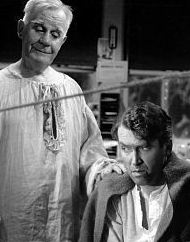
Henry Travers as Clarence Odbody
after 'saving' George. [A]
Last time we left George Bailey, from Redford Falls, NY, (a State of the American Union, which is in the jurisdiction of the Federal Reserve System) after he gave a home loan to young Bo Anderson.

Next day and with the $900 required in his account, Bo went to see Old Sven, first thing in the morning, intending to pay for the house with a cheque.

 "Nah!" roared Old Sven, cantankerously. "I don't want no stinkin' piece'o paper. I want the money in my account at Buffalo City Bank!"

Taken by surprise, Bo tried to explain that from the point of view of who-gets-how much, to pay in cheque, with cash withdrawn directly from his account, or direct transfers is immaterial.

Seeing however that Sven would not back down, and feeling disappointed and irritated, Bo went back to Bailey's headquarters and only branch at Main Street muttering to himself all the way.


A Nightmare on Main Street

Upon hearing from Bo, George Bailey, looking up from his coffee cup, said reassuringly: "Don't you worry, son!"

"That's what we'll do: We'll advance $900 from your account to Buffalo [City Bank], instructing them to credit Old Sven's account".

Because the $900 balance in Bo's account is a liability for Bailey's, Buffalo won't accept it, if no offsetting asset is transferred.

He must decide what assets to transfer. Not the loan itself, clearly: it involves a stream of interest payments. Besides, Buffalo could not want it: it could be a dud loan.

No. George must transfer $900 in liquid assets, so that Buffalo is sure Old Sven can withdraw the money and hide it under his mattress, if he so wishes.

Again, George must check Bailey B&LA's books. This is how Bailey's records looked like the previous day:

Assets          | Liabilities          | Net equity
----------------+----------------------+-----------
+$900           | +$900                |          
+$100           | +$100                |          
----------------+----------------------+-----------

Presumably, Bailey B&LA has performed other transactions before; it should have other assets and liabilities; there should be some net equities. But... that's not shown above! That's because those records show only yesterday's transactions. Technically, that's not a balance sheet.

In fact, Bailey's has an account with the Fed. Banks use these accounts to settle transactions involving other banks. In the US it's a licensing requirement.

If Bailey's own account with the Fed has a balance of at least $900, he can simply transfer the $900 to Buffalo, as a positive balance with the Fed is an asset for Bailey's: the asset needed for the transfer.

These transactions add this entry to Bailey L&BA's records:

Assets          | Liabilities          | Net equity
----------------+----------------------+-----------
+$900           | +$900                |          
+$100           | +$100                |          
----------------+----------------------+-----------
-$900           | -$900                |          

Let's think about what's represented above. In nominal dollar values (and that's what's shown in the table) $900 is $900.

But those entries, even if showing equal amounts, refer to different things: $900 in the top-most asset line is Bo's loan; the $900 in the lowest asset line is the Bailey B&LA's Fed balance transferred to Buffalo.

Bailey's assets diminished, but its loan portfolio remains unchanged (Bo's loan is filed under A, inside the old wooden filing cabinet, just behind George).

What are the two $900 entries under liabilities? If it were vitally important, one could say the top-most is the "deposit that came into existence simultaneously with the loan (liability and asset)".

But George is a simple man; for him, it's unimportant what label to use, as long as the bookkeeping entries are right and they sure seem right to him. Besides, to say it was a deposit created "out of thin air", although technically incorrect, has two advantages: it's shorter and quite metaphorically descriptive.

So, unless a much better reason is advanced to be technically precise if idiomatically awkward, George (who can be pigheaded) will keep describing this as "out of thin air".

Anyway, the bottom-most $900 is Bo's balance, transferred to Old Sven's Buffalo account.

Let's note three things here:
  1. Bailey's liabilities diminished by the same amount as its assets ($900), therefore, Bailey B&LA's net equity did not change;
  2. Bailey B&LA's $900 balance with the Fed was there before George gave Bo the loan; it would still be there, had Sven not stubbornly insisted on having the $900 transferred to his account. It only became relevant due to the need to transfer funds from Bailey's to Buffalo. And its relevance is limited, as we'll soon see.
  3. Further, the third line only reflects transactions due to the transfer of funds from Bailey's to Buffalo. Keep this in mind, as it will be recalled later.
As Bailey B&LA's deposits decreased and its loan base remains unchanged, George will need to check whether Bailey's still complies with legal reserve requirements.

(Incidentally, in Australia as reserve requirements are calculated differently, it's possible that a bank would not need to do anything. See footnote 1.)

Additionally, the skeptical reader might ask what if Bailey's balance with the Fed had been less than $900? Say, $750?

Ah ha! Two problems! Maybe the line "unconstrained lending creates deposits" was wrong after all! Should we start pulling our hairs, running around madly and wailing desperately?

Feel free, but George seems confident: should there be any reserve shortfall, he has time to get deposits from the public (i.e. borrowing from depositors), loans from other banks or the Fed, as he did yesterday, as a matter of fact.

What about the shortfall in Bailey's account with the Fed?

No worries, mate. In the US, the Fed has an overdraft facility and it's legally obliged to back interbank transfers, should balances prove insufficient: interbank payments don't "bounce". Naturally, should Bailey's go into overdraft, it owes the difference ($150=$900-$750) to the Fed and must repay it real quick, and with interests, too. (A brief exposition is presented in the Appendix).

So, how will George get these $150 to pay the Fed?

Again, pretty much as he did yesterday when he needed reserves: by asking loans.

So, can George solve all Bailey's problems by borrowing? Not all, but most of them.

Could Bailey's keep this situation forever? Probably not: at one hand, the Fed charges interests for their loans; at the other hand, banks not only charge interests; unlike the Fed, they could also refuse to lend to each other (as European banks allegedly did just last year).

But the relevant question here is not whether there are potential limitations. Clearly, there are. That's the nightmare scenario.

The relevant question here is: is there any reason to believe banks are normally affected by those limitations? To me, that doesn't seem to be the case: most of George's nights are nightmare-free.


Buffalo: Show me the Money!

These are Buffalo City Bank's records:

Assets          | Liabilities          | Net equity
----------------+----------------------+-----------
+$900           | +$900                |          

The +$900 asset is Bailey's balance with the Fed, transferred to Buffalo. To Buffalo it's irrelevant whether Bailey's had the $900, used an overdraft or had to beg for money: from Buffalo's perspective, they received a single amount and this amount is an asset for them.

The $900 liability is the deposit Buffalo was instructed to make in Old Sven's account. That money comes from Bo's account, but now belongs to Old Sven; therefore, it is Buffalo's liability.

Let's observe something: this line in Buffalo's records corresponds to the last line in Bailey's.

Bailey's and Buffalo's combined records:

Assets          | Liabilities          | Net equity
----------------+----------------------+-----------
+$900           | +$900                |          
+$100           | +$100                |          
----------------+----------------------+-----------
-$900           | -$900                |          
+$900           | +$900                |          

The two last lines cancel each other out, because what's a credit for bank one, is a debit for bank two.

Therefore aggregate balances with the Fed did not change. So, Bailey's lost its $900 Fed balance? Meh. Buffalo gained $900. In this sense, as mentioned above, the Fed balances are of limited relevance. [2]

Furthermore, these two banks' combined assets and liabilities did not change, neither did their combined net equity. In fact, their combined loan portfolios did not change, either; nor did their combined deposits.

To all purposes, we could just delete the last two lines in the table above and the end result would be exactly the same as the one shown in a previous post.

In other words, it doesn't make any real difference to consider two banks (and, no, I won't show this for more than two banks).

Considering two banks introduces a real-life complication, that's true; but it's a complication unnecessary to the understanding of the basic situation: i.e. when there are no liquidity problems in the banking sector.

Or to put this in a more graphical way: when considering more than one bank, "Bailey B&LA" can be interpreted as the whole banking sector.


Buffalo Sven's Wild East

Old Sven is not a particularly rational person and, against better advice, withdraws the $900, presumably to hide them under his mattress (as he is reputed to be stingy, too).

Buffalo had no problem to give him the $900 in cash, because the transfer was in liquid assets; this reduced both Old Sven's account balance and Buffalo's liquid assets balance (both by -$900).

These are Buffalo City Bank's records:

Assets          | Liabilities          | Net equity
----------------+----------------------+-----------
+$900           | +$900                |          
-$900           | -$900                |          

Buffalo did do not need pre-existing reserves, neither did it need loans from other banks or the Fed.

Buffalo's net equity change: $0.


Epilogue

Before jumping to his death, Clarence Odbody, George's guardian angel, talked George into how life is wonderful. Clarence gained his angel wings.


Appendix

This is how Bailey L&BA's records look like if the overdraft facility (not the reserves) is needed:

Assets          | Liabilities          | Net equity
----------------+----------------------+-----------
+$900           | +$900                |          
+$100           | +$100                |          
----------------+----------------------+-----------
-$750           | -$750                |          
+$150           | +$150                |          
-$150           | -$150                |          

Third line: -$750 is interpreted as in the previous case (Bailey's reserves transferred to Buffalo).
Fourth line: +$150 is the overdraft for the difference between the $900 transferred and the $750 available in Bailey's balance (i.e. a loan from the Fed to Bailey's).
Last line: -$150 the balance of the transfer to Buffalo.

I know, this all can be a bit tiresome, but it's for a good cause!

Notes:
[1] Being in the US, Bailey's needs to comply with the fractional banking reserve regulations enforced by the Fed, most familiar to US economists (explaining why they explicitly mention them in their posts).
These regulations, in the US, require that reserves must amount to 10% of deposits kept "in the freezer" (i.e. liquid assets).
An eventual Bailey B&LA (Australia) would need to comply with the Australian Prudential Regulation Authority's regulations, contained in APS 201, establishing that ADIs (authorized deposit taking institutions) must keep reserves to "meet commitments and obligations under normal operations conditions" for up to 1 month, and are "capable of operating for at least five business days" under adverse circumstances.
These regulations, in Oz, boil down to require that reserves must amount to a proportion of deposits kept "in the freezer"; this proportion, however, is not necessarily 10%, but contingent upon predicted level of activity.
Call it Aussie slang: pretty much the same, but not quite.
[2] Clearly, if Bailey's used the Fed's overdraft this is no longer true. But, in this case, the combined banking sector owes the Fed and the debt is offset by their surplus balance.

Image Credits:
[A] "Henry Travers as Clarence Odbody after 'saving' George". Wikipedia.

Thursday, 5 April 2012

Bailey's Home Loans.

George Bailey (James Stewart), Mary Bailey (Donna Reed)
and their youngest daughter Zuzu (Karolyn Grimes). [A]
The year is 1929; the place, Bedford Falls, NY.

It's 10:05 am and you, as owner/manager of Bailey Building and Loan Association, are sitting at your desk.

You are happy and relaxed: life's wonderful, just hunky dory. As a conscientious banker, you make sure Bailey B&LA complies with all legal requirements and standard accounting practices.

Suddenly, young Bo Anderson comes along, sweating and slightly short of breath. Without knocking at the door or even greeting, Anderson says:
"Mr. Bailey, sir, I need ya help. I wanta buy Old Sven's house and I need $900. I'm gunna get married to Mary Ellen Walton and we need a house".
After Anderson explained himself, you, as Bailey's main and only credit analyst, give Anderson the loan.

Anderson, more relaxed now, manages to smile and, before leaving, turns and says with manifest gratitude:
"Ma was right. She always tells me to go talk to George Bailey, that he's a good man".
After Anderson leaves, as Bailey's CFO, head accountant and only bookkeeper, you open the books and write down the transaction:

Assets          | Liabilities          | Net equity
----------------+----------------------+-----------
+$900           | +$900                |      

With this transaction, Bailey's assets (the Anderson loan, represented, say, by a mortgage) increased by $900. You opened an account at Bo's name, with $900 (the money he'll use to buy the house). That's a liability for Bailey's. As both assets and liabilities increased by the same amount, Bailey's net equity did not change.

What about Bo Anderson? For him Bailey's asset is a liability; and Bailey's liability is an asset. Bo's net equity hasn't changed, either.

Similar scenes are happening all across the State of New York, or even the US.

All the B&LAs giving loans to buy houses, and all the Bos, Joes and Jacks buying them with the money thus raised, saw their assets and liabilities go up. That's true.

But their net equity? It didn't change: not one B&LA saw their net equity increase, just like Bailey's net equity did not increase. And exactly the same happened to all the Bos, Joes and Jacks.

Before proceeding, notice what happened here exactly: a loan was given, a double-entry transaction was inscribed in a book. Nothing else. In particular, the loan was given, but no previous depositor was mentioned.

Now, let's consider two separate issues: (1) Bailey's need to comply with fractional reserve legal requirements and (2) Bo's use of the money he's just gotten.


George Bailey and Fractional Reserve

After writing down the transaction above, George Bailey (you) finds that both Bailey's loans (assets) and deposits (liabilities) went up by +$900.

If depositors never withdrew money from their accounts and banks didn't exist to make profits, that would likely be the end of the story: Bailey's did create deposits "out of thin air", by a simple double-entry bookkeeping operation.

Alas, people don't keep money in a bank's account without a purpose: sooner or later, they'll want their money back. And banks lend money for a profit.

Over banking history, this has caused some difficulty: if a bank's depositors came all together to withdraw their money, the banker wouldn't be able to return it to them. To avoid it, and following the law, George Bailey need's a reserve in liquid assets (let's say, cash).

Strictly speaking, no bank (or B&LA) can ever reduce this risk to zero. To achieve this they could not lend anything: their deposits would need to be sitting there idly by. But, if they couldn't lend any money, how would banks make any profits?

As a rule of thumb and compromise, the amount loaned by a bank must be a fraction of the deposits it keeps. Let's say, 90%. 10%, therefore, needs to be kept as a reserve. Incidentally, notice that all these considerations are not originated in double-entry bookkeeping: it's a legal imposition.

So, if at a given moment your deposits add up to $10,000, then you can have at most $9,000 in loans. The remaining $1,000 deposited are kept as reserve. And this is all the law requires of a banker. In principle, how you achieve that is up to you (but central banks will give you a little hand, as we'll see soon).

Bailey's has a new deposit ($900) and a new loan ($900), but no additional reserves: Bailey's reserves and deposits might be $100 short. But there's no need to panic, yet. George Bailey needs to check the books.

Maybe he finds he's already got the $100: perhaps yesterday, just before locking the door for the day, Giuseppe Martini (George's good friend), came in and deposited $100. In that case, the money was just there waiting to be used as reserve (not waiting to be loaned!) and George can recline his chair, light up a Camel, cross his hands over his belly, put both feet on the desk, and say: "It's a wonderful life".

Before moving on, let's recap: the Anderson deposit was still created "out of thin air", this did not change. It was this eventual previous deposit (Martini's) that was actually backed up by some form of cash. The whole deposit was used as reserve.

What if Martini (or another customer) did not deposit any money previously? No biggie. Henry F. Potter (Bedford Falls' wealthy slumlord and general purpose nasty guy) or another customer could still come by and deposit the amount required.

For that matter, perhaps George, himself, could deposit some money in his own account. Or he could call another B&LA or bank and ask for a loan.

Ultimately, all else failing, he can ask for a Fed loan. That's one of the things a lender of last recourse does.

Whatever happens, this is what the book shows at the end of the day:

Assets          | Liabilities          | Net equity
----------------+----------------------+-----------
+$900           | +$900                |      
+$100           | +$100                |       

The $100 under assets is the addition to reserves, the $100 under liabilities is the new deposit, regardless of its origins (other depositors, other banks, George's own pocket, the Fed). Considering all the day's transactions, we have $900 in new loans and $100 in reserves (totaling new assets for $1,000), and $1,000 in deposits (i.e. liabilities): Bailey's complies with the law.

Bailey's did not need to have the deposits before making loans. It could have happened, but it wasn't necessary. [1]

More generally: not every single deposit needs to keep the 90%:10% ratio prescribed by fractional banking. Because of this, Bailey's created money "out of thin air" even in the presence of fractional reserve banking.

And this is a general principle: not a single bank needs to wait until they have a deposit to lend 90% of it. That's not what fractional reserve banking forces banks to do. So, no money multiplier, thank you very much.

When Old Sven deposits in his own account the $900 Bo paid him, neither Bailey's nor any other bank needs to put $90 in the freezer, leaving $810 for future loans. They can just lend the entire $900 or more, if they can, in the reasonable expectation that they could get the reserves required. [2]

But there's something more: aggregate assets and liabilities increase equally, alright. But we can't say that Anderson ultimately owes money to any individual. Because the $900 were created "out of thin air", out of the $900 Bo got, not a cent can be traced back to individuals. Bo owes money to Bailey's.

More generally, it's not true that a household's liability means another household's asset. If a macroeconomic model (whether one calls it NK, NC, KKK or KGB) is based on this assumption, then one can say "Houston, we've gotta problem".


Bo's House

Now, we leave good old George Bailey and drop by Bo Anderson's newly-bought house.

As we've just heard, Bo paid Old Sven for his house. His equity did not change by doing that: he still owes Bailey's $900 (that is a liability for Bo) and has an asset (the house) with a market value of $900. Net equity: $0.

But, let's remember that many Bos, Joes, and Jacks, all over the place, are buying houses. Perhaps housing prices start to go up! If that's the case, Bo could soon be getting capital gains. Bo's net equity could be increasing.

This is not a direct consequence of double-entry bookkeeping, and sometimes, rightly or wrongly, this is the impression one gets when this phenomenon is explained by Prof. Keen's followers.

It's just that the liability Bo acquired is used to finance the acquisition of a physical asset. In other words, in the case of housing, debt is used to fuel demand in the so-called "real" economy. If the supply is less than the demand, prices could go up.

The other side of the coin is that house prices (against what many Aussies believe) sometimes go down: in that case, Bo could end up underwater. D'oh!


Last Word

This is my account of what Steve Keen has been trying to explain in his recent debate with Paul Krugman.

I cannot guarantee the account is 100% faithful to Prof. Keen's teachings, as I've followed him only irregularly, but it's my honest understanding of what he says.

And, at least to me, it doesn't sound nonsensical or "mystical", which is an adjective Prof. Krugman used to describe Prof. Keen.

But it is a simplification, as footnote 2 makes clear.

I also deliberately chose "George Bailey", an extremely likeable fictional banker, who follows the rules to the letter and is not desperate to make a quick buck.

And if even George Bailey can and would lend "out of thin air", it seems utterly naïve to assume real bankers can't.

Those are my two cents, anyway.


Image Credit
[A] George Bailey (James Stewart), Mary Bailey (Donna Reed) and their youngest daughter Zuzu (Karolyn Grimes), from the motion picture "It's a wonderful life". Wikipedia.

Notes:
[1] In fact, George would be negligent and Bailey's could go broke if that was the usual situation: Bailey's can't afford having too many unproductive interest-earning deposits.
[2] Strictly speaking, this is only true if there were no other constraints. But there are: often banks face constraints relating loans to capital, for instance. Or related to obtaining financing from other banks or large institutional investors. One such constraint could force a bank to deny or postpone loans. And, even though this needs to be taken into account, these additional constraints generally only qualify the general principle: banks can lend as much as they want.

Friday, 9 March 2012

Europe: Baled Out (?)

Upon news that private Greek government bondholders agreed to have their holdings reduced by up to 74% of their face value, it appears the requirements for the second Greek bailout were fulfilled.

Stockmarkets around the world seemed subdued, however:

Dow Jones  +14.08 (+0.11%)
FTSE 100   +27.76 (+0.47%)
Dax        +45.67 (+0.67%)
Cac 40      +9.12 (+0.25%)
(See here)

Have we seen the last of this slow motion train wreck? Maybe.

Business Spectator/AAP:
"The agency that oversees financial derivatives [ISDA] says a massive debt relief deal for Greece constitutes a so-called credit event, meaning it will trigger payouts on bond insurance [CDS].(…)
"That means holders of credit default swaps on Greek bonds will be able to claim insurance payments as a result of Greece's decision to force its debt holders into a bond swap."
(See here)
In the Greek case, these payouts are estimated at US$3.2 bn.

At one hand, this averted Robert Peston's scenario. (See here)

At the other hand, the debts of other European nations, like Italy, Spain, Portugal and Ireland are similarly covered by CDS (altogether, some US$2.7tn in CDS in circulation).  And after Greece, it is not inconceivable that a nation could trigger a credit event. (See here)


Baled Out!

Thursday, 8 March 2012

Greece 'Closes in' on Debt Swap as Deadline Looms.

That's the title both BBC and Bloomberg's were showing.

As of writing this (5:15am Australian time), the BBC news item (8 March 2012) had been last updated  at 16:52 GMT. (See here)

Frankfurt and Paris were up.

Tuesday, 6 March 2012

There We Go, Again...

At 4:27 local Australian time, this the BBC World News Finance (Update as of 17:23 GMT):

"Stock markets down on Greek swap fears.
"Stock markets have declined sharply on concerns ahead of a key deadline to secure Greece's future in the euro."

Dow Jones -176.38 (-1.36%)
FTSE 100   -44.75 (-1.52%)
Dax       -233.35 (-3.40%)
Cac 40    -124.98 (-3.58%)

See here

Sunday, 12 February 2012

Bits & Pieces: RBA's Infallibility.

Moses with the Tablets of the Law.
Rembrandt (1659) [A]
An opening note for overseas readers: for diverse reasons, a favourite Australian pastime is to predict when the RBA will change official interest rates.

------------

A few days ago SMH's Jessica Irvine published a piece on why economic forecasters engaging in this "hobby" often get it wrong. Read it here: it's a good read.

The piece was motivated by last week's surprise RBA decision to keep official interest rates unchanged. Bank economists (plus journalists, and commentariat) forecast a reduction, almost unanimously.

Don't get me wrong, Irvine makes a good case: it's these economists' job to make forecasts and they make them using imperfect information. They are vulnerable to confirmation bias, too.

Irvine: "The problem is, these economists are only human".

Fair enough.

She also mentions journalists: "And then comes the media, which, it must be said, doesn't deal well with uncertainty (a human trait)".

Again, fair enough. I have no objection.

Irvine doesn't mention the sundry commentary one finds in the blogosphere, but one could assume similar reasoning applies to the best of it: an all-too-human tendency to over-simplify and follow the leaders.

In contrast, "the Reserve, for its part, feels under no compulsion to fall into line with this game calling. Its board members have the privilege of waiting until all the data is in before acting", said Irvine.

This is much less reasonable.

Irvine implicitly assumes that the RBA's decision was right. This is most obvious in the preceding quote, but you can perceive it in the whole text.

I object to that assumption. The RBA is as much under pressure to make a decision, as the forecasters are to second-guess it in advance. It's the RBA's job to make decisions under pressure.

To make these decisions the RBA uses information, which is publicly available. Therefore, is not clear the RBA has any substantial advantage over forecasters in this regard.

Furthermore, the board members and staff preparing the RBA's board briefs are as susceptible to confirmation bias as any one else. Despite the RBA's mystical aura of infallibility, it's staffed and directed by humans.

In other words, the situation is probably much more symmetrical than Irvine's account suggests.

Asymmetry do enter the situation when one takes into account the consequences of a mistake, which Irvine didn't do: most likely a red-faced forecaster, in the case of a bank economist.

If the RBA makes a mistake the consequences would be more serious. And, at least in this occasion, it is not trivial the decision was right.

Image Credit:
[A] Moses with the Tablets of the Law. Rembrandt (1659). Wikipedia.