Showing posts with label Nietzsche. Show all posts

Tuesday, 14 April 2015

Nietzsche on Women.


"238. (…) On the other hand, a man who has depth of spirit as well as of desires, and has also the depth of benevolence which is capable of severity and harshness, and easily confounded with them, can only think of woman as ORIENTALS do: he must conceive of her as a possession, as confinable property, as a being predestined for service and accomplishing her mission therein. (…)
"239. The weaker sex has in no previous age been treated with so much respect by men as at present--this belongs to the tendency and fundamental taste of democracy, in the same way as disrespectfulness to old age--what wonder is it that abuse should be immediately made of this respect? They want more, they learn to make claims, the tribute of respect is at last felt to be well-nigh galling; rivalry for rights, indeed actual strife itself, would be preferred: in a word, woman is losing modesty. And let us immediately add that she is also losing taste. She is unlearning to FEAR man: but the woman who 'unlearns to fear' sacrifices her most womanly instincts." (Nietzsche, "Beyond Good and Evil").

Although Nietzsche was infatuated with several women, and proposed to some, he never got married.

----------

Somehow, I'm reminded of this scene from Ron Howard's 2001 film "A Beautiful Mind", starring Russell Crowe, Jennifer Connelly, Paul Bettany, Ed Harris, and Christopher Plummer.


Update:
17-04-2015: Nietzsche -- unlike Schiller, his hero -- wasn't much of a "farfallone amoroso", it seems. :-)

Sunday, 5 April 2015

The Pope and Nietzsche: An Easter Dialogue.


With cameo appearances by John Maynard Keynes, Rush Limbaugh, Karl Marx and Friedrich Engels, and yours truly.

Here’s Pope Francis explaining why his social concerns (inequality, poverty, lack of solidarity, hunger in the world, the suffering of children) do not make of him a Marxist:
(With Spanish accent, in humbly conciliatory tone) “There is nothing in the Exhortation [‘Evangelii Gaudium’] that cannot be found in the social Doctrine of the Church. (…) I was not, I repeat, speaking from a technical point of view but according to the Church’s social doctrine. This does not mean being a Marxist.” (link)
Here’s Friedrich Nietzsche, prophet of those who "are the quality in life and surely carry the seeds of all human advancement", explaining why he’s unmoved by the Pope’s words:
(German accent, shouting rabidly) “Whom do I hate most heartily among the rabbles of today? The rabble of Socialists, the apostles to the Chandala, who undermine the workingman’s instincts, his pleasure, his feeling of contentment with his petty existence -- who make him envious and teach him revenge … Wrong never lies in unequal rights; it lies in the assertion of 'equal' rights … What is bad? But I have already answered: all that proceeds from weakness, from envy, from revenge. The anarchist and the Christian have the same ancestry.” (“The Antichrist”, page 58)
Here’s John Maynard Keynes:
(English aristocratic accent, smirking contemptuously) “In one respect Communism but follows other famous religions. It exalts the common man and makes him everything. ()
“We hate Communism so much, regarded as a religion, that we exaggerate its economic inefficiency; and we are so much impressed by its economic inefficiency that we underestimate it as a religion.” (“A Short View of Russia”, link)
Rush Limbaugh:
(In barely coherent Yank English) “But, regardless, what this is -- somebody has either written this for him or gotten to him. This is just pure Marxism coming out of the mouth of the Pope.” (link)
Yours truly, in second-hand Aussie accent: Holy Father, let's try and see the bright side of this. At least Limbaugh doesn't hate you.

----------

Given the example of  Óscar Romero (among a great many others) and in spite of the above, readers may, nevertheless, think it prudent for Pope Francis to make it clear his distance with Marxism. The opposition to Marxism, they could add, is due to its association with the Soviet Union.

Perhaps Karl Marx and Friedrich Engels would have understood the concern. But, they would have been skeptical about that solution. Marx and Engels writing in the winter of 1847-1848 (70 years before the Russian Revolution):
"Where is the party in opposition that has not been decried as communistic by its opponents in power? Where is the opposition that has not hurled back the branding reproach of communism, against the more advanced opposition parties, as well as against its reactionary adversaries?" ("The Communist Manifesto", Preface)

There's little point in dialogue when the other side is deaf to one's voice (this goes to you too, Robert).

Perhaps you should try the advice of David Ruccio and Robert Paul Wolff: first you need to decide on which side you are on and let the chips fall where they may. It won't stop the abuse, but at least you could sleep soundly at night.

UPDATE:
27/05/2015. Predictably, a young and psychopathic ignoramus would eventually parrot the same crap Keynes and Nietzsche penned before him, as proof of his (it's a male, trust me on that) erudition:
"Marxism and Catholicism. My first thoughts are we are seeing two denominations of the same failed religion, with both reflecting blind faith over rationality and reason. History hasn’t been kind to either over the last century or two has it?" (26 May 2015 at 2:57 pm, check the comments thread)
See also here.

Thursday, 2 April 2015

A Short View of "A Short View". (and iv)

(From part iii)

Writing in a liberal democracy, presumably for the bourgeois reader, Keynes expressed with relative “political correctness” what others in different circumstances were at liberty to express with much blunter honesty:
Slavery is of the essence of culture, a truth of course, which leaves no doubt as to the absolute value of existence. This truth is the vulture that gnaws at the liver of the Promethean promoter of culture. The misery of toiling men must still increase in order to make the production of the world of art possible to a small number of Olympian men. Here is to be found the source of that secret wrath nourished by Communists and Socialists of all times, and also by their feebler descendants, the white race of the 'Liberals', not only against the arts, but also against classical antiquity.” (Nietzsche, "The Greek State")
It’s not known whether Keynes, Clive Bell (or any of the Bloomsberries) ever read Nietzsche, but there is a clear parallel between their views (in Skidelsky’s account) and Nietzsche’s, slightly blunter ones.

Indeed, a couple of years ago, Corey Robin (associate professor of Political Science at Brooklyn College), published "Nietzsche's Marginal Children: On Friedrich Hayek" (here). Using the notion of "elective affinity" (roughly, my own "shared worldviews") Robin explains how many of Nietzsche's elitist and anti-democratic ideas, through Hayek and the Austrian school, shaped our economic reality:
"[N]o one understood better than Nietzsche the social and cultural forces that would shape the Austrians: the demise of an ancient ruling class; the raising of the labor question by trade unions and socialist parties; the inability of an ascendant bourgeoisie to crush or contain democracy in the streets; the need for a new ruling class in an age of mass politics."
Focusing on Hayek and the marginalist/subjectivist Jevons, Walras and Menger, Robin did not mention Keynes. He should have (and this is a friendly critique to his otherwise excellent essay):
"From a distance it is easy to see how many presuppositions they [Keynes and Hayek] shared. (…) Both emphasised the importance of subjectivism in economic thinking. (…) Both were inegalitarians, believing in the beneficial spillovers from pockets of wealth. Neither was an ardent democrat." (Robert Skidelsky, "Hayek versus Keynes: The Road to Reconciliation")
Coming from a similar millieu, Keynes and the Austrians had to share worldviews: they and their peers carry the world on their shoulder. Beware the day they decided to shrug. The same reasoning Robin masterfully displays in relation to the Austrians, applies to Keynes: he belongs with them.

Atlas. [A]
----------

Just like Keynes, or the Austrians could not claim originality in their views, as Nietzsche held similar ideas before them, neither could Nietzsche himself make that claim.

Whether he knew it or not, one can see the shade of an older author on Nietzsche's pompous ramblings:
"It would be well for those interested to reflect whether there now exists, or ever has existed, a wealthy and civilized community in which one portion did not live on the labor of another; and whether the form in which slavery exists in the South is not but one modification of this universal condition … Let those who are interested remember that labor is the only source of wealth, and how small a portion of it, in all old and civilized countries, even the best governed, is left to those by whose labor wealth is created." (John C. Calhoun, 1836 and here)
There is a terrible lucidity in Calhoun, a kind of dark nobility in refusing to hide behind hypocritical faux humanism or undergraduate philosophising. Sometimes, it seems, there is more honour and dignity in the exploiters than in their lackeys and attack poodles.

It's not the exploiters, and least of all Keynes, the Austrians and their race of arrogant parasites to the parasites. who are "are the quality in life and surely carry the seeds of all human advancement": it's the humble workers who carry them in their backs.

Survival of the fattest. [B]
Perhaps Calhoun's contempt for liberals (shared by Nietzsche) isn’t so hard to understand, after all.

----------

Just one question is left unanswered. Why has “A Short View of Russia” remained largely forgotten -- as if it were a shameful family secret -- by contemporary liberal economists?

Given Keynes' intense interest for religion, it seems appropriate to answer that question thus:
22 And Ham, the father of Canaan, saw the nakedness of his father, and told his two brethren without.
23 And Shem and Japheth took a garment, and laid it upon both their shoulders, and went backward, and covered the nakedness of their father; and their faces were backward, and they saw not their father's nakedness(Genesis, 22-23, KJV).

Image Credits:
[A] Atlas at the Rockefeller Center. This work is in the public domain. Wikipedia.
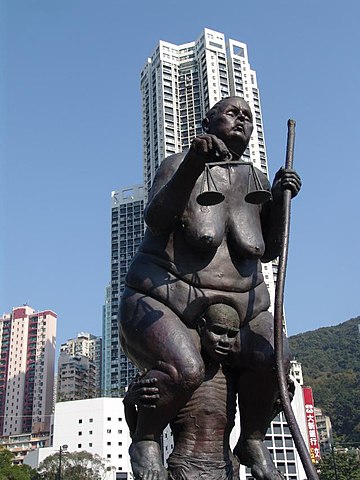
[B] "Survival of the Fattest", by Jens Galschiøt, and Lars Calmar. This file is licensed under the Creative Commons Attribution-Share Alike 3.0 Unported license. My usage of the file does not suggest their author endorses me or my use of it. Source: Wikipedia.

Sunday, 29 March 2015

A Short View of "A Short View". (iii)

(From part ii)

How could worldviews commonly regarded as antagonistic, as those represented by Keynes and Mises/Rand, coincide in such a fundamental manner?

Lord Skidelsky, Keynes’ respected biographer, offers a measured and carefully worded indirect answer:
"There was clearly a tension between its [Bloomsbury Set’s] cultural ideals and democratic sentiment: civilisation, as Clive Bell put it, always rested on having someone to do the dirty work. Maynard Keynes, as we shall see, attempted to go beyond this contradiction; but it cannot be claimed he got very far. And he, like the rest of the Bloomsberries, depended completely on domestic servants to sustain their own lives [cf. Peter Clarke’s comments in Liberals and Social Democrats]. Bloomsbury was rooted in the class assumptions of the Victorians. Their revision of the Victorian scheme of life tended to take them back to the eighteenth century idea of a cultured aristocracy rather than towards the ideal of a civilized democracy". (“John Maynard Keynes: Hopes Betrayed 1883-1920”, pp. 248-250)
Whatever later commentators might argue, the Bloomsberries’ beliefs and ideals, writes Skidelsky, were not the product of dispassionate philosophizing: they were rooted in their social context. What holds true to them and Keynes, also holds true to Nietzsche, Mises, Rand.

Ironically, one of the real, but unmentioned, targets of Keynes’ ideological tantrum would probably have agreed with Skidelsky: Keynes must be judged within his social, economic, and historic context.

Karl Marx:
"I paint the capitalist and the landlord in no sense coleur de rose.  My standing point, from which the evolution of the economic formation of society is viewed as a process of natural history, can less than any other make the individual responsible for relations whose creature he socially remains, however much he may subjectively raise himself above them". (“Das Kapital”, vol. 1, preface to the 1867 edition).
Keynes wasn’t creating anything new in moral and political philosophy, just giving expression to his class’ pre-existing views of society and of his fellow human beings: the same views Nietzsche articulated before, and Rand and Mises would echo decades later.

----------

By 1925, in the middle of the Roaring Twenties (perhaps the last hurrah of the Belle Epoque), the class views Keynes reflected, while cheerful, were not untroubled. The previous year, Calvin Coolidge was elected U.S. President. His campaign slogan describes the times: "Coolidge Prosperity".

Across the pond, Keynes -- perhaps with more than a little bravado -- puzzled over the appeal of “Leninism”: “It is hard for an educated, decent, intelligent son of Western Europe to find his ideals here, unless he has first suffered some strange and horrid process of conversion which has changed all his values”.

The income figures Thomas Piketty and others compiled shed some light on Keynes’ optimism and puzzlement with any discontent:

(source)

In other words (by interpolation between 1919 and 1937), in 1925 a member of the British 1% perceived a gross income (in Piketty’s definition) equivalent to about 25.0 times the average for the remainder 99%: a remarkable difference. Keynes -- the self-described "educated, decent, intelligent son of Western Europe" and financial speculator -- had little reason to feel uncomfortable and one cannot blame him for fearing that could come to an end.

Upton Sinclair, an American journalist and another eye-witness of the last days of the Belle Epoque, could have added: "It is difficult to get a man to understand something, when his salary depends upon his not understanding it."

It's on this light that Keynes' oft-quoted appeal to the “ideas of economists and political philosophers” reveals itself in all its self-justifying glory:
I am sure the power of vested interests is vastly exaggerated compared with the gradual encroachment of ideas Soon or late it is ideas, not vested interests, which are dangerous for good or evil."
Another English economist -- one much closer to Keynes -- would have disagreed with Keynes on that and, instead, would have proposed the primacy of vested interests and prejudices in determining economic wisdom:
"Anyone who says to you: 'Believe me, I have no prejudices,' is either succeeding in deceiving himself or trying to deceive you." (Joan Robinson, "Economic Philosophy", p. 26)
There is little difference between Keynes' "pratical men, who believe themselves to be quite exempt from any intellectual influences, are usually the slaves of some defunct economist" and "the Devil made me do it".

You don't need a Ouija board to understand how Keynes, Mises, Nietzsche and others could coincide at a fundamental level; a materialist conception of history is more than enough.

 (To be continued)

Thursday, 26 March 2015

A Short View of "A Short View". (ii)

(From Part i)

Why Keynes -- reputedly one of 20th century's greatest economic minds -- did not provide any economic figure, any fact, or analysis, in support of his allegations, and, instead, was happy to pen a piece of bullying, worthy of a Jeremy Clarkson?

A careful reading of the essay suggests an answer: unlike Clarkson, Keynes had no reason to fear a backlash.

Expressing himself for public consumption, the appearances-conscious Keynes wasn’t entirely forthcoming on the causes of his evident displeasure, but there was a deep personal grievance behind Keynes’ essay, a grievance he shared with members of the Western bourgeoisie.

Understandably so: an intellectual and patron of the arts, a prominent eugenicist (Keynes would serve from 1937 to 1944 as head of the Eugenics Society), and aspiring member of the British bourgeoisie, the future 1st Baron Keynes (made hereditary peer in 1942) could not have enjoyed what he witnessed in “Russia”.

Judging by his own words, repeated 3 times for emphasis, this is what irked Lord Keynes the most:
  1. How can I adopt a creed which, preferring the mud to the fish, exalts the boorish proletariat above the bourgeois and the intelligentsia who, with whatever faults, are the quality in life and surely carry the seeds of all human advancement?
  2. In one respect Communism but follows other famous religions. It exalts the common man and makes him everything.
  3. The exaltation of the common man is a dogma which has caught the multitude before now. Any religion and the bond which unites co-religionists have power against the egotistic atomism of the irreligious.
Speaking in the first person, Keynes declares the deepest cause of his outrage: “Leninism” exalts the “mud, the “boorish proletariat”, the “common man” (synonymous, for Keynes). Not him. Keynes -- and presumably his peers -- the “fish”, the member of the “intelligentsia” and aspiring “bourgeois” (“the quality in life and surely carry the seeds of all human advancement”) is no longer the navel of the universe. The rabble daring to challenge the Olympian men (in Nietzsche's admiring description).

That was his deep, personal grievance: the loss of social standing and control.

He wasn't the first to fear the day of reckoning. Before the Russian Revolution, others felt the same; the economist Knut Wicksell (who influenced Keynes personally), among them. How could Keynes, seeing the beast up close, have felt differently? 

----------

Over 30 years later, a member of the now extinct petty provincial aristocracy from Central Europe would write this praise:
“You have the courage to tell the masses what no politician told them: you are inferior and all the improvements in your condition which you simply take for granted you owe to the effort of men who are better than you.”
Those words, echoing Keynes, could have been addressed to him … but they weren't.

The starry-eyed fan behind them was not one of Keynes’ devotees; in fact, he radically disagreed with him on economic doctrine (e.g. “What he really did was to write an apology for the prevailing policies of governments”).

Baron Keynes ("I do not mean that Russian Communism alters, or even seeks to alter, human nature, that it makes Jews less avaricious or Russians less extravagant") did not live to witness the unintended  (?) snub, but in those lines Ludwig Heinrich, Edler (Baronet) von Mises was complimenting  Russian-born Alisa Zinov'yevna Rosenbaum -- Ayn Rand -- on the publication of “Atlas Shrugged”.

Both Mises and Rand, like Keynes himself, were unconditional in their support for "the bourgeois and the intelligentsia who, with whatever faults, are the quality in life and surely carry the seeds of all human advancement"; both of them, non-religious Jews.

(To be continued)

Friday, 20 March 2015

“Blade Runner”.


Together with “2001: A Space Odyssey”, but in a different way, Ridley Scott’s 1982 “Blade Runner” (based on the 1968 novel “Do Androids Dream of Electric Sheep?” by Philip K. Dick), starring Harrison Ford, Rutger Hauer and Sean Young, is another of my all-time favourite sci-fi movies.

Without giving away too much on its plot, in my opinion, the film combines deeply human reflections about the inevitability of death and about what the human condition entails, with clearly political elements of Nietzschean thought: the slave/master, Übermensch/Untermensch contrast.

This scene, however, gives an unexpected twist to everything Nietzschean in the film:


After acknowledging the distinction Übermensch/Untermensch, Scott seems to ask his viewers “who’s who”? It's clear who is the Übermensch and who is the Untermensch, but who is the master and who, the slave?

----------

From Vangelis’ superb soundtrack, “Blade Runner” end titles:


I imagine the world’s most reviled, slandered man, born in Trier, would have smiled. 

Saturday, 27 September 2014

The Marx of the Master Class.


"It would be well for those interested to reflect whether there now exists, or ever has existed, a wealthy and civilized community in which one portion did not live on the labor of another; and whether the form in which slavery exists in the South is not but one modification of this universal condition… Let those who are interested remember that labor is the only source of wealth, and how small a portion of it, in all old and civilized countries, even the best governed, is left to those by whose labor wealth is created." (John C. Calhoun, here)

Reading outside your usual area of interest is often a loss of time. Sometimes, however, it can be extremely rewarding. That was the case with Richard Hofstadter's 1948 biographical essay on John C. Calhoun (1782 - 1850) -- whose title opens this post.

----------

A wealthy South Carolina slave-holding planter by birth, and a lawyer by training, Calhoun got involved with politics early, eventually holding major political offices, including the seventh Vice Presidency of the U.S.

John C. Calhoun, 1849. [A]
Given his personal background, young Calhoun gravitated quite naturally to the Democratic Party (at the time committed to a Jeffersonian concept of agrarian society, popular in the South), although initially sharing ground with their opposition, the Whig Party (classical liberalism and protectionism, more palatable to Northern tastes). Against what was common among other planters, Calhoun started as a nationalist, favoring a strong federal government and import tariffs (both unpopular in the South).

From 1830 on, and reflecting the increasingly divergent interests of slaveholding South and capitalist North, Calhoun distanced himself from his nationalist, federalist and protectionist past and fully embraced the Southern planters' cause. Although interesting in itself, neither Calhoun the statesman, nor the somewhat surprisingly dedicated family man, are the focus of this post and perhaps his daguerreotype provides the more suggestive and vivid description of the statesman.

----------

As his initial sympathy for the North waned, Calhoun the thinker grew increasingly critical of the capitalistic North. This was not an exclusively American phenomenon. Across the Atlantic, Thomas Carlyle (1795 - 1881) is another example of reaction against the ascendant bourgeoisie.

Several things, however, distinguished Calhoun's thought from that of other anti-capitalist reactionaries. Carlyle argued for the English landed aristocracy's moral superiority (exposing himself to accusations of hypocrisy and racism). Calhoun did not follow that route.

Defiantly admitting the exploitative character of the Southern agrarian society, Calhoun observed that the capitalistic North was every bit as exploitative. However, by pretending otherwise -- as liberals/Whigs are wont to do -- in addition to being exploitative, capitalist society was also self-deceiving, hypocritical, and cowardly.

On February 4, 1836, then senator Calhoun (MA) delivered a report entitled "Incendiary Publications", before the U.S. Senate. In that report (a fragment of which opens this post), Calhoun, in ruthlessly lucid terms -- that would sound familiar to whoever read The Communist Manifesto -- approaches the phenomenon of exploitation, manifested throughout history.

Compare Calhoun's writing to the opening lines from the Manifesto:
"The history of all hitherto existing society is the history of class struggles.
"Freeman and slave, patrician and plebeian, lord and serf, guild-master and journeyman, in a word, oppressor and oppressed, stood in constant opposition to one another, carried on an uninterrupted, now hidden, now open fight, a fight that each time ended, either in a revolutionary reconstitution of society at large, or in the common ruin of the contending classes". (See here)
Slavery in the South -- Calhoun understood -- is but one instance of this universal condition, necessary for the existence of any wealthy and civilized community: one portion of the community lives on the labour of another. It is this stolen ease that allows civilization's great achievements (a subject that Nietzsche would retake decades later).

That wasn't the only opportunity Calhoun broached that subject either, nor was him the only commentator arguing along those lines: James H. Hammond and the depraved George Fitzhugh in some ways went further than him, proposing the extension of slavery to white Americans.

----------

But there are more differences. While Carlyle's ideal society was one dominated by the landed aristocracy, Calhoun recognized that the ground gained by the American bourgeoisie could not be regained. Foreshadowing Nietzsche, Calhoun envisaged an openly anti-democratic "final solution" to the unrest by slaves/abolitionists and workers/socialists (Nietzsche's "rabble"): a mutually beneficial alliance of Southern planters and Northern industrialists.

Hofstadter put it thus:
"Calhoun had an ingenious solution for the sectional problem [i.e. North vs South antagonism]: in return for the South's services as a balance wheel against labor agitation, the solid elements in the North should join her in a common front against all agitation of the slavery issue." 

While Calhoun may have never used the term, he understood as well as Marx and Engels did that "the history of all hitherto existing society is the history of class struggles". His fear was that by struggling among themselves, capitalists and slave-owners were playing into the hands of workers and slaves.

----------

Calhoun died in 1850. To some extent, his nightmarish vision for America died in 1861, with the start of the American Civil War.

----------

While Calhoun ultimately failed as a statesman -- and I, for one, am grateful for that -- the task he imposed himself was too ambitious: no man could have stopped the decline of the slaveholding and agrarian Southern ersatz aristocracy, nor -- paraphrasing the Manifesto -- American society from "more and more splitting up into two great hostile camps, into two great classes directly facing each other -- bourgeoisie and proletariat".

However, one must credit Calhoun with uncanny prescience, as Hofstadter did:
"Calhoun's analysis of American political tensions certainly ranks among the most impressive intellectual achievements of American statesmen. Far in advance of the event, he forecast an alliance between Northern conservatives and Southern reactionaries, which has become one of the most formidable aspects of American politics. The South, its caste system essentially intact, has proved to be for an entire century [remember: this essay was published in 1948!] more resistant to change than the North, its influence steadily exerted to retard serious reform and to curb the power of Northern labor."
For his perspicacity -- if definitely not his intentions -- Calhoun earned the title of "Marx of the Master Class" Hofstadter gave him.

What a contrast with the mediocrity so common among our pathetic, so-called "progressive", "liberal" intellectuals and their discount "idealism".

Hofstadter's essay "John C. Calhoun: The Marx of the Master Class" is a must-read.


Image Credits:
[A] John C Calhoun, 1849, by Mathew Brady. Image in the public domain due to age. Source: Wikipedia.

Wednesday, 10 September 2014

The Problem of Nietzsche.


"By birth, Socrates belonged to the lowest class: Socrates was rabble[*]. We are told, and can see in sculptures of him, how ugly he was. But ugliness, in itself an objection, is among the Greeks almost a refutation. Was Socrates a Greek at all? Ugliness is often enough the expression of a development that has been crossed, thwarted in some way. Or it appears as declining development. The anthropological criminologists tell us that the typical criminal is ugly: monstrum in fronte, monstrum in animo [monstrous in appearance, monstrous in spirit]. But the criminal is a decadent. Was Socrates a typical criminal? At least that would be consistent with the famous judgment of the physiognomist that so offended the friends of Socrates. This foreigner told Socrates to his face that he was a monstrum - that he harbored in himself all the worst vices and appetites. And Socrates merely answered: 'You know me, sir!'
"Socrates' decadence is suggested not only by the admitted wantonness and anarchy of his instincts, but also by the overdevelopment of his logical ability and his characteristic thwarted sarcasm. Nor should we forget those auditory hallucinations which, as 'the daimonion of Socrates,' have been given a religious interpretation. Everything about Socrates is exaggerated, buffo, a caricature; everything is at the same time concealed, ulterior, underground."
(Emphasis added. see here)
The author of that extraordinarily vile invective against Socrates became influential during the twentieth century, after a lifetime of obscurity and mediocrity: Friedrich Nietzsche.

What did Socrates, largely a mythical figure, do to deserve that outburst? "What really happened there"?

Credited by Plato, his disciple, with being the first true philosopher, little is known with any certainty about Socrates. Rightly or not, he emerges from Plato's writings as a rationalist, whose dialectical method was based on logical argument.

One could interpret Nietzsche's venom and slander as the words of a depraved Don Quixote, tilting at windmills, and leave things at that.

My reading, however, is different. Nietzsche's bile, directed against his view of Socrates, the man, should be interpreted as a hateful tirade against what Socrates came to represent:
"With Socrates, Greek taste changes in favor of logical argument. What really happened there? Above all, a noble taste is vanquished; with dialectics the plebs come to the top. Before Socrates, argumentative conversation was repudiated in good society: it was considered bad manners, compromising. The young were warned against it. Furthermore, any presentation of one's motives was distrusted. Honest things, like honest men, do not have to explain themselves so openly. What must first be proved is worth little. Wherever authority still forms part of good bearing, where one does not give reasons but commands, the logician is a kind of buffoon: one laughs at him, one does not take him seriously. Socrates was the buffoon who got himself taken seriously: what really happened there?" (Emphasis added)
In Nietzsche's mind, Socrates morphs from risible "buffoon" into a fearsome threat, because by adopting reason and dialogue, embodied by Socrates, the true Greeks of "noble taste" and "good bearing", the "good society", allegedly forfeited their "authority", their "command": "the plebs come to the top".

Recognizing implicitly the weakness of his position, Nietzsche gives up on rational reasoning, and, instead, appeals to an hominem argument (nominally against the man, but by association, against the ideas of the Enlightenment); in so doing expresses without masks the fear that others also expressed in barely disguised form (Corey Robin called that "elective affinity").

And, to Nietzsche's horror, since the Enlightenment, reason and democracy were predicated as the way of the future for Europe and the world.

Indeed, a spectre was haunting Europe.

----------

Nietzsche's fears about reason were as premature and unjustified as his attack is full of ironies: democratic dialogue between reasonable and polite gentlemen does not lead to social change.

That, however, does not stop Nietzsche from fearing the mere possibility. This makes of him a rightful enemy of democracy and a prophet of fascism, in addition to being a Post-Modern precursor. Is in this sense that Nietzsche deserves to be read and where he does provide insight.

----------

Ironically, the man who distrusted science and reason, appealed to Cesare Lombroso (the father of the "science" of anthropological criminology) to justify his tirade.

After mercilessly mocking Socrates' alleged ugliness, Nietzsche ended up looking like this:

Portrait of Friedrich Nietzsche by Hans Olde (1899/1900) [A]

And after throwing stones on Socrates' reason roof, fearing reason all his life, only at the end Nietzsche fully embraced unreason [#]:
"To his friend Meta von Salis he [i.e. Nietzsche] wrote:
" 'God is on the earth. Don't you see how all the heavens are rejoicing? I have just seized possession of my kingdom, I've thrown the Pope in prison, and I'm having Wilhelm, Bismarck, and [anti-Semitic politician Adolf] Stocker shot.'
"To his closest friend, theologian Franz Overbeck, Nietzsche wrote:
" 'The world will be turned on its head for the next few years: since the old God has abdicated, I will be ruling the world from now on'."
There is poetic justice in that.

Notes:
[*] The original in German reads "Sokrates gehörte, seiner Herkunft nach, zum niedersten Volk: Sokrates war Pöbel". The noun "Pöbel" translates as "rabble" and it is this word I use, instead of the softer adjective "plebeian", which Walter Kaufmann and R.J. Hollingdale used. While etymologically connected to plebe, Pöbel carries in German a stronger negative connotation than the English plebe.
[#] Quoted from Sax, Leonard. What was the cause of Nietzsche’s dementia?
Journal of Medical Biography 2003; 11: 47–54.

Image Credits:
[A] "Portrait of Friedrich Nietzsche by Hans Olde (1899/1900)". This image is in the public domain because its copyright has expired. Source: Wikipedia.

Saturday, 23 August 2014

Nietzsche at Nuremberg.


Thursday, 17 January 1946.

Morning Session

The President: "I call upon the Counsel for France".

[A]

M. François de Menthon (Chief Prosecutor for the French Republic):
"Over a people in this state of spiritual crisis and of negations of traditional values the culminating philosophy of Nietzsche was to exercise a dominant influence. In taking the will to power as a point of departure, Nietzsche preached, certainly not inhumanity but superhumanity. If there is no final cause in the universe, man, whose body is matter which is at once feeling and thinking, may mould the world to his desire, choosing as his guide a militant biology. If the supreme end of humanity is a feeling of victorious fullness which is both material and spiritual, all that remains is to insure the selection of physical specimens, who become the new aristocracy of masters.
"For Nietzsche the industrial revolution necessarily entails the rule of the masses, the automatism and the shaping of the working multitudes. The state endures only by virtue of an elite of vigorous personalities who, by the methods so admirably defined by Machiavelli, which alone are in accord with the laws of life, will lead men by force and by ruse simultaneously, for men are and remain wicked and perverse.
"We see the modem barbarian arise. Superior by his intelligence and his wilful energy, freed of all conventional ethics, he can enforce upon the masses obedience and loyalty by making them believe in the dignity and beauty of labor and by providing them with that mediocre well-being with which they are so easily content. An identical force will, therefore, be manifest in the leaders, by the harmony between their elementary passions and the lucidity of their organizing reason, and in the masses, whose dark or violent instincts will be balanced by a reasoned activity imposed with implacable discipline.
"Without doubt, the late philosophy of Nietzsche cannot be identified with the brutal simplicity of National Socialism. Nevertheless, National Socialism was wont to glorify Nietzsche as one of its ancestors. And justly so, for he was the first to formulate in a coherent manner criticism of the traditional values of humanism; and also, because his conception of the government of the masses by masters knowing no restraint is a preview of the Nazi regime. Besides, Nietzsche believed in the sovereign race and attributed primacy to Germany, whom he considered endowed with a youthful soul and unquenchable resources."
(see here)
----------

After the previous tragicomic interpretation of Nietzsche and his moral philosophy, the words of the French Chief Prosecutor at Nuremberg add a rather sinister dimension to the man and his political philosophy.

And, yet, Nietzsche (and his political philosophy) is the man some (like this young, up-and-coming Post Keynesian) want to propose as your inspiration, instead of Karl Marx.

Now, choose.

Don't worry if you have a family. It's not me you'll have to answer to, if you chose the wrong guy.


Image Credits:
[A] Nuremberg Trials: some of "he accused on their bench (front left to right: Wilhelm Frick, Julius Streicher, Walther Funk; back left to right: Franz v. Papen, Arthur Seyß-Inquart, Albert Speer, Konstantin v. Neurath)". The image is in the public domain. Source: Wikipedia.

Monday, 11 August 2014

Nietzsche, the Übermensch?


Or, The Birth of Tragicomedy.

In life, Friedrich Wilhelm Nietzsche (1844-1900) was, or tried to be, many things. Intellectually influential, however, he was not, as the following Google Ngram chart suggests:

(Right-click to open in a separate tab)

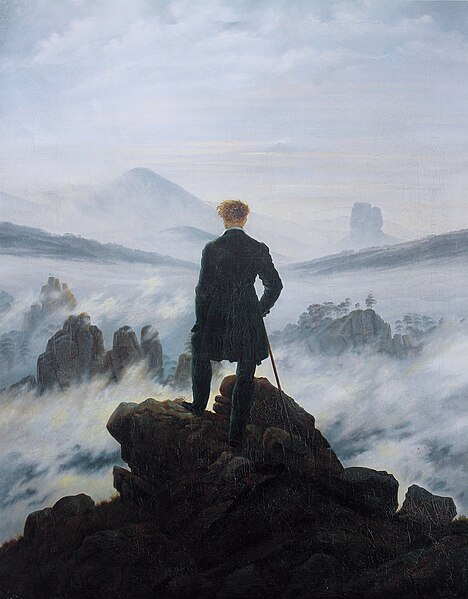
Born well into the Romantic period, Nietzsche in many ways embodies, with diverse degree of success, notions associated with that movement: the man struggling alone against frightful difficulties, against society itself and its norms, to bend the world to his will: the Übermensch (Superman).

Nietzsche's goal in life:
"I teach you the overman [i.e. Übermensch, literal translation; superman]. Man is something that shall be overcome. What have you done to overcome him?" (link)
"Wanderer Above the Sea of Fog" [A]

It was in death (first intellectual and, then, physical) that Nietzsche became influential. There is little more romantic than that.

----------

During most of his childhood, after his father and little brother's deaths, Nietzsche was the only male in a not very affluent Prussian household, dominated by strong female authority figures (including his mother and domineering sister, Elisabeth -- two years younger -- grandmother and two unmarried aunts).

Never much of a "farfallone amoroso" (oblivious to his shyness, moody disposition, and chronic financial insolvency, Nietzsche apparently attributed his lack of success with the ladies to his appearance alone), Nietzsche twice turned to the military in pursuit of fulfilment ("Cherubino, alla vittoria! Alla gloria militar!"), in spite of his poor eyesight and health.


The first time (1867), as a trainee artillery officer, a horse-riding accident left him disabled. A few years later, during the Franco-Prussian War (1870-1871), fully recovered from his injuries, he volunteered for duty but, after a short stint, was sent home in defeat, not by French bullets or bayonets, but by diarrhoea and diphtheria.

After that experience, Nietzsche settled for academic life. However, unhappy with the professorship his teacher, Friedrich Wilhelm Ritschl, got for him at the University of Basel, in 1878 Nietzsche resigned, to become a gardener. A few weeks later, he quit his new career; his weak back taught him the seemingly unimagined: gardening involves not only fresh air and the magnificent Alpine outdoors; it involves back-breaking work.

Then, he attempted a writing career, but his books wouldn't sell, leaving him always short of cash.

----------

On January 1889, Nietzsche's writing career came to an end, after suffering an irreversible mental breakdown. A final indignity awaited for him: his care fell upon Elisabeth (for whom Nietzsche had mixed feelings), until his death in 1900.

Those proved to be Nietzsche's luckiest career moves, as the Google Ngram chart also suggests. Elisabeth would become his best literary agent: immortality finally was at hand.

----------

As is often the case with philosophers, Nietzsche's work is subject of interpretation. For Alain de Botton [*] a generous interpreter (from whom I draw heavily), Nietzsche is a moral philosopher and tragic romantic hero whose own life illustrates his philosophy of struggle in the face of overwhelming adversity:
"Like his father, he [i.e. Nietzsche] had wished to offer us paths to fulfilment. But unlike pastors … he had judged difficulties to be a crucial prerequisite of fulfilment, and hence knew saccharine consolations to be ultimately more cruel than helpful." [page 243]
While that interpretation allows us to salvage something valuable from his life, Nietzsche himself conspires against it, for his own inadequacies (among them, lack of empathy, and egotism) and lack of self-awareness. More a tragicomedy than a drama.

Notes:
[*] De Botton, Alain. 2000. "The Consolations of Philosophy". Sydney: Penguin Books Australia.


Image Credits:
[A] "Wanderer Above the Sea of Fog", 1818, by Caspar David Friedrich. This is a faithful photographic reproduction of a two-dimensional, public domain work of art. The work of art itself is in the public domain. Wikipedia

Update:
(17-08-2014) Added the short paragraph on Nietzsche's luckiest career move.

Tuesday, 24 June 2014

Pilkington, Hegel and Rumba: The Quote.

"I can't call what David Harvey does pointless intellectual masturbation because what David Harvey does, does not feel good at all". (J. Bradford DeLong)

Economist, philosopher, journalist, op-ed writer, hedge-fund manager, think-tanker, and Pope, movie star, quantum physicist, hipster, statistician, rock god, Nietzschean Übermensch and _____________ (you fill in the blank) Philip Pilkington found the definitive reason why Marxism totally sucks and is out, all guns blazing, to set things straight:
"I'm going to here quickly lay out why the LTV requires Marx's materialist dialectic to function philosophically. In order to understand this we must first understand how 'value' functions in Hegel."
Like, wow. After that readers would perhaps have expected with trepidation a lesson, profusely supported on Hegel quotes, about how value really, really functions. Shock and awe stuff. Makes sense, yes?

You would have been mistaken. Philip's ways, like the Lord's, are mysterious: he quotes from Post-Modern historian Michael S. Roth, who explains French Hegelian Alexandre Kojève's ideas about what Hegel really, really meant. If you try it slowly you'll get the idea. Otherwise, try this diagram:

(source)

Readers may be asking now, why so convoluted? No idea. Ask Philip.

But here comes the best part: The Quote! I took a screen capture, so you dear readers won't accuse me of lying. Without further ado, in all its PoMo glory, I give you, The Quote:

(right click to open in a separate tab for a larger image)

So, "human desire is the desire…", tautology, anyone? "… for recognition (reconnaissance), which, according to Kojeve's Hegel, alone can lead to self-consciousness". Yadda yadda. "Desire, Kojeve says (following Hegel) is the presence of an absence". Evidently, right? It couldn't be the absence of a presence… Or just the opposite, or… something.

After half an hour struggling (Ah! Prof. DeLong, how I appreciate your wise words now!) I gave up and attempted to move on, just to stumble upon this:
"I highlight the above examples not because they are particularly important with regards to Roth's excellent analysis but because they serve as a simple departure to discuss a properly dialectical analysis of value as against a crude Marxist so-called "dialectical materialist" analysis" (emphasis mine).
Simple?! Not particularly important?!

A little digression: do you, dear readers, remember the episode where the Simpsons travel to Japan? At one stage, Homer yells in frustration "modafuka mi", which, although it may sound like cursing, it is not -- the subtitles helpfully instruct us, is Japanese for "D'Oh!"

Well, that was my exact reaction. I too exclaimed "D'Oh!" in Japanese, even though I can't speak that language.

After that philosophical preamble and paraphrasing DeLong, Philip finally came to the "suggestion of a shadow of an argument":
"As we can see, for Kojève and Hegel value is attributed to objects due to our desire for them. This desire, in turn, is inter-subjective …
"This is similar … to that posited by … Thorstein Veblen … It is also similar to James Duesenberry
"It is, in its very structure, interdependent; that is why, for example, people are more inclined to buy Nike runners when they see Michael Jordon
[sic] wearing them".
Now comes the tricky bit. I suppose I should start my counter-argument, but… what kind of argument to choose? Something abstract wouldn't work any better here than it did in the comments thread to that post (more on this below).

So let me try, instead, a more concrete approach. Take something as unglamorous as toilet rolls: do people buy toilet rolls for the (A) "symbolic positions they [i.e. the toilet rolls, not the people, I think] occupy in the inter-subjective network of desires" or (B) because people just want to buy it after learning how Philip swipes his ass after taking a dump (which is the creative result of the "satisfaction of a human desire": to eat)?, or (C), well, people need to swipe their own asses?

The Michael Jordan's sneakers thing Pilkington periodically resurrects apply only to a limited set of goods. At the risk of stating the bleeding obvious: it couldn't be otherwise! Not all final goods, or even consumption goods, can be luxury goods.  It doesn't apply to toilet rolls. What about intermediate goods? How do you price them?

But then, don't firms buy stuff? Say, does Nippon Steel & Sumitomo Metal buy iron ore because it "will win recognition in the eyes of our [i.e. their] peers"?

But Pilkington proposes his "Nike-Jordan theory of value" as a general theory of prices, in place of Marx's theory of value and of the marginalist theory of value. Veblen himself never meant his ideas as a general theory of value: how on earth would he explain prices? This was evident to Veblen, is evident to me and I bet is evident to the readers (well, maybe not to Will and "Felipe"), but, boy, is evidently news to Pilkington.

Moreover, why do employers pay their workers? Because they desire (as in The Quote) their staff and want "the loved ones to return the love"? That's called sexual harassment.

To make a long story shortish, after that pseudo-intellectual farce ended, a fairly abstract discussion between commenter Hedlund and Pilkington ensued. That's probably the most entertaining part of the post, but I won't chronicle it: check it by yourselves. The discussion soon became heated (almost unilaterally, I should add, with Hedlund mostly on the receiving end) and finally, Hedlund gave up, leaving Pilkington the final word:
"Insults and rudeness are not equivalent to Unhappy Consciousness and ressentiment. I might be an asshole; but at least I'm an epistemologically correct asshole. And I'll take that over being a cult follower and a shabby philosopher any day."
I disagree on his alleged epistemological correctness, but that won't surprise you, dear readers. What might surprise you is that I actually agree with Pilkington on something fundamental: he is a rude asshole.

He's also many other things, including an imbecile and a wanker, but you fill in the blanks, _____________

----------

Being totally serious now: this creature gives Post Keynesian economics a bad name, and that's something Post Keynesian economists cannot afford. You guys look the other way when he goes bananas with Marxists and mainstreamers, perhaps thinking that so long as he leaves you alone, things don't matter. But they do: he claims to be one of you and this is what people perceive.

Mark my words: you've been warned.

Tuesday, 20 August 2013

John Aziz on Subjectivism: Das Mudpie!

John Aziz (associate editor, Pieria: profile) on the subjective theory of value (STV) and why it, in his estimation, is "the greatest idea in the history of economics". (Like... wow!)

Aziz:
"This [i.e. individually differentiated needs] leads to variations in price - different people are prepared to pay different prices for the same good or service based on their own need or want for it. While open markets and free exchange give a level of order to this process - quote prices, and moving averages - ultimately markets are moved by individuals' subjective valuation process, and the negotiation process." (See here)
So, in Aziz's estimation, two main things determine prices: individuals' subjective valuations, mediated by markets.

Having established his initial position, Aziz proceeds then to compare the STV to its theoretical rival: "The subjective theory of value's chief rival - the labour theory of value [i.e. LTV] advocated by David Ricardo, Adam Smith and Karl Marx - is deeply problematic".

And what are those deep problems? "The great trouble with this is the notion of a real (or fundamental, or intrinsic) price. Prices are just functions of market participants' decisions."

That is, for Azziz, the LTV is "deeply problematic" because in it prices are not determined by individuals' subjective valuation, mediated by markets, as in the STV.

In other words the LTV is deeply problematic because it is not the STV. Case closed. Aziz advances no other reason. For instance, doesn't claim the STV to be more empirically accurate.

So, one could be tempted to ask why the rather obvious fact that the LTV is not the STV is such a troublesome thing?

The only reason Aziz hints at is this: in Aziz's estimation "the subjective theory of value is the greatest idea in the history of economics"! Starting with the premise, the conclusion is the premise itself: the cycle is complete! No more reason is required.


Aziz's personal estimation is the rule to decide whether something is problematic or not. Take that, Ricardo, Smith and Marx!

----------

While I myself find the invention of sliced bread a greater thing than the subjective theory of value, even among rabid anti-LTV people, particularly among some PKers, the notion that "individuals' subjective valuation, mediated by markets" determine prices is considered bogus.

----------

I'll be honest: I have nothing personal against John (somehow, at this moment, to address him by his first name sounds friendlier, and I am trying to be nice: you hear me, Chris?); and I have no wish to antagonize yet another young, up-and-coming, philosophically-minded writer, interested-in-economics, UK blogger, so, I'll leave things at that.

In particular I will not comment on his (to me, already strangely familiar) rather vague reference to Nietzsche and Kierkegaard. Moreover, I will not comment on the "counter examples" he proposed (particularly the extremely unfortunate Mudpie one), even at the risk of disappointing the good folks of Kapitalism101!

Wednesday, 15 May 2013

The Pilkington Critique.

Prof. Corey Robin (from Brooklyn College/City University of New York, a Crooked Timber collaborator and blogger) has long maintained that the thoughts of the two Friedrichs (Hayek and Nietzsche) are linked.

In his latest essay (and companion introductory piece) Robin goes one step further: there are striking similarities, he argues, between the marginalist (also known as neoclassical) and Nietzschean theories of value. Among other similarities that Robin outlines, both theories are strictly subjective and both lead to highly hierarchical views of society.

Personally, I find his reasoning compelling, intriguing and full of important implications; but not being acquainted with Nietzsche's thought, I can't say whether Robin made his case beyond any possible objection. I'd recommend interested readers to read Robin's essay (warning: it's long, and it would be better to read the introductory post first).

Predictably, the essay generated a number of rather critical responses from the "conservative, centre right, libertarian" blogosphere. (See here, here and here, h/t Mike Norman Economics)

Much more surprisingly, perhaps, it also generated a critique from the "progressive" side of the spectrum.

Philip Pilkington ("a writer and research assistant at Kingston University in London" and frequent contributor of Naked Capitalism), after a brief acknowledgement of Robin's work (to the extreme of awarding Robin an interview!), goes on to say:
"His latest piece is grossly misguided and reflective of the fact that, when it comes to theoretical economics, academic critics on the left simply do not know their enemy [Austrian and neoclassical economics] at all".
However harsh these words might sound, those who have followed Pilkington's output will recognize that he is often much less nuanced. So, that's the first surprise.

Pilkington then sums up his case:
  1. "Robin does not quite grasp the essence of either modern neoclassical or Austrian economics"; and
  2. Against Robin's thesis of a commonality between marginalist (particularly Hayekian) and Nietzschean doctrines, Pilkington asserts that "it is Nietzsche's critique of all theories of value and, by implication, all systems of morality that lay the ground for the most effective critique of the marginalist toxin".
Whatever the explicit reasons Pilkington alludes, one, however, is left with the suspicion that what "lies [sic] somewhere in the background" of Pilkington's critique is the use Robin makes of Marxist terminology:
"It would also appear that, lying in the background somewhere, Robin assumes that the only antidote to the scourge of marginalism is the dusty old labour theory of value - as problematic and discredited as it is. This is something of a guess on my part but if I'm correct it is but another indication that the left are fighting battles that have long since been thoroughly and completely lost".

----------

To substantiate his claims, Pilkington first undertakes to show how Robin misread Nietzsche.

Robin quoted the following passage from Nietzsche ("The Gay Science", 1882), as evidence that the German philosopher's thought parallels marginalism:
"Whatever has value in our world now does not have value in itself, according to its nature-nature is always value-less, but has been given value at some time, as a present - and it was we who gave and bestowed it".
Robin goes on to compare Nietzsche's quote with an older quote from Menger:
"That was in 1882. Just a decade earlier, Menger had written: 'Value is therefore nothing inherent in goods, no property of them, but merely the importance that we first attribute to the satisfaction of our needs, that is, to our lives and well-being'."
As Robin indicated, one can find matching quotes from the other first-generation marginalists:
"Repeated reflection and inquiry have led me to the somewhat novel opinion, that value depends entirely upon utility. Prevailing opinions make labour rather than utility the origin of value; and there are even those who distinctly assert that labour is the cause of value." (W.S. Jevons, 1871. "The Theory of Political Economy", chapter 1, Introduction)
At the risk of being repetitive: Jevons and Menger's works, both marginalist, predate Nietzsche's "The Gay Science" by some ten years.

Referring to Nietzsche's quote, Pilkington, who claims a deeper, superior understanding of the problem, says:
"In this passage [Nietzsche's] Robin sees an anticipation of the pseudo-subjectivist marginalist theory of value - that is: the theory of marginal utility."
----------

After demonstrating his understanding of written language, Pilkington moves to show his knowledge of neoclassical economics:
"I shall not here get into too many concrete examples having provided them elsewhere before, but take the standard marginalist exercise in 'showing' that a perfectly competitive firm in a perfectly competitive market will always equate marginal revenue with marginal cost. (…)
On the one hand, it tells the student the morally purifying tale that they should make optimal use of scarce resources - this is based on the fantasy of 'utility'".
The "standard marginalist exercise" Pilkington is referring to is indeed standard: it's the problem of a firm's profit maximization.

Beyond the reproaches Pilkington makes, on which I agree, the example of a firm that equates marginal revenue (i.e. $!) with marginal costs ($!) is equating dollar measures, not utility.

Pilkington, it seems, confuses the textbook consumer's utility maximization problem with the firm's profit maximization problem. It's telling that he seems oblivious to the difference.

----------

But, for argument's sake, let's forget about all that. Let's assume Pilkington made his points: Robin misread Nietzsche, which Pilkington knows very well; furthermore, Pilkington has a vastly superior economic knowledge.

Pilkington justified the "pseudo" attached to the label "pseudo-subjective" marginalist theory of value, which he opposes, anyway. On top, there is no point in looking to the "dusty old labour theory of value" for an answer: it is discredited.

What next? How does one build a theory of value from Nietzsche's "true" subjective views:
"Nietzsche's subjectivist theories of values and morals are completely different. Indeed, they are quite the opposite. Nietzsche's theories, as those philosophers that developed them recognised well, were all about flux and change - the movement of people, their wills and their desires through time. These theories were about the mysterious forces that lay inside each individual, forces which they themselves do not properly understand, that push them to and fro, dictating their whims and desires. These forces, for Nietzsche, were above and beyond anything that could be objectively conceived in any rationalistic manner. Because these very forces determined our very ability to reason and hence our very impulse to try to determine things objectively, they could not be conceived of through the frame of objective knowledge. Such would be like an eye trying to look in upon itself".
It falls upon Pilkington to answer this question.

----------

Ultimately, it is regrettable that a writer who has gained some prominence by railing against mainstream and Austrian economics (rightly so, in my opinion, although apparently for all the wrong reasons) seems entirely unawares of how ironic this is:

"Robin assumes that the only antidote to the scourge of marginalism is the dusty old labour theory of value - as problematic and discredited as it is".
Menger, quoted by Corey Robin:

"The most momentous consequence of the theory is, I take it, that it is false, with the socialists, to impute to labor alone the entire productive return."
----------

We, the unwashed, the uneducated, the workers, cannot expect much from "progressives" like this.