Showing posts with label logic. Show all posts

Friday, 2 December 2016

Friedman as Logician (ii)


Faust's pact with Mephisto,
engraving by Julius Nisle, circa 1840. [A]

The previous post argued that Friedman's methodology allows unsound arguments.

Fine. So what?

That post provides material sufficient for an answer. As it happens, the answer turns out to be delightfully topical: unsound arguments are a Faustian bargain.

Thursday, 24 November 2016

Friedman as Logician (i)


"Few persons care to study logic, because everybody conceives himself to be proficient enough in the art of reasoning already. But I observe that this satisfaction is limited to one's own ratiocination, and does not extend to that of other men". Charles S. Peirce.
"You seem a little confused. You [sic] first statement ‘all dogs are mammals' is indeed circular". Phil Stein.

If the proposition "good reasoning is unimportant" were a human being, it would surely be an extremely unpopular and sad character: few would like to be seen in her company. In particular, economists and econo-aficionados of all stripes glory themselves in their assumed, but frequently unproven, logical thinking.

Friday, 18 November 2016

Friedman's Methodology: Maximally Questionable.


The expression below shall prove useful, even if we avoid the maths. So, be brave:

        Max p*q(K, L) – w*L – r*K
       K, L
(1)     K >= 0
        L >= 0


Firms and households/consumers are the two fundamental economic agents: microeconomics begins with their study. Expression (1) is the firm's most basic representation: it shows its profit maximisation problem in the long run and embodies a number of different assumptions (see Appendix 1, for details). Even if readers find that expression otherwise cryptic, at least the "Max" should indicate "maximisation", while p*q - w*L - r*K is profits: revenue (price times quantity) minus costs (wage bill: wages times manhours; and capital costs: percent return times capital).

Friday, 25 March 2016

Einstein on the Philosophy of Science.


Albert Einstein quoted by Prof. Don A. Howard in "Albert Einstein as a Philosopher of Science":
"In a 1936 article entitled 'Physics and Reality,' he [i.e. Einstein] explained why the physicist cannot simply defer to the philosopher but must be a philosopher himself:
'It has often been said, and certainly not without justification, that the man of science is a poor philosopher. Why then should it not be the right thing for the physicist to let the philosopher do the philosophizing? Such might indeed be the right thing to do at a time when the physicist believes he has at his disposal a rigid system of fundamental concepts and fundamental laws which are so well established that waves of doubt can’t reach them; but it cannot be right at a time when the very foundations of physics itself have become problematic as they are now. At a time like the present, when experience forces us to seek a newer and more solid foundation, the physicist cannot simply surrender to the philosopher the critical contemplation of theoretical foundations; for he himself knows best and feels more surely where the shoe pinches. In looking for a new foundation, he must try to make clear in his own mind just how far the concepts which he uses are justified, and are necessities'."

Friday, 5 February 2016

Popper and the Dark Matter Matter.


Although the ongoing public debate on string theory has captured the limelight and the public's attention (at least, the interested public's attention) leaving dark matter in the dark (pun intended), chances are my readers have heard/read about the latter.

Together with the slightly more recent dark energy (and the even more recent and highly controversial dark flow), dark energy is another hot topic in contemporary physics.

But, what is dark matter? How was it discovered? More importantly for my own purposes: how does it fit in the great Popperian scheme? The following video clip, accessible to the wider public, provides an overview as useful as it is entertaining:

Friday, 22 January 2016

A New 9th Planet for the Solar System?


Mike Brown and Konstantin Batygin (astronomers from the California Institute of Technology) announced they have conjectural evidence for the existence of a ninth planet in our solar system.


Details were published in the newsmedia, in the Caltech website ("Caltech Researchers Find Evidence of a Real Ninth Planet", by Kimm Fesenmaier, Jan. 20), and in the Science magazine website ("Astronomers say a Neptune-Sized Planet Lurks Beyond Pluto", by Eric Hand. Jan. 20).

Monday, 11 January 2016

Popper and the Coelacanth.


No, that's not Popper. That's Marjorie Courtenay-Latimer and her dino-fish. [A]

On December 23, 1938, while visiting her friend captain Hendrick Goosen, Marjorie Courtenay-Latimer (curator of the provincial natural history museum of East London -- northeast of Cape Town, South Africa) accidentally discovered, part-hidden under Goosen's daily catch, a fairly large, odd-looking fish.

Tuesday, 22 December 2015

Bridgman, Elephants, and the Judges of Science.


The name Percy Williams Bridgman (1882-1961) will hardly ring a bell among econosophers. Physicists may remember him as the 1946 Nobel Prize in Physics
"For the invention of an apparatus to produce extremely high pressures, and for the discoveries he made therewith in the field of high pressure physics".
More of an experimentalist than a theoretician, Bridgman, however, was interested in the philosophy of physics. His ideas, under the label "operationalism", when applied to other fields, met with less than spectacular results.

Many of his observations (like those below, from his 1950 book "Reflections of a Physicist"), however, seem as valid today as they were 60 years ago and their application could go beyond physics:

Sunday, 20 December 2015

Joan Robinson and the Elephant.


[A]

Joan Robinson knows one when she sees one:
"I cannot define an elephant but I know one when I see it. An ideology is much more like an elephant than like a point." (Robinson 1962:8)
"Scientific method is another kind of elephant -- something which exists and can be described, not defined." (p. 25)
----------

Monday, 7 December 2015

Cogito Ergo Sum (ii)


Let's try something different. Show that

            1       1         1
(1)       ----- - ----- < ---------
          1,000   1,001   1,000,000


Wednesday, 11 November 2015

Cogito Ergo Sum.


Two persons are credited with the quotes below. One is very well-known among economists -- amateurs and professionals, alike -- the other is better-known among philosophers and logicians.

Person A is quoted variously as saying:
"I don't need algebra, I can think."
or, in an alternative version:
"I never learned math, so I had to think."
Person B:
"Few persons care to study logic, because everybody conceives himself to be proficient enough in the art of reasoning already. But I observe that this satisfaction is limited to one's own ratiocination, and does not extend to that of other men."
----------

Sunday, 8 November 2015

A Favourite of Mine.

Doppler effect of water flow around a swan. [A]

Let's hypothesise.

Suppose I tell you "Joe is a man". We can -- hopefully readers will agree -- abbreviate that sentence: M. (Think of stenography.)

Now, we may say: if Joe is a man, then he must have testicles and penis. Yes? This longer sentence is formed by "Joe is a man" and "Joe has testes and willy", joined by a connective ("then").


Saturday, 14 July 2012

On Marxist Vocabulary (II)

or, "Marx for Dummies", Please!

In the previous post I referred to the instructive comments thread generated as reply to Robert Viennau's "Vocabulary for Marxism" and I mentioned "an extremely remarkable blooper, noticed by 'A' ".

Well, here I address this blooper.

A little background, repeated for those who didn't read the previous message (tsst! tsst! naughty, naughty). Two users, one identified as "Philip Pilkington" and the other as "A", exchanged some long messages in the course of two days, at Viennau's blog.

Selected bits from that dialogue:
  1. "Pilkington" addressing "A": "Now, you're talking about demand (which is NOT a Marxist term, it is neoclassical and you shouldn't mix the two as it shows a bad understanding of Marx)." (July 11, 2012 11:37 AM. Uppercase in the original.)
  2. "A" addressing "Pilkington": "This is incorrect, and almost aggressively so. (...) Yes, supply and demand are not strictly Marxian terms as such; they were in fact used by the very classicals he studied". (July 11, 2012 8:31 PM)
"A" is right, of course.

I am not too familiar with the Physiocrats and Mercantilists, so I'll leave this literature out.

But, beginning with the Classicals, in "Wealth of Nations", published in 1776, Smith used the word "demand", in its usual modern macroeconomic sense of the word, a number of times:
"This permission of exporting, he [Mr. Locke] said, rendered the demand for silver bullion greater than the demand for silver coin. But the number of people who want silver coin for the common uses of buying and selling at home, is surely much greater than that of those who want silver bullion either for the use of exportation or for any other use." (Chapter V. Of the Real and Nominal Price of Commodities… Emphasis added.)
In 1859, when Marx published "Critique of Political Economy" (Part I, The Commodity), which appears to be the text "Pilkington" cited from, the word "demand" had been in use for almost a century, at least. In that very chapter, Marx himself explicitly mentions it:
"Even when no immediate need for these use-values exists, the demand for them is bound to be more general than that for other use-values, since they constitute the most substantial physical element in wealth."
It is astounding, then, that "Pilkington", expressing himself with self-assurance approaching arrogance, turns out to be mistaken about this most basic fact. It seems to me, with his/her "almost aggressively so" remark, "A" could legitimately be called a master of the understament!

----------

But, for the sake of the argument, let's accept that "Pilkington" was right on this, why is it illegitimate for a Marxist to use terms from other schools of economic thought? To me, that's far from obvious.

Above I stopped at Marx when searching for users of the concept of "demand". Now, after considering that demand is a neoclassical concept, I can ask: should modern day non-neoclassical economists abstain from using that word?

Advancing the historical record to save us some time, post-Keynesian Prof. Bill Mitchell, in his latest fully-fledged article, included no less than 13 direct references to the word "demand", either as a noun or as a verb:
"Further, debate remains as to whether the mark-up is invariant to the state of demand."
"In the short-run, the price will be rigid with the firm supplying output according to demand."
"The latter is determined by the state of aggregate demand in the economy and as we saw in Chapters 7 and 8, is determined by the level of household consumption expenditure, private investment expenditure, net exports and government spending."
That, in an article addressing aggregate supply!

As is customary in "Pilkington's" comments in that thread, no reason is adduced for that startling opinion, other than "it shows a bad understanding of Marx". Readers of my previous post would not have missed the irony in this phrase, as it apparently happened to "A".

"Pilkington" himself, who doesn't seem to be a Marxist, is using Marxist terms. Should he be forbidden from doing so? Does it show a bad understanding of "Pilkington"? [*]

But, perhaps more to the point, given that "Pilkington" was commenting in the comments thread to Viennau's post on a Marxian vocabulary for non-Marxists: I would have thought that to use terms from other schools of thought is a good thing, provided they are used correctly.

Notes:
[*] Actually, it probably does!

On Marxist Vocabulary.

or, Learn to Walk Before you Run.

Upon unsympathetically mentioning Noah Smith (who doesn't seem to consider a basic familiarity with Marxist concepts necessary to speak of Marxism), Robert Viennau proposes a minimalist Marxian vocabulary.

I find that a useful and justifiable initiative, as I myself am convinced many speak of Marxism, without knowing what they are talking about.

As often happens, however, the comments to Viennau's post are probably as valuable as the post itself.

Soon enough two parallel debates evolved. Neither provides deep theoretical insight on Marxism. They, however, illustrate Viennau's point about basic concepts. In this sense, the exchange is highly instructive. The takeaway, as I see it, is "This is what happens when you speak of things you don't understand."

It also illustrates a catalogue of logical fallacies.

The most interesting exchange occurs between two users, one signing on as "Philip Pilkington", the other as "A".

Selected bits from "Pilkington" vs. "A":
  1. "A" addressing "Pilkington": "Those two shoes in your example are actually distinct use-values; both cover the feet just as well, but one may signal social status or convey group inclusion while the other may well carry a stigma. In that case, these are really two distinct commodities, despite the similarities in the way they are produced" (July 10, 2012 5:49 PM)
  2. "Pilkington" replying to "A": "Clearly then, social status does not add to the physical properties of the commodity (which is impossible). So, something else is increasing exchange value here" (July 11, 2012 5:47 AM)
  3. "Pilkington" addressing "A": "Also, in purely supply/demand terms it is by no means clear that advertising is simply an artificial demand simulation [sic] technique. I would argue that it creates a new product." (July 11, 2012 11:37 AM)
At the risk of stating the obvious: in the first point, "A" established a proposition (the two use-values, commodities, products, shoes, are distinct); "Pilkington" rejects this proposition in point 2; only to formulate it again, inadvertently, one day later, after a lengthy and rather unpleasant discussion, in point 3!

Apart from the contradiction (which arises presumably because "Pilkington" simply did not understand or even read what "A" wrote the day before), these bits show a number of logical fallacies.

In the second point, for example, "Pilkington" rejects "A's" explanation. He/she does so because "social status does not add to the physical properties of the commodity".

It is true that "social status does not add to the physical properties of the commodity", as "A" readily acknowledged ("This sounds like a fair point", July 11, 2012 9:41 AM).

It is also irrelevant: "A" never claimed it did. More importantly, Marx never claimed it did, as "Pilkington" himself made clear.

And yet, "Pilkington" brought it to the fore, and then went on to beat this "straw man".

Again, "Pilkington" advances a new, potential "straw man" in point 3: advertising, for him, is not simply "an artificial demand stimulation technique". This may or may not be so, but what does it have to do with what "A" argued?

In fairness, if "A" perceived these fallacies, he/she never mentioned them. Perhaps, had the fact been mentioned, the discussion could have been saved (personally, I doubt it, but who knows?).

----------

A debate is not like the Catholic mass, where the celebrant/lector finishes his first reading from the Good Book with: "The Word of the Lord". The congregation can only reply in humble awe: "Thanks be to God!"

In a debate one must provide evidence for one's statements: if you claim a higher knowledge, cite it, give details. It's not enough to say "post-structuralist and neo-structuralist critiques which won the debate in the philosophy departments" support my position and leave things at that.

If one disputes another's argument, it's not enough to say "is generally incoherent and wooly on the points that I raise": why is it "woolly", where is the incoherence?

Why does one need to provide evidence? Because, otherwise, people would need to take one's word for it.

That may be acceptable if one has faith in The Word of the Lord. But that wasn't a mass; it was a debate. And if there are already preexisting, reasonable and unchallenged doubts on the word of that particular lord, in his/her understanding of the basics, this becomes even more important.

No amount of posturing, patronizing, or arrogant remark can fix this.

Without cites or details, to appeal to "post-structuralist and neo-structuralist critiques which won the debate in the philosophy departments" is no different from an appeal to the authority of some nebulous "philosophy departments"; without explanations, to say "the work you reference is generally incoherent and wooly on the points that I raise" is barely distinguishable from an ad hominem.

Without cites or details, to the initial suspicion of elemental ignorance, this kind of "argument" only adds suspicion of inability to reason properly and/or suspicion of deliberate sophistry. It only adds insult to injury.

It seems, the Bible and a pulpit may be effective rhetorical devices for priests in a mass, not so in a debate.

Which leads me to this: "A" also mentions ad hominem as one of "Pilkington's" arguments of choice.

In a related category is the random use of "metaphysical" to describe one's opponents' arguments (see here)

----------

Determined readers could probably find other instances of sloppy, negligent reasoning (and I'm finishing another post examining an extremely remarkable blooper, noticed by "A").

But I'll finish with one more case of faulty reasoning.

As seen, Viennau's post was about Marxist terms used, neglecting their specific technical meaning. The discussion veered towards a different subject (advertising, exchange and use values), at "Pilkington's" single-minded initiative.

But one thing is to be single-minded, a different thing is to stubbornly refuse to acknowledge one's mistakes, particularly when those mistakes have a bearing in the discussion one is intent on pursuing and are related to the subject of Viennau's post (you've got to love the irony).

The second debate into which the thread evolved is telling in that sense. In it yours truly was the other side of the discussion, with "Pilkington" repeatedly dodging my comments. If the readers are interested, check my own interventions, with "Pilkington's" non-replies, in that thread.

Why is this fallacious? Well, in order to criticize something, one needs to grasp the basics. Not only "Pilkington" clearly doesn't understand them, he/she doesn't even acknowledge the need for such understanding: he/she is running fast, but is unable to give baby steps.

Saturday, 10 December 2011

Circular Reasoning

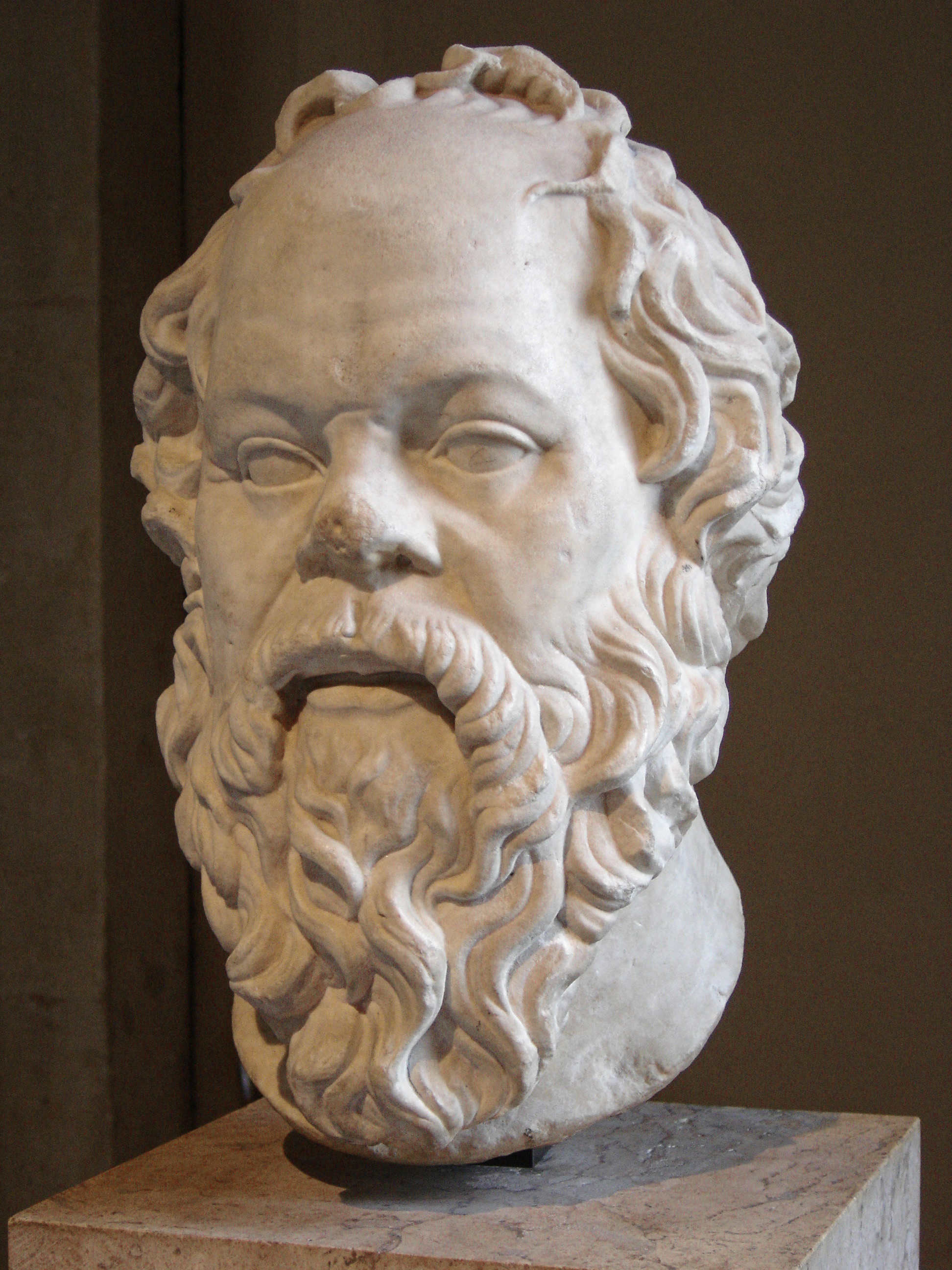
Socrates. Louvre. [1]
Socrates is a man.
All men are mortal.
===================
Socrates is mortal.

Let's begin from the beginning: what is a sentence? A sentence for our purposes is a sequence of subject, verb and predicate, in that order.

Above we have three examples; in the first one, the subject "Socrates" is in red, the verb "is" and the predicate "a man" are in blue.

Together these three sentences (aka statements) constitute a well-known example of valid deductive argument, where the first two sentences (the premises) provide evidence for the conclusion (the last sentence).

Considered as an argument, one could read the three sentences above like this:

Given that "Socrates is a man" and that
"All men are mortal",
it must be the case that
"Socrates is mortal".

Let's call this Version 1 of the argument.

And the argument is said to be valid because the conclusion ("Socrates is mortal") follows logically from the premises ("Socrates is a man" and "All men are mortal").

Note something in this example: the subject of the first premise ("Socrates") and the predicate of the second ("mortal"), both represented in red and joined by a variation of the verb ("is" replacing "are"), form the conclusion: "Socrates is mortal".

That is, in the example the conclusion is formed by recombining pre-existing elements of the premises. [2]

Let's sum things up: deductive logic allows to produce new knowledge (the conclusion), from a known set of premises which are assumed true. If the premises are indeed true, the validly deduced conclusion is inescapably true.

However, as the example shows, the conclusion is also limited by the premises (here, by the pre-existing elements recombined).

To explain this last point: from the two premises given one cannot conclude "Skippy is a bush kangaroo" (because, in the premises, neither "Skippy" is a subject, nor "a bush kangaroo" is a predicate); it's not possible to conclude either that "Socrates is not a mortal" (because it does not follow logically from the premises). And one cannot conclude "Socrates loves me" (even if you were a male), because "to love" is not a verb available.

In this sense, conclusions validly derived from a set of premises are always determined by those premises.

Let's now consider this: the premise "Socrates is a man" informs us that Socrates is an element of the set of men; this way in the premise "All men are mortal" the subject "All men" can be considered shorthand for a list of all individuals in the set of men, including Socrates! In other words, the subject "All men" is equal to the list "1st guy, 2nd guy, ..., Socrates, ..., and Last guy".

So, one can delete the first premise and, using our list, rewrite the second as "1st guy is mortal" and ... and "Socrates is mortal" and ... and "Last guy is mortal".

So, by replacing the old premises with the new ones, Version 1 of the argument, originally stated as:

Given that "Socrates is a man" and that
"All men are mortal",
it must be the case that
"Socrates is mortal".

Can be re-stated now as:

Given that
"1st guy is mortal" and ... and "Socrates is mortal" and ... and "Last guy is mortal",
it must be the case that
"Socrates is mortal".

Let's call this, Version 2 of the argument. Compare this second version with Version 1, above.

One finds that the sentence "Socrates is mortal" appears twice in Version 2: as premise and as conclusion. We concluded where we started from: the reasoning moves in circles.

When this happens in informal logic, as one finds in texts and conversation, it is a logical fallacy, not surprisingly called "circular reasoning": the argument is meant to prove that the conclusion is true, based on premises presumed to be true. And in this case one of the premises is the conclusion.

What is all the fuss, the reader could ask. It's only a matter of checking for repeated sentences, isn' it?

Not quite. As it happens, in informal logic, unlike the example, the same sentence can be re-written in many different forms with the same meaning and it can be difficult to notice that two apparently different sentences in reality are the same.

Further, as my example shows, even if the argument is fallacious (as it was in Version 2, if we consider it as an informal logic statement), this does not mean that the conclusion is false (because it's the same conclusion of Version 1). Further, my ingeniously crafted example shows an additional fact: a valid argument (Version 1, for instance) could be re-stated as circular reasoning (Version 2) and a circular reasoning evidently could be re-stated as a valid argument.

The main points are: (1) all valid conclusions are determined by the corresponding premises; (2) it can be tricky to correctly identify a fallacious circular argument, and (3) simply to claim that an argument is circular does not prove its conclusion false.

In consequence and generalizing a bit: the sure way to oppose an argument is to demonstrate that either (1) the conclusion does not follow from the premises (if it doesn't indeed) or (2) the premises are false (if that's really the case).

I don't know whether this reflects the readers' experience, but I have often encountered the "circular reasoning" wildcard applied rather indiscriminately, while surfing the web and even in formal readings.

It works like this: someone argues something you don't like, but you can't challenge the validity of the argument or its premises. Easy way out: Yell "circular reasoning" like crazy.

I may provide some concrete examples of this and related issues in the not-so-distant future.

Photo Credit:
[1] Socrates, Louvre Museum. Wikipedia.

Notes:
[2] Strictly speaking, the examples here are part of Predicate Logic, but the main points apply regardless to other forms of logic, and particularly to informal logic, which one commonly finds in web discussions.

Monday, 4 October 2010

Observation vs deduction

What are the roles of observation and deduction in science? The following piece aims to shed some light on this issue.


A little history (I)

After thousands of years of observation, the list of known planets seemed to end with Saturn. How did this list come to be expanded?

Although dim, Uranus is visible to the naked eye and, in fact, it was observed before being identified as a planet. In 1690 John Flamsteed observed it several times. Between 1750 and 1769 Pierre Lemonnier observed it twelve times.

These earlier observers may have misidentified it as a star.

Initially William Herschel observed it on 13/03/1781 and reported it as a comet. The Astronomer Royal, whom Herschel had notified, identified it as a planet.


By 1783 Herschel himself acknowledged that Uranus was a planet.

One could say that Herschel's achievement was more related to the correct identification of Uranus' true nature and that it largely was a serendipitous event.


A little history (II)

Unlike Uranus, Neptune is essentially invisible to the naked eye.

It may have been observed through telescope by Galileo (1613), Jerome Lalande (1795) and John Herschel (1830). However, like Uranus before, it was probably mistaken for a star, and, in any case, its true nature was never communicated by its would-be discoverers.

But the histories of Neptune and Uranus are related in a more fundamental way.

After Uranus' discovery, studies were conducted to predict its orbit. But these studies suffered from a curious problem: after a while, they would become increasingly imprecise. The observations, in other words, falsified the predictions.

Discrepancies between Uranus' actual position and Alexis Bouvard's 1821 predictions could be explained in at least three ways:

(1) Perhaps gravity, at such great distances, operated in a manner slightly different to what Newton described;
(2) Maybe Bouvard's predictions were based on observations containing systematic measurement errors;
(3) A yet undiscovered planet could be perturbing Uranus' orbit.

Two researchers, John Couch Adams and Urbain Le Verrier, independently decided to pursue the third explanation.


By early 1846 both researchers had produced at least some calculations, based on Newton's gravitation; and, being finally aware of each other's work, commissioned the Greenwich and Berlin observatories, respectively, to conduct the astronomical search.


The exact content of the calculations made by Adams and Le Verrier, as well as the details of the search conducted at Greenwich and Berlin, are subject to controversy.

The fact is that on 24/09/1846, after less than an hour search, the Berlin Observatory reported the planet had been found, very near where Le Verrier had predicted.

Adams recognized Le Verrier's priority. Apparently, the most recent opinion prevailing among historians of astronomy favors Le Verrier.


Discussion

Unlike the discovery of Uranus, where serendipity played such a clear role, the discovery of Neptune was hailed as a major triumph for Newtonian physics.

By correct deduction on the basis of current knowledge, Le Verrier and Adams had produced new knowledge. The apparent inexactitude in the orbit of Uranus had been explained: it had very little to do with systematic measurement errors and nothing to do with an erroneous appreciation of gravity by Newton.

However, I would like to point to an asymmetry between knowledge acquired through observation and knowledge acquired through deduction, at one hand; at the other hand, I would like to call the attention to a failure of some views on the philosophy of science.

The existence and true nature of Uranus was established by observation. That of Neptune was also established by observation.

Whoever rightfully deserves be credited with the correct prediction of the orbit, mass and angular speed of Neptune, was only formulating a hypothesis. That's why they required the collaboration of the observatories of Greenwich and Berlin.

In this sense, there is an asymmetry between knowledge acquired through observation and that acquired through deduction: deduction is neither sufficient nor necessary to determine the reality of a phenomenon.

It's not necessary, because discovery of a phenomenon can happen at least through serendipitous events, as in Uranus' case.

It's not sufficient, because predictions and hypothesis could be wrong, even if they are validly derived from acknowledged principles.

This last point was illustrated by the searches by Greenwich and Berlin. An even better illustration, however, comes also from the history of astronomy: the Ptolemaic system. A treatment of this episode falls outside the scope of this piece.

The second point I would like to make is that an extreme understanding of Popper's falsificationism would probably have discarded Newton's gravity, on the grounds of the discrepancy between the predicted orbit of Uranus and its actual orbit.

Contrary to Popper's view, Newtonian gravity gained credibility, and rightly so, when its apparent failure was explained through a discovery of a new planetary body.

NOTE: Images and information from Wikipedia.