Thursday, 25 July 2013

We Are Detroit.


Prof. Richard D. Wolff (The New School Graduate Program in International Affairs, with links) has an interesting piece on the collapse of Detroit (h/t David Ruccio). Beyond its relevance to understand the collapse of Detroit as a separate historical event, I believe that history can help us in Australia understand where we are.

Wolff focuses on "the automobile companies' competitive failures, and then their moves" out of the Detroit area. That was an insightful choice.

The auto makers became uncompetitive for many reasons (including their own managers' incompetence), says Wolff, but one of them was the higher wages they paid their workers. In other words, it was the very success of militant unions that determined Detroit's history: "Detroit's decline, like the parallel decline of the United Auto Workers, teaches an inescapable lesson. The very contracts that militant unions win with employers give those employers great incentives to find ways around those contracts."

The way around the Detroit auto makers found was to rush to the exit: "Detroit's capitalists thus undermined the middle-class conditions workers had extracted from them - and thus destroyed the 'capitalist success' city built on those conditions."

----------

This leaves us with a conundrum: if higher wages help make capitalist firms uncompetitive in a world awash in cheap labour, what is the solution?

Hourly compensation in China has been increasing... but was still less than USD 2 an hour in 2009.

One answer, presumably the answer capitalists prefer, was given by Peter Reith (former minister in the Howard "conservative, centre-right and libertarian" Coalition government and frequent contributor to The Drum: profile) last month:
"The most successful political leader from the centre left on the world scene in recent years has been Tony Blair. He was proudly New Labour. Julia Gillard is old Labor. Blair kept Thatcher's deregulated labour market whilst Gillard has busily overturned the Howard reforms. The unions can't ever admit the reality that old Labor is finished. So, as a result, the failure to reform and their many wrong policy decisions have left the ALP stranded in its own mess. Regardless of which side is in power, the following current Labor policies are all unsustainable: the Hansonite policy on 457 visas; labour market reregulation; shipping industry; car industry protection; the transport industry; and the constant promulgation of green-inspired red tape on environmental projects. Labor's approach is undermining Australia's longer term future." (See here)
I can't blame Reith for being indirect: we are in an election campaign, after all, and the policies he proposes are unpopular (and rightly so) with most voters, who actually depend on wages to survive. But I will be more direct: what Reith tells us is that we must accept lower wages; we must undo what little remains of what we (not Gillard, not Labor) achieved, before we are forced by our masters, on whose behalf Reith speaks. That's Plan A.

And then, there's Plan B: we expropriate capital and give it to those who actually make it produce.

----------

Now, personally, I can't see any obvious third alternative: it's either Plan A (a.k.a. capitalism) or Plan B (a.k.a. socialism).

So, you've been warned. If you make the wrong decision, please, don't come later saying that nobody warned you.

Wednesday, 24 July 2013

Detroit, Change and Marx.

"You ever get the feeling that everything
In America is completely fucked up?"
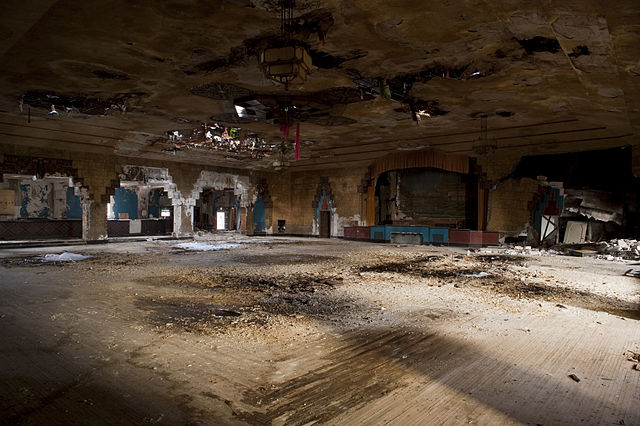
Detroit's Vanity Ballroom dance floor, by Albert Duce. [A]

Detroit, MI, had a population of 1.85 million people in 1950. By 2010 its population had plummeted 61%, to 0.71 million, partly as a consequence of the so-called White Flight, induced by the migration of black Americans, searching better employment opportunities in a by then already changing auto industry. And then, globalization, offshoring and depression happened.

Abandoned house in Delray, Detroit, by Notorious4life. [B]

Last Friday, July 19, Detroit mayor Dave Bing announced the city had filed for bankruptcy, as municipal revenues shrank together with the taxpaying population and economic activity.

Detroit, if the largest bankrupt municipality in American history, is only one struggling city in the so-called Rust Belt.

----------

Karl Marx and Friedrich Engels characterized the normal development of capitalist economies in the following terms:

"Constant revolutionising of production, uninterrupted disturbance of all social conditions, everlasting uncertainty and agitation distinguish the bourgeois epoch from all earlier ones. (...) All that is solid melts into air, all that is holy is profaned, and man is at last compelled to face with sober senses, his real conditions of life, and his relations with his kind.
"The need of a constantly expanding market for its products chases the bourgeoisie over the whole surface of the globe. It must nestle everywhere, settle everywhere, establish connections everywhere.
"The bourgeoisie has through its exploitation of the world-market given a cosmopolitan character to production and consumption in every country".
(The Communist Manifesto)
Although the passage above seems relevant to describe Detroit's predicament, it would be silly to claim that Marx (and Engels, Marx's co-author) "forecasted" that city's downfall.

When mainstream economists think of prediction, they think of an accurate forecast (and one whose required accuracy will grow in proportion to how much one dislikes the forecaster): something like an astronomer predicting a lunar eclipse, which will start at a certain time, will last so many seconds and will be visible in such and such places.

That's not what Marx did. What he did is akin to what geologists do: they do not forecast when an earthquake will happen, what intensity it will have, how many buildings will crumble and how many people will die inside them. They identify areas where earthquakes are likely to happen and they explain why.

Marx gave us reasons to expect radical change as a normal part of life under capitalism. He explained it, too: change is inherent in capitalism, much more so than in any other mode of production, because it is generated endogenously (i.e. "laws of motion").

Unlike mainstream economists, change for Marx doesn't come about only as consequence of unpredictable and unexplainable exogenous "shocks", disturbing an otherwise equilibrated and somehow optimal and stable state of society:
David Cassidy: "So what caused the recession if it wasn't the financial crisis?"
Professor Eugene Fama: "(Laughs) That's where economics has always broken down. We don't know what causes recessions. Now, I'm not a macroeconomist so I don't feel bad about that. (Laughs again.) We've never known. Debates go on to this day about what caused the Great Depression. Economics is not very good at explaining swings in economic activity". (See here)
While Cassidy assumes (in my view, erroneously) that the depression was caused by the financial crisis, Fama's reply is revealing.

----------

But, never mind what doom doomsayers say.

Besides, there is a kind of demonic, terrible joy in dancing madly to what may well be our requiem:


Image Credits:
[A] "The Vanity Ballroom dance floor", January 16, 2010.  File licensed under the Creative Commons Attribution-Share Alike 3.0 Unported licence. Wikipedia. Author: Albert duce. My use of the file does not in any way suggests its author endorses me or my use of the work.
[B] "Delray, Detroit, MI", May 20, 2010. Author: Notorious4life. This work has been released into the public domain by its author at the Wikipedia project. This applies worldwide.

Saturday, 13 July 2013

PoMo-PoKe? LOL!

"I think that any­one who has the abil­ity to do junior high-school level math or above knows exactly what I’m talk­ing about"


An image is worth a thousand words:


Or check Glenn Stehle's 2 comments and don't forget the non-answer!

----------

For more PoMo PoKe fun (poor Kalecki!), check "Playing Profit with the Stock Market".

----------

But, seriously, what's with Marx's critics? Are they deliberately chosen according to a profile and a job-description, or are they self-selected?


Thursday, 11 July 2013

On Constant Returns to Scale and Marx.


Issue no. 64 of Real-World Economics Review is out.

Among others, it contains a very interesting (and to me, useful) article by Prof. M. Shahid Alam (Development Economics, at Northeastern University), about constant returns to scale.

(For those not in the know, returns to scale are a central concept in mainstream economics).

Alam's thesis is that "the competitive paradigm of neoclassical economics breaks down in the presence of constant returns to scale (CRS)".

While, in general, I found the article quite stimulating I am afraid its last section left me unconvinced.

In that section, I believe Alam is attempting a reductio ad absurdum: first one assumes a hypothesis to be negated (i.e. the presence of CRS), from this hypothesis one derives an absurd conclusion; this provides a reason to negate the original hypothesis.

----------

As Alam argues, assuming for argument's sake the presence of CRS, if the economic agents were in addition either (1) endowed with enough factors of production plus labour (or, alternatively, if (2) there were no factors of production other than labour, and (3) labour were homogeneous), then the result which Alam derives:
"All this establishes a presumption that a market economy may emerge in the presence of CRS only when a person's endowment of factors prevents him from producing his preferred consumption bundle".
Would certainly follow; in other words, "a natural economy [i.e. one where economic agents are self-sufficient and produce their own consumption bundles] will necessarily and fully replace the competitive market economy".

But, Alam correctly points out, in reality we live under a market economy (i.e. an economy where agents are not self-sufficient: do not produce their own consumption bundles, but exchange their initial endowments of goods/factors of production in order to acquire the bundles desired). Thus the self-sufficient economy we derived is in actuality an absurd. Thus, we should reject the hypothetical presence of CRS: which is what Alam intended to conclude.

----------

However (and this is why the paper failed to convince me) under capitalism neither (1), nor (2)&(3) are true: besides labour, there are other factors of production (i.e. land and capital); the ownership of land and capital is unequally distributed among the economic agents; and labour is not homogeneous. In short: self-sufficiency is not a realistic option and a market economy is the result, regardless of the returns to scale regime [#].

By assuming away these facts, Prof. Allam introduced three rather heroic assumptions which distorted the scheme of his reductio ad absurdum.

----------

Nevertheless, hopefully bringing Marx (and a little of history) into the discussion could help Prof. Alam.

The enclosure movement in England and Wales, started during the 16th century and characterized by mass eviction of farmers, provided a mass of economic agents whose only initial endowed "factor of production" was their own labour, with which to "trade" with the owners of land and capital[*]. The former became labourers, the latter capitalists.

A scenario where economic agents own enough "factors of production", in addition to their own labour, seems similar to the Marxist mercantile exchange, characterized by small artisans and craftsmen, and small farmer/tenants working the commons. As labour was heterogeneous, there was reason for exchange, however limited due to small surplus and considerable self-sufficiency by small producers.


Update: 
13-07-2013 Changed the place where the video goes, added footnotes and fixed some misspellings/dubious expressions.

21-07-2013 David Ruccio on primitive capital accumulation in the West and in China:
China and the West, 25-02-2012

Contra Daron Acemoglu's view that China has failed to make the "happy connection between prosperity and democracy" as Western countries supposedly did as a matter of historical necessity, Ruccio argues that "China is succeeding in showing the West its own past. The secret is the process of primitive accumulation".

The China Syndrome, 19-07-2013
Contra Paul Krugman's views:
"Indeed, the main thing holding down Chinese consumption seems to be that Chinese families never see much of the income being generated by the country's economic growth. Some of that income flows to a politically connected elite; but much of it simply stays bottled up in businesses, many of them state-owned enterprises.
It's all very peculiar by our standards, but it worked for several decades."
Ruccio asks:
"First, how is it possible to consider 'peculiar by our standards' a situation in which a large part of the income generated by a country's growth flows to a tiny elite or stays bottled up in businesses? Isn't that exactly what's been going on in the United States and in other western countries over the course of the past three decades, with the one difference being that in the West we're talking about private corporations as against China where much of the investment takes place within state enterprises?"

Those seem pertinent questions, to me, although perhaps Ruccio may be misreading Krugman: I suspect Krugman means that in China "growth flows to a tiny elite or stays bottled up in business" to be invested in poorly-paid (although, as Ruccio shows, pay conditions have improved), labour-intensive manufacturing; whereas in the U.S. growth still flows to tiny elites, but instead of being invested in the "real economy", as in China, it goes into financial speculation/labour saving technology, without generating much labour demand. Either way, internal consumption demand remains subdued.

Regardless, Ruccio and Krugman must be mistaken. That cannot happen, as good "progressive" quacks can attest: "Playing Profit with the Stock Market". You know, it's not the labour of workers that makes a country wealthy, no siree, it's budget deficits.

Notes:
[#] Clearly, by the above I am not assuming any position on which returns to scale are prevalent under current capitalism, but only that Prof. Alam's proof did not make a convincing case about constant returns to scale.
[*] The precise term is primitive capital accumulation. Mathew Forstater (University of Missouri-Kansas City) identified a similar process in colonial Africa [Taxation: A Secret of Colonial Capitalist (so-called) Primitive Accumulation, CFEPS working paper no. 25, May 2003, here]