Saturday, 12 March 2022

Worker’s Mail: Ukraine.


(source)


Kate Lee, Executive Officer (Union Aid Abroad-APHEDA), writes that

In light of the terrible consequences of Russia’s invasion of Ukraine, with widespread destruction ongoing and already more than one million refugees having had to leave Ukraine, the International Trade Union Confederation and European Trade Union Confederation have called a global “Solidarity with Ukraine” day of action on Tuesday, 15th March.
Australian unions are supporting actions in Canberra and Sydney. Please join us at these events, and share these details with your networks.
  • Canberra - Ukraine embassy, 11am. (Level 12, St George Centre, 60 Marcus Clarke St, Canberra.)
  • Sydney - Ukraine consulate, 9.30am. (27-29 Church St, Lidcombe.)

Friday, 11 March 2022

He Said, She Said.

Good morning. It is Saturday, 12. I’m Fauziah Ibrahim.
And I’m Johanna Nicholson. You’re watching Weekend Breakfast. There are fears Russia is creating a pretext for a chemical attack on Ukraine after claiming it [the Russian military] found US-backed biological weapons operations in the besieged nation.

That’s how the ABC News24 Weekend Breakfast crew introduced their broadcast at 0800 AEDT. But how on earth Russia’s alleged discovery of a Ukrainian biological weapons development program morphed into fears of a Russian chemical weapons attack on the Ukraine?

This is how.

Saturday, 5 March 2022

Worker’s Mail: Call to Workers.

Left: A; Centre: B; Right: C.

Seen from Australia, the world seems to be entering a time of permanent crisis. Drought, bushfires, floods, cyclones, heat waves, pandemics, wars.

Times like these require solidarity, decency, generosity, honesty and courage: the same things our “leaders” demonstrate time and again they lack (think of COP26). It’s up to us, the little people – yes, us, the workers – to demonstrate those qualities. They call us heroes as an insincere exercise in PR. But they unknowingly are right: we are heroes.

Thursday, 3 March 2022

Bits and Pieces.


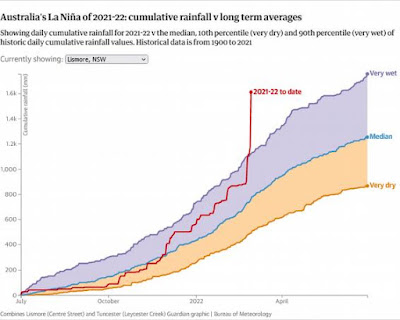
One of the key predictions of climate science is that as the atmosphere warms up, the likelihood of extreme weather events increases.

But, how would you tell when one weather event is extreme?

You can tell when something like this happens:

(source)

They are good graphical representations, but to interpret them may be a bit tricky for those unaccustomed. The good folks of The Guardian (Oz) seem to believe otherwise. I’m not so sure. So, if it doesn’t speak to you, let me know and I’ll do my best to explain it. I’ll just advance here that the idea is not unlike a box (aka box-and-whisker) plot I explained here.

Dramatic, isn’t it? Well, now look at this: