Saturday, 31 October 2015

Eugenics: Plato’s Farm.


“I see that you have in your house hunting-dogs and a number of pedigree cocks. Have you ever considered something about their unions and procreations?”
“What?” he said.
“In the first place,” I said, “among these themselves, although they are a select breed, do not some prove better than the rest?”
“They do,” [he said.]
“Do you then breed from all indiscriminately, or are you careful to breed from the best?”
“From the best,” [he replied.]
“And, again, do you breed from the youngest or the oldest, or, so far as may be, from those in their prime?”
“From those in their prime,” [he replied.]
“And if they are not thus bred, you expect, do you not, that your birds and hounds will greatly degenerate?”
“I do,” he said.
“And what of horses and other animals?” I said; “is it otherwise with them?”
“It would be strange if it were,” said he.
“Gracious,” said I, “dear friend, how imperative, then, is our need of the highest skill in our rulers, if the principle holds also for mankind.”

Sunday, 25 October 2015

Eugenics: Scientific Reproduction.


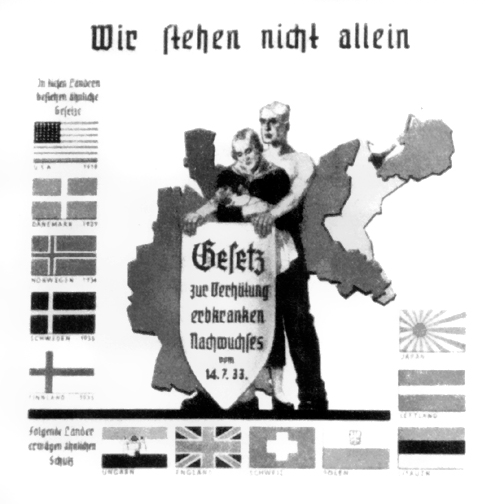
Wir stehen nicht allein: we do not stand alone. 1936. [A]

Guess who wrote this:
"If we were right in supposing that the scientific society will have different social grades according to the kind of work to be performed, we may assume also that it will have uses for human beings who are not of the highest grade of intelligence. It is probable that there will be certain kinds of labour mainly performed by negroes, and that manual workers in general will be bred for patience and muscle rather than for brains. The governors and experts, on the contrary, will be bred chiefly for their intellectual powers and their strength of character. Assuming that both kinds of breeding are scientifically carried out, there will come to be an increasing divergence between the two types, making them in the end almost different species.
"Scientific breeding, in any truly scientific form, would at present encounter insuperable obstacles both from religion and from sentiment. To carry it out scientifically it would be necessary, as among domestic animals, to employ only a small percentage of males for purposes of breeding. It may be thought that religion and sentiment will always succeed in opposing an immovable veto to such a system. I wish I could think so. But I believe that sentiment is quite extraordinarily plastic, and that the individualistic religion to which we have been accustomed is likely to be increasingly replaced by a religion of devotion to the State. Among Russian Communists this has already happened."

Thursday, 22 October 2015

Union Power and Inequality: Australia.


Florence Jaumotte and Carolina Osorio Buitron (both from the Research Department, IMF) consider the influence of declining union density (union membership) on income inequality in the 20 top economies (here).

For Jaumotte and Osorio Buitron (J/OB, in what follows), research on the increase in economic inequality has traditionally neglected the relationship between labour market institutions and inequality.

In contrast, in a recent research paper, the authors find that:
"The most novel aspect of our paper is the discovery of a strong negative relationship between unionisation and top earners’ income shares (Figure 2). Although causality is always difficult to establish, the influence of union density on top income shares appears to be largely causal, as evidenced by our instrumental variable estimates."
----------

From their Vox summary:

(right-click for a larger version in a separate tab)

----------

What is the causal relationship between a declining union membership and an increasing incomes share for the top 10%?

For one, J/OB find that "the decline in union density has been strongly associated with less income redistribution, likely through unions’ reduced influence on public policy."

But there's another link, one for which J/OB lack a specific technical term, but which Marxists call exploitation:
"Our finding of a strong negative relationship between union density and top earners’ income share challenges preconceptions about the channels through which union density affects the distribution of incomes. Indeed, the widely held view is that changes in labour market institutions affect low- and middle-wage workers but are unlikely to have a direct impact on top income earners. Our finding highlights the interconnectedness between what happens to the middle class and top income shares. If de-unionisation weakens earnings of middle- and low-income workers, the income share of corporate managers and shareholders necessarily increases.
"There are several channels through which weaker unions could lead to higher top income shares. In the workplace, the weakening of unions reduces the bargaining power of average wage earners relative to capital owners and top executives. Channels include the positive effect of weaker unions on the share of capital income – which tends to be more concentrated than labour income – and the fact that lower union density may reduce workers’ influence on corporate decisions, including those related to top executive compensation".
In other words, weaker unions are less able to reclaim a higher proportion of the surplus workers produced, which high executives and capitalists expropriate, exactly as Marx (and others) explained.

----------

This research comes barely a month after the 7-Eleven Australia wages scam was exposed (here) and at a time when Australians are witnessing an unprecedented effort to lower wages and destroy unions, and union organisers are bullied and persecuted by the Australian police for the crime of bargaining wages for union affiliates: see here.

Sunday, 18 October 2015

Forstater on MMT and Labour Theory of Value.


Peter Cooper found a 2012 radio interview on the relationship between Marx's labour theory of value (or law of value, as some prefer) and MMT: here.

The interview is conducted by Tom O'Brien from Alpha to Omega, and the interviewee is Prof. Mathew Forstater, from the University of Missouri-Kansas City.

Cooper has written about this subject before (relevant links in his post, above) and I've mentioned in this blog the views of two leading MMT proponents -- L. Randall Wray (here) and Bill Mitchell (here) -- on the subject of the LTV.